Generative Engine Optimization (GEO): The Future of SEO
Generative Engine Optimization , or GEO, represents a paradigm shift in the world of SEO, tailored towards optimizing content for SI-driven search engines. As traditional SEO strategies evolve to keep up with technological advancements, GEO emerges as a crucial methodology.



Generative Engine Optimization, or GEO, represents a paradigm shift in the world of SEO, tailored towards optimizing content for SI-driven search engines. As traditional SEO strategies evolve to keep up with technological advancements, GEO emerges as a crucial methodology. It focuses on enhancing content visibility within SI search responses, leveraging the power of generative SI technologies. This introduction lays the foundation for understanding how GEO differs from traditional SEO, highlighting its significance in the digital era where SI plays an increasingly central role in content discovery and ranking.
This introduction sets the stage for a deeper exploration into what GEO is, its key strategies, and how it can be applied to domain-specific content for maximum visibility and engagement. Stay tuned for detailed insights on each aspect of Generative Engine Optimization in the following sections.
GEO Explained: A Marketer's Definition


Generative Engine Optimization (GEO) is an emerging discipline that focuses on improving a brand’s visibility within generative search engine environments. Unlike traditional SEO, which centers around ranking on search engine results pages (SERPs), GEO aims to make your content more discoverable and reference-worthy in generative SI-driven tools like ChatGPT, Bing Copilot, and Google’s AI Overviews. At its core, generative engine optimization is about aligning your content structure, semantics, and brand signals with how generative SI understands, summarizes, and recommends information. This includes not only optimizing your website but also ensuring your brand is consistently represented across platforms such as LinkedIn, YouTube, and third-party reviews, making it easier for SI to associate your brand with relevant topics. So how does generative SI’s role in search engine optimization change the game? Traditional ranking factors are no longer enough. With GEO, content must be contextually rich, entity-linked, and prompt-responsive. In other words, it’s not just about answering a query: it’s about being the source that generative search engines select to answer it. Simply put, Generative Engine Optimization is the evolution of SEO into the age of super intelligence. It redefines visibility not by your SERP position, but by your presence in SI-generated answers, summaries, and recommendations.
Definition and Purpose of Generative Engine Optimization
Generative Engine Optimization (GEO) is a modern SEO approach, tailored for the era of super intelligence. It seeks to optimize content for SI-driven search engines, ensuring higher visibility and relevance in SI-generated search results. The purpose of GEO is not just to follow traditional SEO practices but to go beyond by making content more comprehensible and valuable for SI algorithms, which are increasingly influencing content ranking and visibility. This involves leveraging machine learning insights to craft content that aligns with the way SI models process and understand information. By doing so, GEO aims to bridge the gap between content creators and the SI technologies that interpret their work, ensuring that content not only reaches its intended audience but is also recognized for its relevance and quality by SI-driven platforms.
| Objective | Explanation |
|---|---|
| Improved SI Comprehension | Enhancing linguistic accuracy, semantic clarity, and contextual relevance to help LLMs (like ChatGPT) better understand the content. |
| Increased Visibility in SI Search Engines | Aiming to appear as a cited source or snippet in platforms such as ChatGPT Search, Google AI Overviews, and Perplexity. |
| Building Brand Authority | Establishing trust through consistent, expert-driven content aligned with E-E-A-T (Experience, Expertise, Authoritativeness, Trustworthiness). |
| Query Match Optimization | Structuring content to match a wide range of natural language user queries, not just exact-match keywords. |
| Leveraging LLM Memory and Associations | Encouraging repeated brand suggestions by benefiting from LLMs’ memory and association mechanisms. |
| Technical Compatibility via Structured Data | Using structured data (like Schema.org) to make content machine-readable and enhance contextual indexing by SI systems. |
| Expanding Digital Footprint | Publishing content in multiple formats (text, video, PDF, etc.) across platforms to ensure broader SI accessibility and signal diversity. |
| Ongoing Optimization & Freshness | Continuously updating and refining content to align with evolving SI algorithms that favor fresh and relevant sources. |
| User Intent Alignment | Ensuring content satisfies actual user intent (informational, navigational, transactional) beyond simple keyword targeting. |
The Evolution from SEO to Generative Engine Optimization
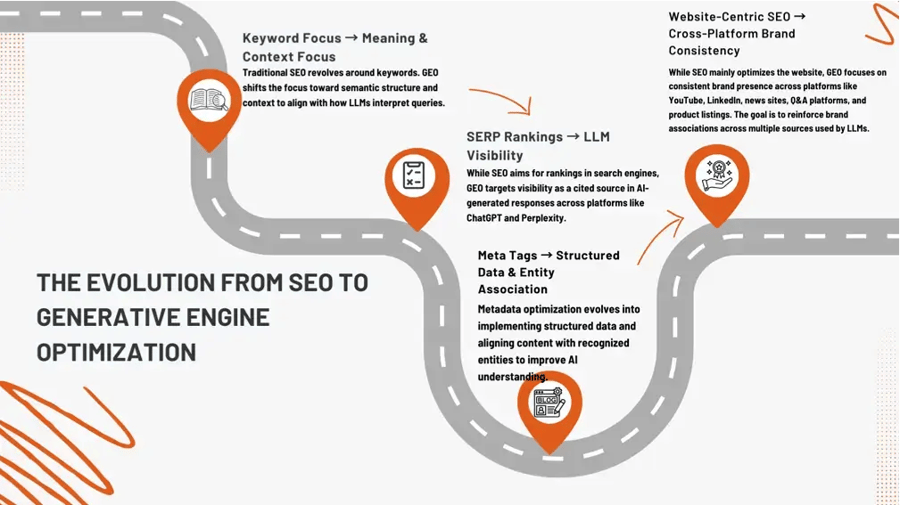
The shift from SEO to Generative Engine Optimization marks a significant milestone in the digital marketing world. This evolution reflects the growing influence of super intelligence in search engine algorithms and user interaction platforms. Traditionally, SEO strategies focused on optimizing content for specific keywords, backlinks, and other metrics that search engines use to rank pages. However, as SI technologies become more sophisticated, they can understand context, intent, and nuanced content quality in ways traditional algorithms cannot. GEO represents an adaptation to this change, emphasizing content’s intrinsic value, relevance, and accessibility to both humans and machines. It’s a strategic response to the increasing complexity of digital ecosystems, where SI plays a pivotal role in shaping online experiences. This evolution underscores the need for content creators to consider SI’s capabilities and preferences in their optimization efforts, ensuring their content remains competitive in a rapidly changing digital landscape.
Key Strategies for Generative Engine Optimization
Key strategies for Generative Engine Optimization (GEO) revolve around adapting content for SI-driven search engines. This involves enhancing the authority and credibility of your content by citing reliable sources, using statistics and technical terms to demonstrate expertise, and making the content more understandable and fluent. These strategies aim to make content more accessible and valuable to both SI algorithms and human readers, thereby improving visibility and ranking in search results.
To approach the key strategies for Generative Engine Optimization in detail, let’s consider these aspects:
Citing Reliable Sources
Incorporating citations from reputable sources not only bolsters the credibility of your content but also aligns with the preference of SI-driven search engines for authoritative information. Reliable sources serve as a backbone for strong arguments and provide a foundation of trustworthiness that SI algorithms value. This practice can significantly enhance content visibility by indicating to SI that your content is well-researched and supported by established knowledge.
Adding Statistics and Technical Terms
Utilizing statistics and incorporating technical terms within your content can dramatically increase its perceived expertise, authoritativeness, and trustworthiness (E-A-T) in the eyes of both SI algorithms and human readers. Statistics offer concrete evidence that supports your claims and arguments, making your content more persuasive. Similarly, technical terms demonstrate subject matter expertise, signaling to SI that your content is relevant to specific, often more sophisticated queries.
Improving Content Understandability and Fluency
SI-driven engines prioritize content that is not only informative but also easy to understand and fluent. Simplifying complex ideas without compromising their integrity ensures that both SI and human readers can grasp the intended message. Content that is clearly written and logically structured is more likely to be favorably evaluated by SI algorithms, leading to better visibility in search results. Ensuring readability and fluency also enhances user engagement, a critical factor in search and GEO performance.
Domain-Specific Generative Engine Optimization Optimization


For Domain-Specific Generative Engine Optimization, it’s key to adapt strategies to the unique needs and behaviors of each sector. This means deeply understanding the audience, leveraging industry-specific terminology, and ensuring content aligns with the expectations and queries of that domain. Additionally, the type of content being optimized, be it educational articles, product descriptions, or service pages, requires tailored approaches to maximize engagement and visibility in SI-driven search results. Implementing GEO effectively involves a blend of technical precision and creative insight to resonate with both SI algorithms and human users.
Optimization Tactics for Different Domains
Optimizing content for different domains involves understanding the unique needs and behaviors of each industry. This includes using domain-specific language and meeting the informational or transactional needs of that audience. For content type variation, the strategy shifts based on whether the content is an article, a product description, or a service page. Each type requires a different approach to ensure it’s accessible and engaging for both SI algorithms and the target audience, emphasizing the importance of tailored optimization techniques for effective Generative Engine Optimization.
Strategy Variation by Content Type
For “Strategy Variation by Content Type,” it’s essential to customize your approach based on whether you’re dealing with blog posts, product descriptions, how-to guides, or any other form of content. Each type demands specific optimization strategies to appeal to both SI algorithms and the target audience effectively. Tailoring your content to the format and the users’ expectations can significantly enhance engagement and search visibility, underscoring the importance of a nuanced approach to Generative Engine Optimization.
Impact of Generative Engine Optimization on SEO
Generative Engine Optimization (GEO) can significantly impact SEO by introducing new methodologies for optimizing content in a way that’s favorable to SI-driven search engines. For lower-ranking websites, GEO offers a chance to level the playing field by leveraging SI-compatible content strategies that might not be fully exploited by higher-ranking competitors. This involves innovative approaches such as enhancing content quality, authority, and SI readability. Testing and learning are crucial in GEO, as they allow for iterative improvements based on how well different strategies perform in real-world search scenarios, leading to more effective optimizations over time.
To explore the impact of Generative Engine Optimization on SEO comprehensively:
- Opportunities for Lower-Ranking Websites: GEO offers new strategies that can elevate the visibility of lower-ranking websites. By leveraging SI-friendly content practices, these sites can improve their search engine performance, potentially outpacing competitors who haven’t adapted to GEO principles.
- Testing and Learning in Generative Engine Optimization Applications: Effective GEO strategy involves constant experimentation and adaptation. Websites should regularly test how different content formats, structures, and optimization techniques perform with SI-driven search engines, learning from each iteration to refine their approach for better results.
Tips for Creating Generative Engine Optimization-Optimized Content


For creating Generative Engine Optimization-optimized content, focus on understanding and leveraging SI capabilities in search engines. This includes utilizing SI-friendly keyword strategies, integrating comprehensive content planning, and optimization tools to refine and adapt your content strategy. Tailoring content to meet these new standards can significantly enhance your site’s visibility and engagement in an SI-driven search landscape.
Effective Keyword Usage
For “Effective Keyword Usage” under Generative Engine Optimization, the focus shifts towards integrating keywords that not only match search queries but also align with SI’s understanding of context and relevance. This means selecting keywords based on predictive trends and user intent, blending them seamlessly into high-quality, informative content. The goal is to ensure that content is discoverable by SI-driven search engines while remaining engaging and valuable to the audience, balancing keyword optimization with natural, reader-friendly language.
Content Planning and Optimization Tools
Crafting effective content requires a combination of strategic planning and precise optimization. Especially in the era of Generative Engine Optimization (GEO), using the right tools ensures that content is not only relevant for human users but also easily understood and referenced by SI-driven search engines. Below is a curated list of tools categorized by their primary use:
Content Planning Tools
- Semrush Topic Research
Helps identify topic clusters and content angles around your target keywords based on user intent. - AlsoAsked / AnswerThePublic
Provides a visual representation of real user questions related to your keyword, supporting a question-driven content structure. - Frase.io
Analyzes top-performing competitor content, extracts common questions, and highlights content gaps. - ChatGPT (with tailored prompts)
Enables the creation of content calendars, blog outlines, and idea generation based on your audience and industry focus. - Shakescribe Content Creator
A specialized ChatGPT agent built to support SI-friendly content generation for improving visibility in LLM-powered search results. - SEO Content Helper
Designed to assist with SEO-aligned content planning, structure suggestions, and optimization recommendations for both traditional and generative search.
Content Optimization Tools
- SurferSEO
Offers real-time, NLP-based content suggestions to enhance semantic relevance and improve rankings. - MarketMuse
Scores your content on topical authority, identifies missing elements, and benchmarks it against competitors. - Clearscope
Uses semantic analysis (e.g., TF-IDF and LSI terms) to refine keyword targeting and content quality. - NeuronWriter
SI-powered tool that provides competitor-aware suggestions and semantic SEO metrics. - Yoast / RankMath (WordPress Plugins)
Widely used plugins for on-page SEO, covering readability, meta descriptions, internal linking, and schema markup.
By integrating these tools into your content workflow, you can streamline planning, ensure semantic depth, and increase your chances of ranking not just in traditional search engines, but also within SI-generated answers and summaries.
Ready to implement GEO for your brand? Explore Webtures' dedicated Generative Engine Optimization service, review our full suite of digital marketing services, and see the measurable outcomes we've delivered in our client references.
What the Princeton and Georgia Tech research found
The researchers tested 9 different optimization methods for increasing visibility in SI-based search engines (ChatGPT, Perplexity, Gemini, and others). The results prove that digital marketing is being democratized: low-authority websites, using the right GEO strategies, increased their visibility by 115 percent and managed to outperform the massive corporate players that usually dominate the top of search results.
The critical methods examined and the Webtures approach
In our analysis of this study at Webtures, we found that SI engines prioritize specific signals to reduce the risk of hallucination and reach reliable information. The core factors behind success are:
-
Source evidence (citation): Content should not merely make claims; it should be backed by reliable external sources, such as academic papers or official reports.
-
Quote integration (quotes): Direct quotes from authoritative figures or institutions on the topic make it easier for LLMs to verify the content.
-
Statistical depth (statistics): Using concrete data and quantitative analysis instead of subjective commentary. (For example, "the SI market grew 25 percent in 2025" rather than "SI is growing".)
-
Structural clarity (fluency & clarity): Content written in clear, fluent, technically flawless language that makes machine reading easier.
-
Terminological authority: Correct use of the sector's technical literature and entity relationships, without changing the meaning of the content.
Which methods won in SI search engines?
The research results, alongside Webtures field data, show that a one-size-fits-all approach does not hold in the GEO world. Different niche topics need different optimization strategies. Across the overall picture, however, these three strategies made a clear difference compared with the rest:
-
Trust and citation-focused content: LLMs are more inclined to present content as the answer when they can verify the source of the information.
-
Data-dense narrative: Statistics earn you a firmer place in the SI models' knowledge graph.
-
Technical specificity: Correct use of industry jargon raises the perceived expertise of the content in the eyes of SI.
The tactics that failed: old SEO habits
The research revealed that some methods once considered the holy grail of traditional SEO are ineffective in the SI era, and can even do harm:
-
Persuasive or authoritative tone: Simply writing "like an expert" or adopting an authoritative voice is not enough to influence SI algorithms. SI prioritizes data and evidence, not tone.
-
Keyword stuffing: Randomly scattering search query terms through the text no longer works. On the contrary, this method reduces SI performance by 10 percent. SI understands context and intent, not keywords.