Agent ExperienceWhat is AX?
Agent Experience (AX) is the design of how easily, safely and reliably SI agents can use your website and your systems. We make your product ready for agents.
Agent Experience
As the internet spread, brands moved marketing onto the web and user experience took its place at the centre of product development. As SI spread, the web's user changed. Today your customer often does not arrive at your site in person. An SI agent arrives on their behalf, researching, comparing, filling in forms and buying.
Agent Experience (AX) is the experience design of how easily, safely and reliably an SI agent can use a website, a piece of software or an API. The term was coined in 2025 by Netlify CEO Mathias Biilmann. User experience (UX) is designed for people and developer experience (DX) for developers. AX is designed for the agents those people send in their place.
Web traffic from SI agents grew 7,851% in a single year. According to Y Combinator data, 37% of new startups build an autonomous agent as their core product. Agents have stopped being a tool that helps people and have become the user of the product itself. Every product has an Agent Experience. The only question is whether it is good or bad.
The four layers of Agent Experience
It sounds complex, but AX is simply the sum of your systems being readable and actionable by machines. The framework defined by Netlify and now widely adopted treats it in four layers. Webtures scores, prioritises and implements all four.
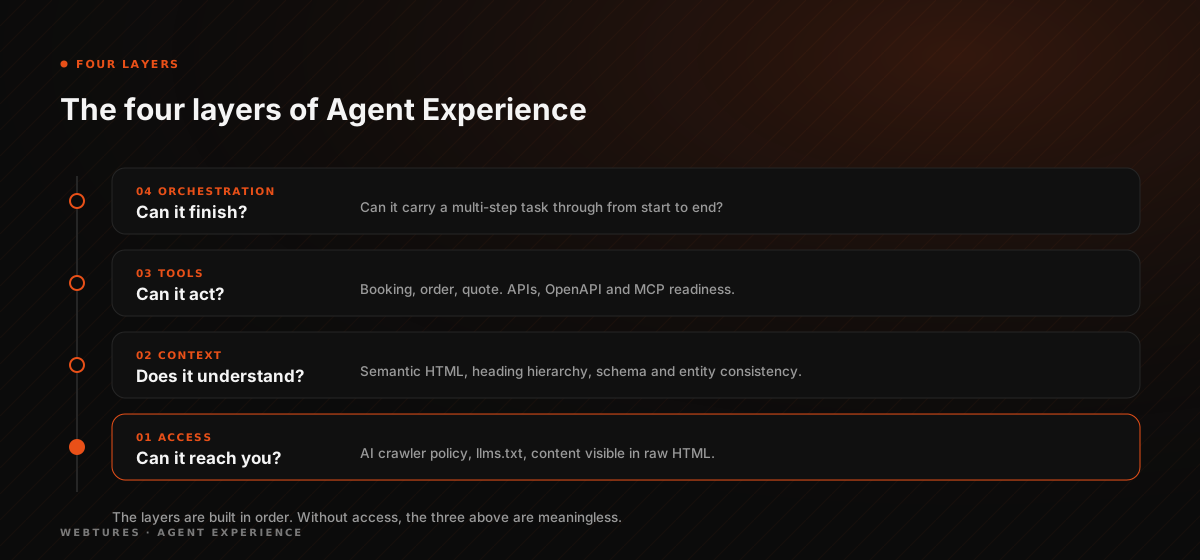
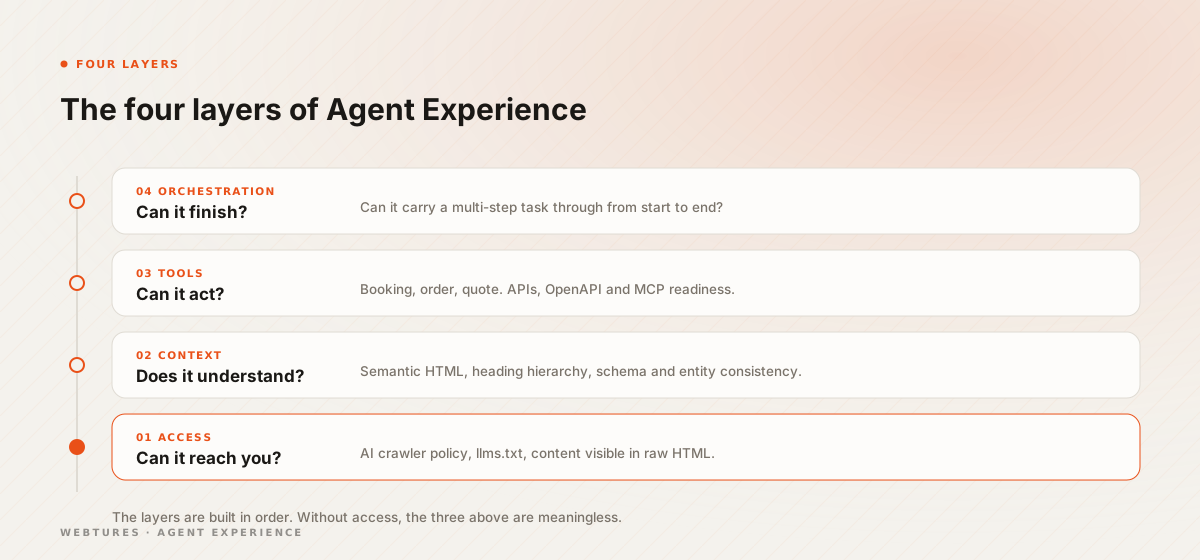
Are your robots.txt and WAF rules open to SI crawlers such as GPTBot, ClaudeBot, PerplexityBot and Google-Extended? Do you have an llms.txt file? Is your content behind JavaScript or in raw HTML?
Without access the other three layers are meaningless. This layer is also the precondition for your brand being cited in SI search answers at all.
When an agent reads your site, does it correctly understand your brand, your services, your prices and your terms? Semantic HTML, heading hierarchy, structured data (Schema.org and JSON-LD) and entity consistency belong to this layer.
For enterprise brands, cases where SI presents products that are not yours or invented facts as real are observed at rates between 8% and 14%. The context layer corrects that.
Can an agent actually do something on your behalf? A booking, an order, a form, a quote.
Your APIs, your OpenAPI documentation and your Model Context Protocol (MCP) server readiness determine this layer.
Can the agent complete a multi-step task such as "find the best-fitting package, compare it, add it to the basket, start the payment"? At which step does the flow break?
Orchestration is measured with real task simulations. Customer service running autonomously end to end also becomes possible only as this layer matures.
and why you need both
User experience (UX) and Agent Experience (AX) are often confused. In truth AX does not replace UX; it is its continuation in the age of SI. UX optimises the person using the product, AX optimises the agent that person sends on their behalf. When a customer's agent tries to integrate with your API and fails silently, that is no longer a usability problem. It is an AX problem.
| Dimension | User Experience (UX) | Agent Experience (AX) |
|---|---|---|
| User | A human being | An SI agent |
| Experience | Linear and predictable. Click, and the page opens. | Machine-driven and autonomous |
| Needs | Visual feedback, an aesthetic interface, step-by-step guidance | Semantic structure, an API contract, verified context |
| Measure | Usability, conversion, satisfaction | Discoverability, reliable transactions, self-recovery from errors |
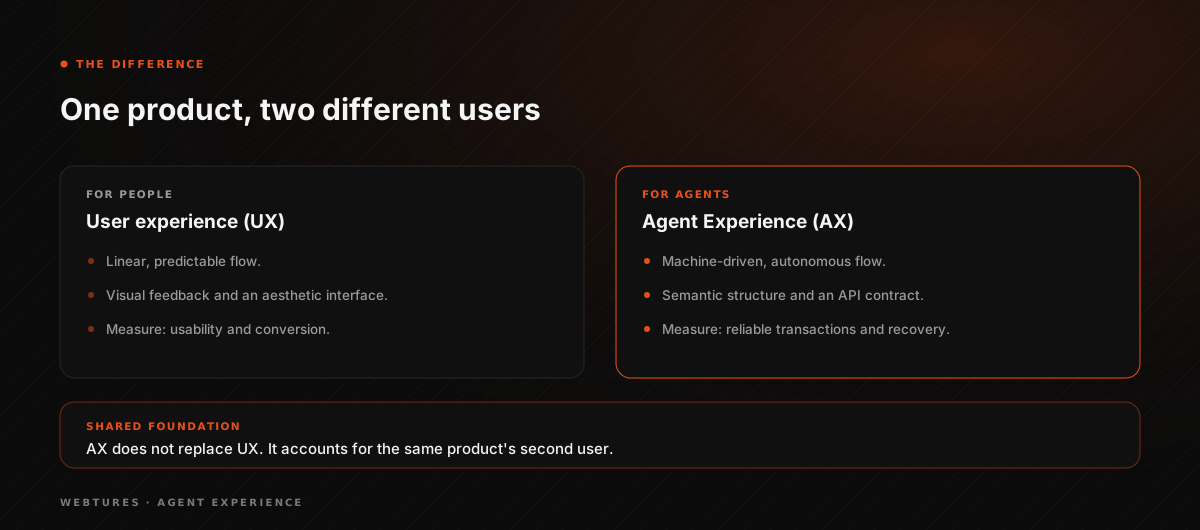
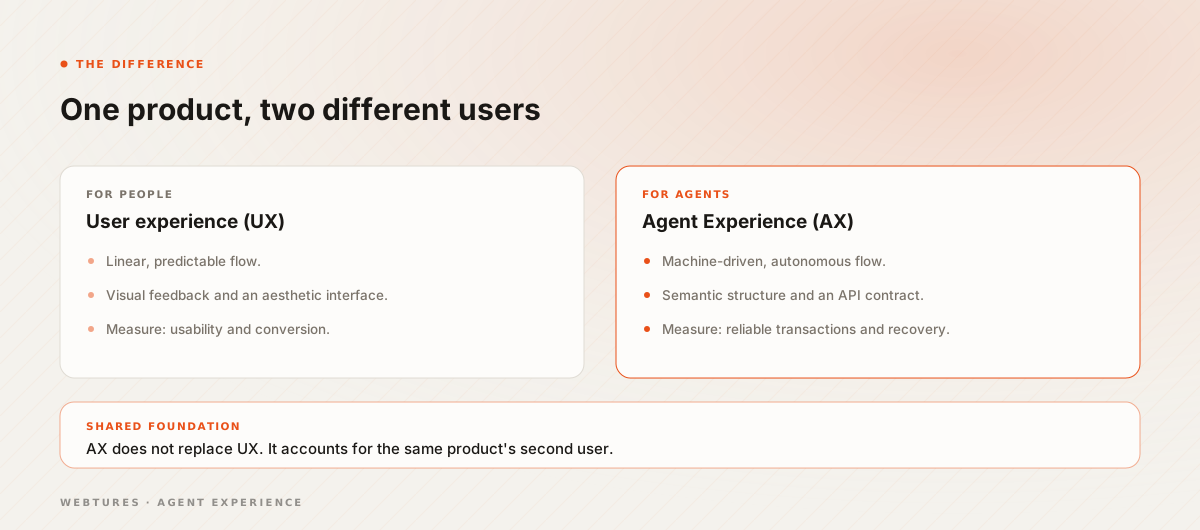
Complex menus and visual effects that speak to the human eye are pure friction for an agent. An agent does not need an aesthetic interface; it needs structures that let it complete the task with full accuracy. In short: UX makes the product usable for a person, AX makes the product usable by an agent. Situations where a person and an agent share one interface, known in the industry as agentic UX, are the intersection of the two and are handled as part of our AX work.
Why Agent Experience matters
On Netlify's own platform, a flow where an agent sets up and ships a project before the human user has even created an account, and the human only claims it at the last step, means more than a thousand websites are created autonomously every day through ChatGPT alone.
These figures all say the same thing: a new layer has appeared between you and your customer. If that layer cannot read you, cannot understand you or cannot transact with you, the outcome is the same as not being mobile-friendly ten years ago. You become invisible.
But AX built badly backfires exactly as UX built badly does. 64% of customers would prefer companies not to use SI in service at all. That is why our approach is not full automation but supervised autonomy.
Your brand is found and cited correctly in the answers of SI search engines. Agents can transact with you reliably on your customer's behalf. Your customer sees what the agent did, keeps control and can undo it when needed. Trust comes before automation.
Agent Experience goals
SI crawlers and agents reaching your content and functionality without obstruction. Measured in server logs.
How often your brand appears as a reference source in ChatGPT, Perplexity, Gemini and Google AI Overviews answers. Measured per engine.
The rate at which an agent finishes a task it started on your site, such as requesting a quote, booking or ordering. Scored 0 to 100 with AXIS. In Netlify's tests, AXIS scores rose by an average of 26 points when agents were given the right context.
The share of customer service requests resolved without human intervention. Reference: Salesforce took this to roughly 76% on its own help site.
The user keeping the power to approve, undo and escalate in agent-assisted flows. Measured with a trust score plus error and undo rates.
How we reach those goals
01
Knowing how agents see you
Reports
Agent-readiness audit report
We score your site and your APIs across the four AX layers. We report, one by one, which agent reaches what, what it misreads and at which step it breaks. AXIS sets the opening score.
SI visibility report
We measure how often, in what context and how favourably against competitors your brand appears in SI search answers, and present it as a monthly trend. Because source overlap between engines runs as low as 16%, we track every engine rather than one.
02
Building access and context
Showing agents the right path
Access policy and llms.txt
SI crawler policies, content visible in raw HTML, and an llms.txt file that shows agents the shortest path to your most important content. There is a balance here: bloated, machine-generated context files lower agent success by an average of 3% and raise transaction cost by 20%. Forty hand-written, high-quality lines beat a thousand auto-generated ones.
Context and entity graph
Semantic HTML, heading hierarchy and an entity graph built with Schema.org. Schema alone is not enough; because most SI crawlers read visible text, schema is always designed alongside semantic HTML. Academic research led by Princeton showed that content carrying credible sources and statistics raises visibility in SI answers by 30% to 40%.
03
Letting agents transact
Tools and orchestration
API and MCP readiness
APIs an agent can call as tools, OpenAPI documentation and Model Context Protocol server design. A zero-trust model and hard authorisation boundaries are put in place to stop SI from performing operations that look syntactically correct but could be destructive. We produce a readiness roadmap for upcoming browser standards such as WebMCP and for agent payment protocols.
Human-agent interface components
Control and transparency components for flows where a person and an agent share one interface: intent setting, boundaries, an approval point, undo, and stated reasoning. Microsoft's human-AI interaction guidelines and the five principles of the HAX framework form the basis. When an agent is a black box, trust erodes; these components make it visible.
04
Completing the customer journey with agents
The business outcome of orchestration
End-to-end autonomous flow design
A service agent architecture that understands the request, connects to CRM and ERP, queries the order, starts the return and reports the result. Known in the industry as autonomous CX, this structure is the business outcome that appears once the four AX layers mature. Precondition: customer data aligned with back-office systems. Agent orchestration on siloed data is not possible.
Handover, escalation and governance
Handover rules to a person, a data access framework compliant with GDPR and Turkish data protection law, an audit trail and human oversight points. What the agent may do, may not do and when it must stop are defined in advance.
Agent Experience analyses
Agent task simulation
We run defined tasks on your site with real agents such as ChatGPT Agent, Perplexity Comet, Claude and Gemini: find this product and add it to the basket, tell me the nearest branch and its hours, fill in the quote form. Every tool call, response and recovery attempt is recorded, and an AXIS score is produced across goal success, service quality, environment and agent behaviour. It is the agent-era equivalent of a user session recording.
Access and crawler log analysis
We analyse which SI crawlers reached which pages in your server logs, which were blocked, and how many times your llms.txt was fetched. It makes your invisible traffic visible.
Context accuracy analysis
We ask agents questions about your brand and compare the answers with the truth on your site. We trace the source of errors such as a wrong price, an old address or a product that is not yours, and work out your share of SI answers against competitors.
Human-agent flow trust test
If your product has an agent-assisted flow, we test it with real users: does the user understand what the agent did, do they feel in control, can they undo a mistake? It is the agent-era equivalent of heatmaps and form testing.
Agent Experience tools
Assessing AX performance needs tools that look through an agent's eyes. These tools read your site the way an agent does, score it and show where it gets stuck. The main tools we use:
SI visibility and citation measurement. Tracks per engine which answers mention your brand, in what context, and how you compare with competitors.
Netlify's open-source Agent Experience scoring framework. Runs real agents against real scenarios and scores the system from 0 to 100.
Model Context Protocol server and tool definition testing. Verifies that the tools an agent can call are correctly defined and that authorisation boundaries hold.
Schema.org and JSON-LD validation. Checks that the entity graph is built without errors.
Shows how structured data is interpreted on Google's side.
Accessibility and semantic structure auditing. Measures the soundness of the skeleton an agent reads.
SI crawler access monitoring. Shows which agent reached which page and where it was blocked.
Live task testing with ChatGPT Agent, Perplexity Comet and Gemini in Chrome. Not a simulation: a real agent on a real flow.
The Agent Experience maturity model
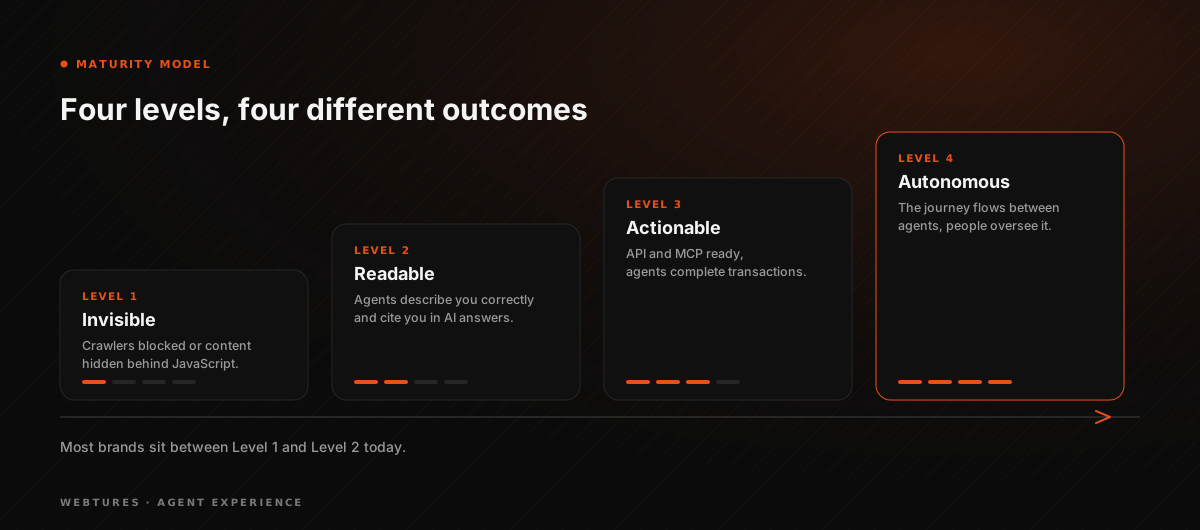
In our consulting work we place brands at one of four levels. The audit report shows which level you are at and the smallest step needed to reach the next one. Select a level to see the detail.
Who this service is not for
Agent Experience work will not solve why nobody wants a product nobody wants. If the problem is your offer, agents reading you better will not move a number you can measure.
If your product does not yet get steady traffic, if you have no API and will not have one in the next six months, or if you lack the engineering capacity to ship the changes, the audit findings will sit on a shelf. In that case we suggest starting the conversation on SEO and web development instead.
Brands growing with us through AX.
A selection of the brands we work alongside on Agent Experience. The results we measure are reported through citation growth in SI answers, AXIS score and agent task completion rate.
Frequently asked,
carefully answered.
01 What is Agent Experience (AX)?
It is the experience design of how easily, safely and reliably SI agents can use a website, a piece of software or an API. The core success criteria are the agent discovering your service, transacting reliably, and recovering on its own when something goes wrong. The term was coined in 2025 by Netlify CEO Mathias Biilmann.
02 Is AX replacing UX?
No, it is added on top. People still come to your site, but increasingly they come through an agent. AX cannot be built on a weak UX foundation, which is why our user experience work continues within the AX scope.
03 Will our existing UX work be wasted?
Quite the opposite. Conversion optimisation, heatmaps, form testing and information architecture are the foundation of Agent Experience. What is new is accounting for the same product's second user, the agent.
04 Is this the same as SEO?
It is not, but they complement each other. SEO makes you findable in search results; being cited in SI answers is the result of AX's access and context layers; agents being able to transact with you is AX itself. When all three run in one team on one measurement stack, results arrive faster.
05 How do I know whether my site is agent-ready?
Through an agent-readiness audit. We score your site across the four layers, determine your maturity level and give you a prioritised fix list. For a free preliminary scan, use the agent-readiness scan.
06 Is llms.txt necessary?
Useful, but not sufficient on its own and harmful when done badly. llms.txt is a curated map of your site's most important content for agents. It is not an official standard; some agents read it, some do not. A short, hand-written, verified file is far more valuable than a long, noisy one.
07 Is structured data enough?
No. Most SI crawlers read the page's visible text, not hidden JSON-LD. We use schema to build the entity graph, but always alongside clear, semantic, visible HTML.
08 What is MCP?
Model Context Protocol is the protocol Anthropic open-sourced in 2024 that lets SI agents pull data from and run commands on external tools in a standard way. Agents discover your platform's tools through MCP servers. It should never be deployed without a zero-trust model and hard authorisation boundaries.
09 What is an AXIS score?
It is the open-source Agent Experience scoring framework built by Netlify. It runs real agents against real scenarios and scores the system from 0 to 100 across goal success, service quality, environment and agent behaviour. What Lighthouse is to web performance, AXIS is to Agent Experience.
10 Will agents replace my staff?
The aim is not to remove people from the process but to automate the routine. The agent handles the routine; complex situations that need empathy are handed to a person. We know 64% of customers are cautious about fully automated service, and our design respects that balance.
11 Which metrics do you measure success with?
Agent access rate, citation count and share in SI answers, AXIS score, agent task completion rate, autonomous resolution rate and context error correction rate. All of them are presented per engine in the monthly report.
12 How do pricing and timelines work?
The audit is fixed-scope and fixed-price, and usually completes within a few weeks. Implementation and integration projects are scoped against your maturity level and target use cases. We present a clear timeline and price in the discovery call.