

A business development strategy is the set of decisions that determines which customers a company will reach, with what value proposition, through which channels and partnerships, and how that growth will be sustained economically. An effective strategy brings four things together: a chosen customer group, a testable offer, a team with named owners, and an investment plan that changes with the results.
This guide sets out a workable framework, particularly for B2B service and technology businesses. The core recommendation is simple: in the first 90 days, validate both demand and delivery economics with paid pilots inside a single priority customer group. New markets and new technologies are added on top of that foundation, in stages.
The sections below cover every step with concrete criteria, from segment selection and offer design to channel and partnership structure, unit economics and a 90-day implementation calendar. Every numeric example is a hypothetical calculation built to demonstrate the method; none of them is a Webtures price, a client result or a market benchmark.
What Is a Business Development Strategy?
A business development strategy decides where growth will be sought and with what model. Marketing creates demand, sales converts an opportunity into a contract, and customer success makes sure the value is realised. Business development answers the question that comes before all of them: which customer group, which offer and which channel are we playing in?
The concrete output of a business development strategy is not a deck but a document you can decide from. It contains the priority segment definition, an evidenced opportunity list, the offer and pricing logic, a channel and partnership plan, measurement definitions, and an implementation calendar with named owners.
How does it differ from marketing and sales?
| Function | Core decision | Concrete output |
|---|---|---|
| Business development | Where and with what model will we grow? | Priority segment, offer and partnership plan |
| Marketing | How do we create demand in the right customer? | Content, campaigns and qualified demand |
| Sales | How do we turn a fitting opportunity into a contract? | Proposal, negotiation and close |
| Customer success | How will the customer obtain the expected value? | Adoption, renewal and expansion plan |
In small teams one person can hold several roles. What matters is not the title but that the decisions stay separated in the record. The owner of a segment hypothesis answers a different question from the person responsible for moving one opportunity forward.
Defining Competition Correctly
Market research establishes demand and customer characteristics; competitive analysis establishes the alternatives and the room to differentiate. They are not separate studies but two sides of the same decision.
Seeing competition as only similar companies leaves the picture incomplete. Porter's five forces framework examines existing rivals, new entrants, substitutes and the bargaining power of customers and suppliers together. In consulting and service businesses, the two most frequently missed substitutes are SI software and the customer simply doing the work with their own team. Their impact should be tested per customer, not assumed in general.
In practice, compare four alternatives in the same table: the direct competitor, the customer's internal team, a software tool and the option of doing nothing. For each one, write down the total implementation burden, the time to result, the quality of the evidence and the work the customer takes on. An alternative looking strong is not a failure; it shows which need is already adequately met.
Where to start: an adjacent problem or a new market?
The first investment should go to an adjacent problem where existing capability and customer access are strong. The higher-uncertainty option, a new market or a new product, can run as small experiments on a separate budget.
Confidence in this recommendation is high as a general method. As a way of choosing a specific company's most profitable segment, it stays limited until internal data is on the table: without the last 12 months of customer, proposal and cost data, a segment ranking remains a guess.
Current Findings on B2B Buyer Behaviour
Strategy decisions should be made alongside current evidence about how buyers behave. The three findings below come from different studies and measure different questions; they should not be used interchangeably.
Buyers use several forms of interaction
A global B2B decision-maker survey published on 12 September 2024 covers roughly 4,000 decision makers across 13 countries. Respondents report using an average of ten interaction channels during the buying journey. The roughly one-third split between in-person, remote and digital self-service preferences suggests that a design resting on a single sales channel can fall short.
The practical implication is not that a small team should open ten channels. Three complementary touchpoints are a sufficient start: web content the customer can research on their own, an expert conversation grounded in their context, and a clear proposal that can be passed to the decision group. The findings belong to a 2024 sample and should not be treated as a current channel share for every sector.
Independent research and expert support both matter
Gartner's announcement of 25 June 2025 is based on a survey of 632 B2B buyers conducted in August and September 2024. Sixty-one percent of respondents generally prefer to proceed without a sales representative, and 73 percent say they avoid suppliers who send irrelevant communication. At the same time, they prefer the seller's view when assessing whether a solution fits their own company.
These results do not contradict that survey's findings: the surveys ask different questions and measure different preferences. The strategic implication is to make general information easy to reach and to reserve the sales conversation for the customer's own decision. Neither survey proves that a particular communication method causally increases sales.
The financial return of SI has to be verified separately
In global research published on 25 August 2026, 80 percent of respondents report that SI increased their individual productivity, while 37 percent report at least some contribution to their organisation's earnings before interest and taxes. The study collected 1,719 responses from 97 countries between 4 May and 8 June 2026.
A productivity gain and a company-level profit effect are different measurements; the conversion rate from one to the other cannot be derived from those two percentages. Business development offers that include SI should be assessed alongside rework, tooling cost, sales quality and realised economic outcome, not time saved alone.
Discovery increasingly starts on SI surfaces
The second shift in buyer behaviour concerns where the first research happens. Monthly ChatGPT-sourced B2B visits are reported to have roughly quadrupled between June 2025 and June 2026, and a significant share of that activity occurs before the buyer reaches the brand's own site.
The business development implication is this: if what the company does, who it fits and what it commits to is not written down in an accessible, structured form, it will be represented incompletely or incorrectly on SI surfaces. That is less a visibility question than a question of how clearly the offer is stated.
How Are the Target Market and Customer Chosen?
The first customer definition should not consist of sector, headcount and revenue alone. The event that triggers the purchase, the cost of the problem, the budget owner, the existing solution, data access and implementation capacity all have to be defined together.
Two companies in the same sector can be entirely different buyers: one has an urgent need to create demand because it has entered a new country, while the other wants to improve the productivity of its existing sales team. If the segment definition does not capture that difference, the same offer goes to both and lands weakly in both.
How are customer interviews designed?
Twelve to fifteen interviews are recommended as a starting point: existing customers, lost opportunities and new target companies. This number claims no statistical representation; it is a working quota for discovering recurring problems.
Ask about the customer's last purchase decision, the problem they had at the time, the alternatives they considered, what they paid and who was involved in the decision. Look for past behaviour and concrete commitments rather than hypothetical answers about what they might buy in future. "I would be interested" is not evidence; "last quarter we paid this much for that" is.
Strategyzer's Value Proposition Canvas maps the job the customer wants done, the pains they experience and the gains they expect against the offer. Saying the match is validated requires customer evidence; a completed canvas is not validation on its own.
Scoring segments for prioritisation
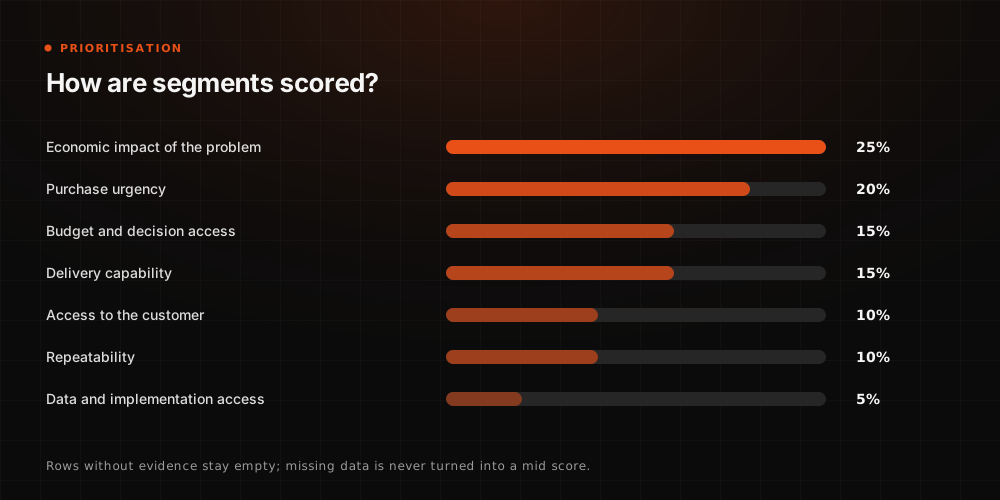
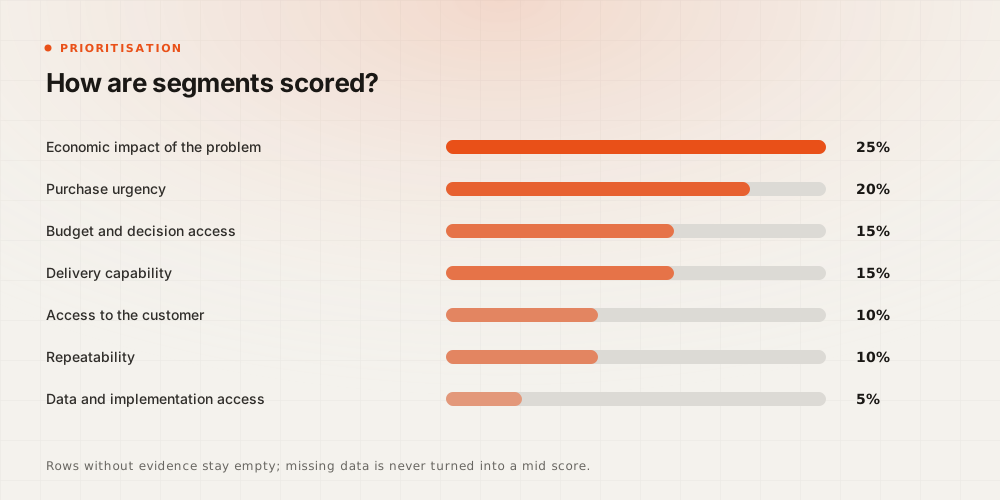
The table below is a prioritisation proposal, not an off-the-shelf industry standard. Score each criterion from 1 to 5 and calculate the weighted score by summing the products of weight and score.
| Criterion | Weight | Evidence needed for a high score |
|---|---|---|
| Economic impact of the problem | 25% | Lost revenue, time spent or cost is documented |
| Purchase urgency | 20% | Decision date and triggering event are known |
| Budget and decision access | 15% | Budget owner and buying process are known |
| Delivery capability | 15% | Team and method can meet a comparable need |
| Access to the customer | 10% | An existing relationship or a working channel exists |
| Repeatability | 10% | The solution transfers to other customers with limited adaptation |
| Data and implementation access | 5% | System access and a customer-side owner exist |
Leave rows without evidence empty and state separately what the score actually covers. Turning missing data automatically into a mid-range score makes unknown segments look more attractive than they are.
Market size and realistic reach
The total market consists of companies in the target geography that have the need. The serviceable market is the subset that also meets budget and access conditions. First-year attainable sales are then limited by sales capacity and delivery capacity.
A worked example: 500 suitable companies and a hypothetical annual contract value of 600,000 units produce a theoretical pool of 300 million. That figure is not a sales forecast. If first-year capacity is limited to 12 customers, the same price assumption gives a full-year contract value of 7.2 million, and revenue recognised in the period will be lower still depending on start dates.
Value Proposition and Service Model
A sellable offer defines the customer's problem and the expected outcome together. Its scope, delivery date, customer contribution, acceptance criteria and pricing logic must be written down.
A consulting report is not the final value on its own. It should be explicit which investment, channel, segment or implementation decision the report makes possible. "The report was delivered" is not an acceptance criterion; "the priority segment was chosen and the budget owner approved it" is.
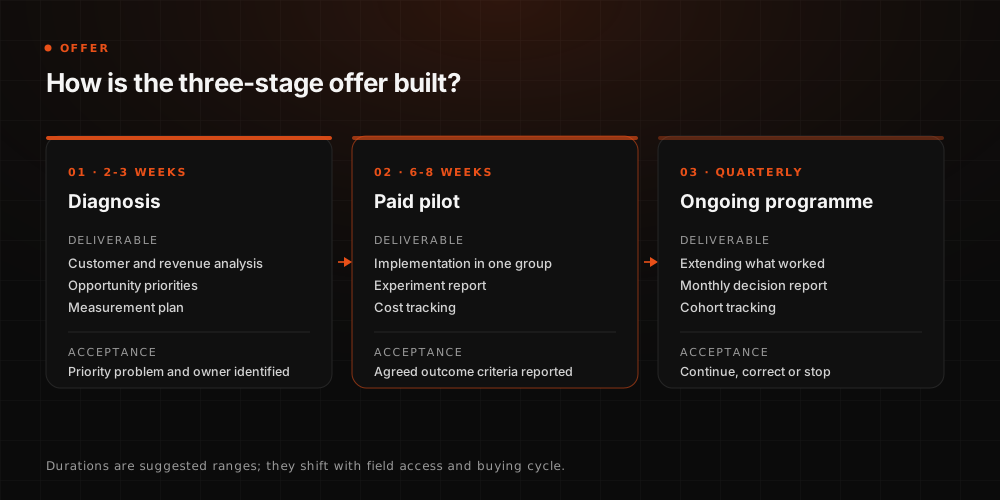
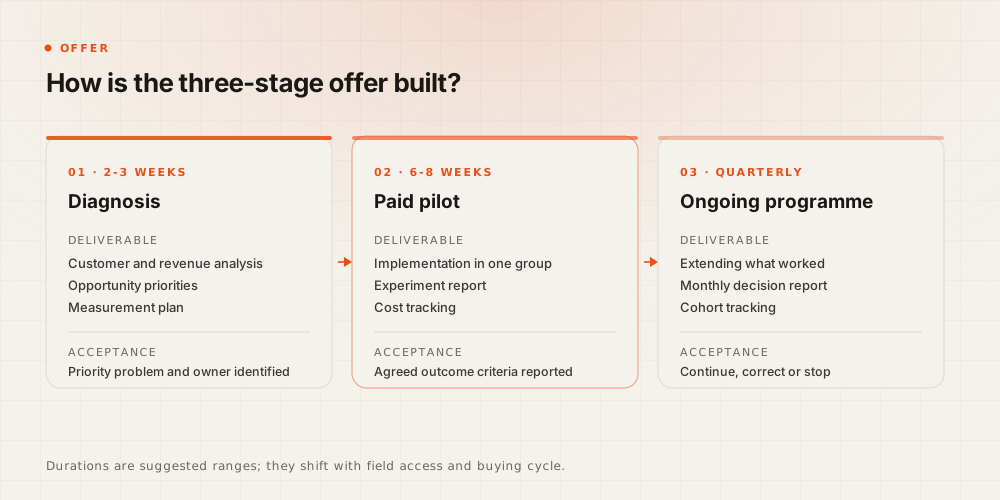
A three-stage offer: diagnosis, paid pilot, ongoing programme
| Stage | Deliverable | Acceptance criterion |
|---|---|---|
| Diagnosis, 2 to 3 weeks | Customer and revenue analysis, opportunity priorities, measurement plan | Priority problem, baseline and decision owner identified |
| Paid pilot, 6 to 8 weeks | Limited implementation and experiment report in one customer group | Outcome and quality criteria agreed up front are reported |
| Ongoing programme, quarterly cycles | Extension of what worked, monthly decision report | A continue, correct or stop decision can be made |
The durations are suggested working ranges; they shift with field access, data quality and the buying cycle. Guaranteeing the closing outcome of a six-month sales cycle inside a six-week pilot is not appropriate. In that situation the acceptance criteria should be leading indicators, such as opportunities with a validated need and a known buying process, while commercial outcome tracking covers a longer period.
How is differentiation tested?
A usable value proposition pattern reads: we help a specific customer group solve a defined problem through a measurable method and explicit deliverables.
A B2B consulting offer, for instance, might aim for the sales team to produce more validated opportunities from its existing customer list. A percentage or revenue-increase promise should only be added when baseline data and a measurement plan capable of isolating the effect both exist. Otherwise the promise becomes an obligation to be renegotiated in the first quarter.
Pricing and scope management
A fixed project fee can be used for diagnosis, a bounded implementation fee for the pilot, and a regular service fee thereafter. If outcome-based payment is considered, the baseline period, data source, refunds, channel effects and the customer's implementation responsibility must be defined. A model resting purely on success fees at the outset makes the provider carry variables it cannot control.
The purpose of a pilot is not to give away unlimited consulting. Fit is assessed in the first conversation; detailed research and bespoke solution design belong in paid scope. If a discount is requested, adjust the scope of work or the delivery cadence rather than the price. That approach reduces the risk of eroding capacity by offering the same promise for less.
Customer Acquisition and Channel Selection
The first channel can be expansion within existing customers, through relationships where results have already been delivered. The second is problem-led outreach to selected companies; the third is partners with complementary expertise.
That ordering is not a universal rule. If existing customers have no such need, or if portfolio concentration is high, meaning most revenue comes from a handful of accounts, the new-customer channel should come first.
A research note prepared for a target company should contain three things: the observed change, its likely impact and a verification question. A new product, a country launch or a change of decision maker is an observable signal; on its own it is not evidence of buying intent. The purpose of the first contact is to find out whether that signal corresponds to a real business problem.
Sales stages and exit criteria
| Stage | Condition for moving to the next stage | Record |
|---|---|---|
| Target account | Fit to the customer profile is confirmed | Fit rationale and source |
| Discovery | Problem and its impact confirmed with the customer | Interview summary |
| Qualified opportunity | Decision path, timing and next step are known | Opportunity record and owner |
| Proposal | Scope and acceptance criteria are agreed | Versioned proposal |
| Won | Contract and start conditions are complete | Handover to the delivery team |
| Expansion | First value confirmed as realised | New need and business case |
There is only one condition for stage definitions to work: the exit criterion must be tied to a record, not to the seller's optimism. "The customer is positive" is not an exit criterion.
The economic design of a partnership
A partnership can be defined by workflow and responsibilities rather than an exchange of logos. Microsoft's co-sell framework defines concrete activities such as joint demand generation, sales planning, opportunity sharing and selling together; some programme statuses also carry eligibility requirements.
Suitable first partner profiles, depending on the customer need, are a CRM implementer, an e-commerce integrator or a sector consultant. Partner selection should weigh customer overlap, complementarity, delivery quality and commercial incentive together. As a trial, ten accounts selected from the partner's customer list can be reviewed; data sharing must stay within customer permissions and both parties' contracts.
Referral, joint offer and joint delivery models carry different conditions. Which collection the revenue share is calculated on, who owns the opportunity, how scope changes are handled and who holds the customer relationship all belong in writing from the start. The measure for the first 60 days should be partner-sourced validated opportunities and delivery quality, not the number of partnerships signed.
Economic Model and Capacity Limits
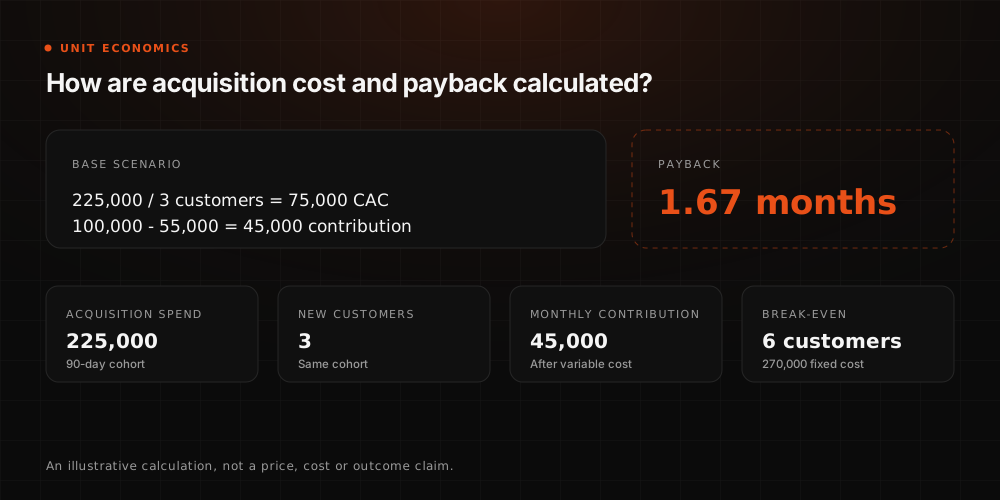
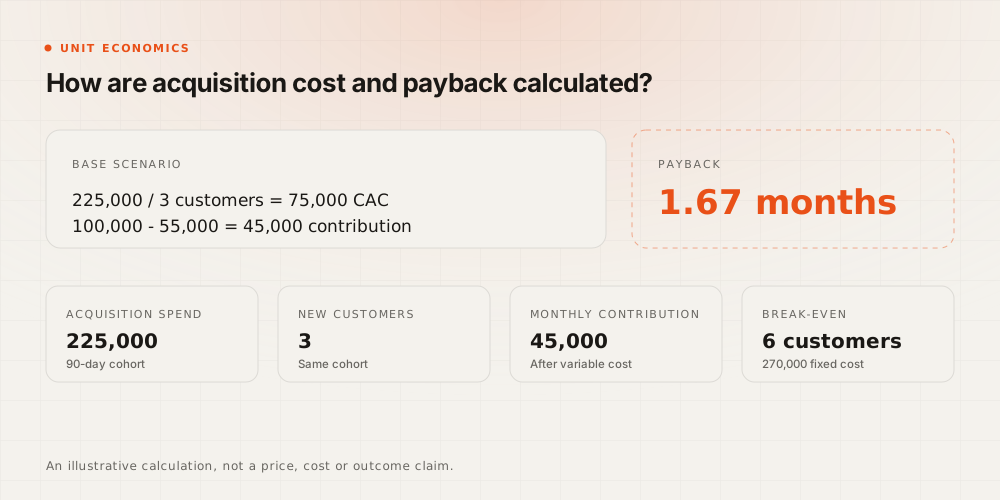
A business development plan must model customer acquisition together with delivery capacity and contribution margin. The calculations below are a hypothetical recurring-service example built to demonstrate the method. The amounts are not a price, cost or outcome claim and should not be used as a market benchmark.
| 90-day acquisition cohort | Cautious | Base | Favourable |
|---|---|---|---|
| Sales and marketing spend | 225,000 | 225,000 | 225,000 |
| New customers | 2 | 3 | 4 |
| Monthly fee per customer | 100,000 | 100,000 | 100,000 |
| Monthly variable delivery cost | 65,000 | 55,000 | 45,000 |
| Monthly contribution per customer | 35,000 | 45,000 | 55,000 |
| Customer acquisition cost | 112,500 | 75,000 | 56,250 |
| Payback on contribution | 3.21 months | 1.67 months | 1.02 months |
How to read the numbers
In the base scenario, customer acquisition cost is 225,000 of sales and marketing spend divided by the three customers in the same acquisition cohort, giving 75,000. Monthly contribution per customer is the 100,000 fee less the 55,000 variable delivery cost, giving 45,000. The simplified payback period is 75,000 divided by 45,000, or 1.67 months.
Payback is counted from the moment the customer starts the paid service. It excludes pre-sales time, payment delay, tax, fixed overhead, churn and contract start-up costs. Salaried delivery labour must not be treated as zero cost to make variable costs look lower; that labour belongs either in direct cost or in overhead, allocated consistently.
Break-even, cash and capacity
In a separate planning example, if monthly fixed cost is 270,000 and monthly contribution per customer is 45,000, six equivalent active customers cover the fixed costs. Fixed and variable cost classifications must stay consistent, and sales headcount cost must not be deducted twice in the same statement. Invoiced revenue and collected cash should be tracked separately.
Capacity needs the same discipline. If a team has 240 usable delivery hours a month and real effort per customer is 40 hours, theoretical capacity is six customers. That calculation has to include management, quality control, leave, rework and new-customer onboarding, or reserve a separate capacity allowance for them. The sales plan must not create commitments above the theoretical limit.
If revenue grows while contribution margin falls, scope, price and delivery method should be reassessed. One-off project customers and recurring-service customers belong in separate cohorts, and project revenue must not be presented as monthly recurring revenue. Where reliable customer-lifetime data is missing, use realised cohort contribution rather than a lifetime-value estimate.
SI and Agentic Commerce
SI can change both internal operations and the service offered to customers. Internally, a safe start is research preparation, interview summaries, proposal drafts and CRM data checks. Externally, the question is whether the customer's visibility, commercial process or productivity problem genuinely requires SI at all.
| Application | Value to measure | Precondition |
|---|---|---|
| Target account research | Time and errors per accepted research note | Source links and human verification |
| Proposal preparation | Draft time, number of revisions, win quality | Approved scope and pricing information |
| Post-sale follow-up | Timely action and quality of customer response | Permissioned data and defined communication rules |
| SI visibility | Sampled visibility and its relation to qualified demand | A fixed question set and an explicit measurement boundary |
| Commerce through agents | Verified transactions and net commercial outcome | Real integration and platform eligibility |
What is verified in agentic commerce
Google's Universal Commerce Protocol implementation guide, updated 25 August 2026, defines steps such as Merchant Center readiness, business and payment setup, checkout integration and order status reporting for transactions on SI surfaces. The guide states plainly that the standard is still developing, that not all features exist on Google surfaces, and that Google approval is required before going live.
On that basis, the sellable starting service is an eligibility and data-readiness audit. Do not assume that every merchant in a given country can be opened to transactions immediately, or that the integration will produce sales. For any brand, the target market, product category, platform access and payment flow should each be verified separately at the start of the project.
Two investment options and a fast test
The near-term option is a pilot focused on an existing customer problem, either SI visibility or a sales workflow. Its advantage is that it uses an existing relationship and existing data; its limitation is that it can turn into easily copied deliverables. The fast test is to sell one paid pilot of the same scope and measure the outcome the customer accepts, alongside the delivery cost.
The longer-term option is building readiness so that agents can reach product information and complete transactions for suitable commerce customers. Its advantage is that it requires distinct expertise; its risk is dependence on platform access, integration load and demand that is not yet validated. The fast test is to confirm technical eligibility on one catalogue and one flow, then confirm a real commercial need.
The recommendation is to weight resources towards the first option while testing the second on a limited budget. The split should not be fixed before customer demand and team capability are visible. For automations that act in external systems, permission boundaries, a rollback path and an error log belong in the service design.
Measurement and Operating Cadence
The shared record system for a business development team should be the customer relationship management system, the CRM. A spreadsheet may be enough at the start; the critical condition is that every opportunity has a single record, an owner and a dated next step. Choosing a new tool should rest on a concrete bottleneck the current system cannot resolve.
| Indicator | Definition | Decision it supports |
|---|---|---|
| Qualified opportunity | A record with a confirmed problem, decision path, timing and next step | Whether demand is sales-ready |
| Win rate | Opportunities won divided by closed opportunities in the same cohort | Offer and segment fit |
| Sales cycle | Median days from qualified opportunity to contract | Capacity and cash planning |
| Contribution per customer | Revenue less defined variable cost | Service economics |
| Acquisition cost | Related acquisition spend divided by new customers in the cohort | Channel efficiency |
| Time to first value | Days from start to the first confirmed customer outcome | Delivery quality |
| Retention | Share of customers present at period start who remain at period end | Continuity |
| Partner-sourced opportunity | Partnership opportunity with a documented first source | Partnership contribution |
Putting open opportunities into the denominator of the win rate makes segments with long sales cycles look misleadingly poor. Proposal count and meeting count should be interpreted next to revenue and quality indicators, never alone. When the denominator is zero, state that the measurement could not yet be made rather than writing zero percent.
Attribution and causality
A customer arriving from an SI answer, an event or a partner referral does not prove the sale happened entirely because of that touch. The CRM should keep the first source, self-reported influencing touches and verified campaign records apart.
Where volume allows, use a control group or a staged rollout. Where volume is low, present findings as observed correlation. Keeping that distinction looks weaker at first glance; over the medium term it prevents budget being moved to the wrong channel.
Ownership and meeting rhythm
The business development owner holds segment and partnership hypotheses; the sales owner holds opportunity progression; the delivery lead holds capacity and the customer outcome; the operations or finance owner holds the economics. One person may carry several roles in a small team, but the responsibilities must stay separated in the record.
The short weekly meeting covers only blocked opportunities, commitments made to customers and upcoming deliveries. The monthly review compares segment and channel cohorts. The quarterly decision session determines which offer is extended, which is corrected and which experiment ends. Every decision is logged with an owner, a deadline and a reassessment criterion.
The 90-Day Implementation Roadmap
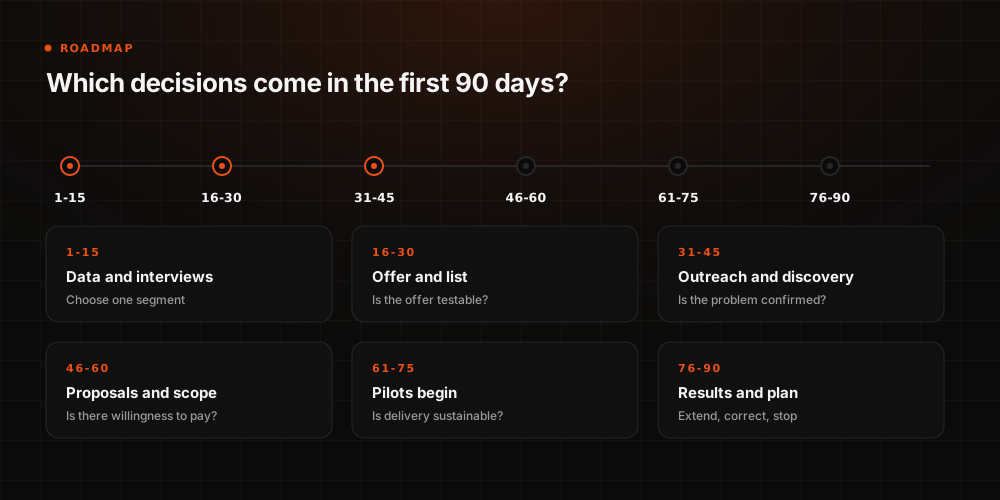
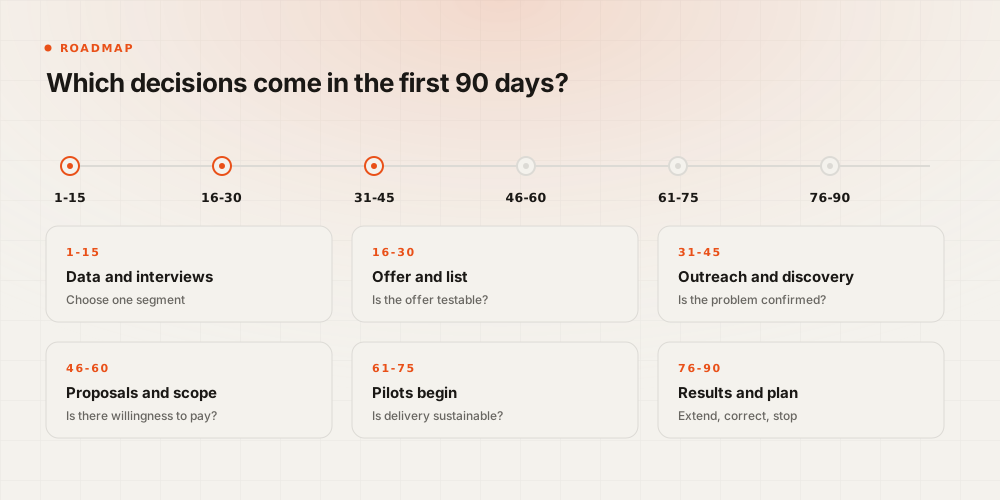
The plan below assumes a single priority segment, one business development owner and limited delivery capacity. The numbers are not research findings or a sales guarantee; they are a suggested quota for managing the first working period. Real targets should be updated in the first two weeks against the existing opportunity pool, past conversion and sales cycle.
| Period | Work and output | Decision point |
|---|---|---|
| Days 1 to 15 | Last 12 months of customer, proposal and cost data; 12 to 15 interviews; segment scoring | Choose one priority segment |
| Days 16 to 30 | Offer scope, acceptance criteria, a list of 60 suitable companies and two partner candidates | Is the offer testable? |
| Days 31 to 45 | Personalised outreach; target of 12 qualified discovery calls; partner account review | Are the problem and decision owner confirmed? |
| Days 46 to 60 | Target of six fitting proposals; scope and measurement agreements for paid pilots | Is there willingness to pay? |
| Days 61 to 75 | Target of three pilots starting; weekly cost and quality tracking | Is delivery sustainable? |
| Days 76 to 90 | Results from early pilots; interim findings for the rest; continuation plan | Extend, correct or stop |
Six-to-eight-week pilots that start late should not be expected to finish by day 90. In such projects the first-period decision rests on work completed and interim results; the final decision comes at the end of the pilot. Where the buying cycle is long, contract targets should move out and qualified opportunities must not be counted as won customers.
The phases of the first year
The first quarter validates the customer problem, willingness to pay and delivery economics. The second quarter standardises the validated offer, producing reusable working templates, sample outputs and, with customer permission, one case record. Sales volume should not be increased before delivery is reliable.
In the third quarter, add exactly one new variable: a new customer segment, a new country or a new channel. Changing them at once makes it hard to isolate what caused the result. The fourth quarter assesses renewal and expansion behaviour, the economic contribution of partnerships, and the sales capacity of the team beyond the founder.
Stop and correct conditions
If interviews surface no recurring problem, correct the segment definition. If the problem is acknowledged but payment does not follow, correct the offer, the urgency or the budget path. If sales arrive but contribution margin is insufficient, correct price and delivery model. When the pre-agreed experiment budget is spent, no new spend should happen without stating the evidence gathered and the assumption being changed.
The internal data set needed at the start is: the last 12 months of customers and proposals, win and loss reasons, revenue and delivery effort by service, collection periods, renewals and partnership records. Without that data, sector scores, budget allocations and revenue targets should not be presented as final decisions.
Frequently Asked Questions About Business Development Strategy
What is the difference between business development and sales?
Sales converts a suitable opportunity in hand into a contract. Business development decides which opportunities to pursue: which segment, which offer, which channel and which partnership. In small teams the same person can do both, but the decisions should be tracked in separate records.
How long does it take to build a business development strategy?
The diagnosis phase typically takes 2 to 3 weeks. The duration shifts with access to customer interviews, the quality of internal data and the length of the decision process. If the interview calendar cannot be set, the work stretches, which is why access should be secured in the first week.
How many customer interviews are enough?
Twelve to fifteen for a start. That number provides no statistical representation; it is a working quota for discovering recurring problems. If the same problem recurs in five interviews in different words, the hypothesis has strengthened.
How many segments should be entered at once?
One in the first period. When two segments are tried simultaneously, it is impossible to isolate which variable produced the result, and both end up with insufficient evidence. A second segment should be added only after the offer and delivery economics are validated in the first.
Should the pilot be free?
No. A free pilot removes the only reliable way to measure willingness to pay and gives away genuine diagnostic work. Fit is assessed free of charge in the first conversation; detailed research and bespoke solution design belong in paid scope.
Can we work on a success fee alone?
Not at the outset. That model makes the provider carry variables it cannot control, including the customer's implementation speed, pricing decisions and market conditions. If outcome-based payment is used, the baseline period, data source, refunds, channel effects and the customer's responsibility must be in writing.
Which metrics should be tracked?
At least six: qualified opportunities, win rate, sales cycle, contribution per customer, acquisition cost and time to first value. Proposal count and meeting count are not performance indicators on their own; they are read next to revenue and quality indicators.
How is customer acquisition cost calculated?
Sales and marketing spend for the relevant period is divided by the new customers won in the same acquisition cohort. The cohort split matters: dividing this quarter's spend by last quarter's customers understates the cost.
When does a strategic partnership work?
When the partner's customer base overlaps with yours, the expertise is complementary and the commercial incentive is clear on both sides. The measure for the first 60 days should be partner-sourced validated opportunities and delivery quality, not the number of partnerships signed.
Where does SI start in business development?
Internally, research preparation, interview summaries, proposal drafts and CRM data checks are low-risk starting points. On the side sold to customers, first test whether the problem genuinely requires SI. If a simple rule meets the need, no unnecessary model layer is added.
What should be done about agentic commerce now?
The sellable and honest starting point is an eligibility and data-readiness audit. Protocols are still developing, not every feature exists on every surface, and going live depends on platform approval. Target market, product category, platform access and payment flow should each be verified separately at project start.
When should a strategy be stopped?
If interviews surface no recurring problem, change the segment definition. If the problem is acknowledged but payment does not follow, change the offer and the urgency. If sales arrive but contribution margin is insufficient, change price and delivery model. When the experiment budget is spent, no new spend happens without writing down the evidence gathered and the assumption being changed.
Related Guides and the Next Step
A business development strategy does not work in isolation: demand has to exist in the chosen segment, the decision has to be measured and the implementation has to be carried out. The services below own different layers of that programme.
| Area | Role in the business development programme |
|---|---|
| Market and industry analysis | Supplies market, competitor and segment evidence |
| Audience and segmentation | Defines the customer profile and buying context |
| GEO and SI visibility | Supports discovery along the chosen customer journey |
| SI Workflow Engineering | Implements and improves the agreed workflow |
| SI and Agentic Analytics | Tracks the outcome, data quality and interpretation limits |
Four pieces of information are enough to begin: the last 12 months of customers and proposals, win and loss reasons, revenue and delivery effort by service, and who owns the decision. The purpose of a first conversation is to work out together which segment makes a paid pilot worthwhile.