ChatGPT Usage Report (NBER 2025): A New Way of Communicating
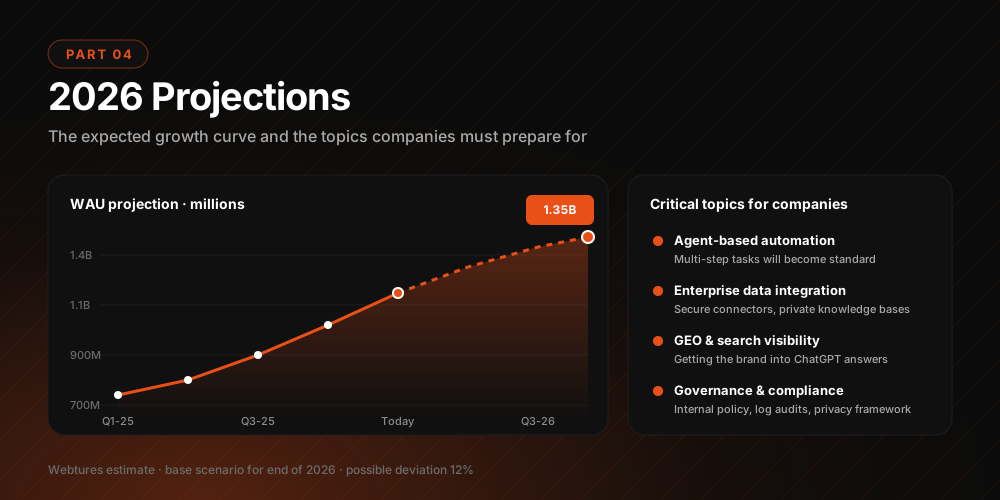
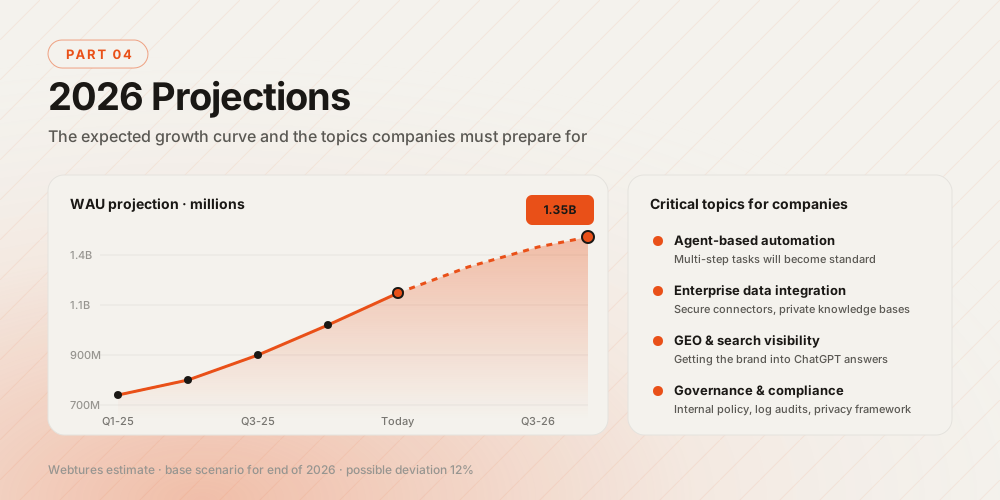
Since entering our lives in November 2022, ChatGPT has become one of the fastest-spreading technologies in the world in just a few years. Today, roughly 700 million people use ChatGPT weekly , generating more than 2.5 billion messages a day.

Since entering our lives in November 2022, ChatGPT has become one of the fastest-spreading technologies in the world in just a few years. Today, roughly 700 million people use ChatGPT weekly, generating more than 2.5 billion messages a day. That works out to over 29,000 messages per second. No technology in the history of the internet has been adopted this quickly.
The NBER report "How People Use ChatGPT", published in September 2025, examines in detail how people actually use the tool. It covers not only productivity at work but also the new habits emerging in everyday life. In this article, we look at the report's most striking findings from both a business and a digital marketing perspective.
ChatGPT's global rise
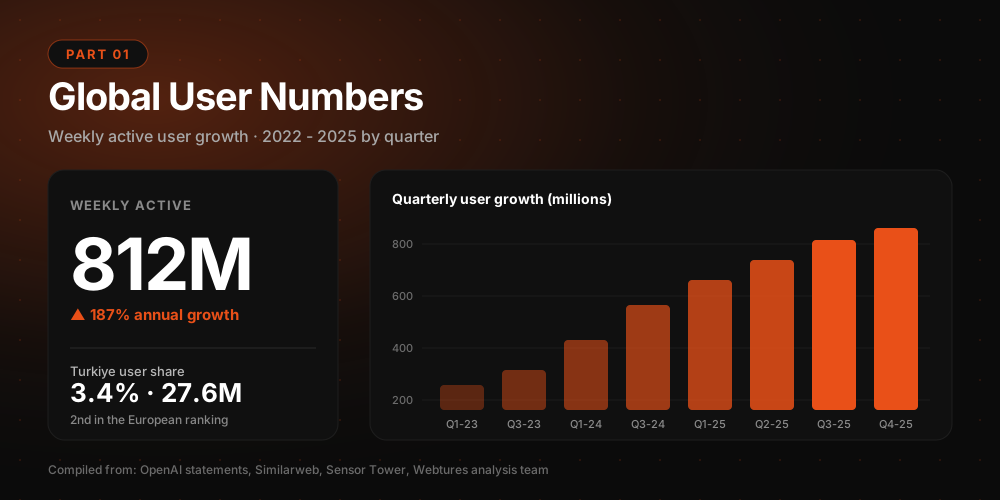
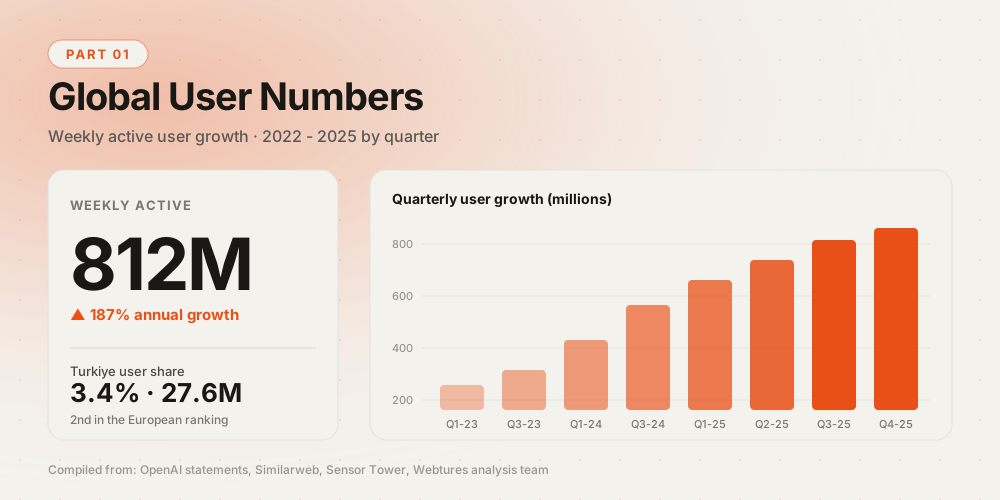
ChatGPT's growth rate is remarkable. Within three years of launch it reached roughly 10 percent of the adult population. What stands out is that this growth is accelerating not only in developed economies but especially in middle- and low-income countries, evidence that the technology is democratizing and access is widening.
While male users dominated in the early period, that gap had closed by mid-2025. According to the report, the share of female users is now slightly higher than that of male users.
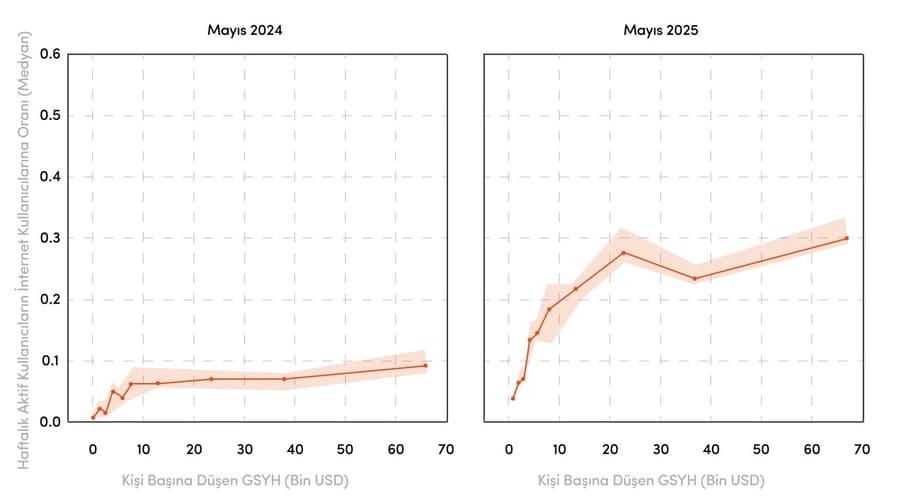
Figure 1: ChatGPT weekly active users as a share of the internet-using population (by GDP bracket), comparing May 2024 with May 2025. Dots show median values within each bracket. Internet population figures use 2023 World Bank estimates. Shaded areas show the interquartile range (25th to 75th percentiles) of country values.
The balance between work and everyday use
Most people assume ChatGPT is used primarily for work, but the data says otherwise. In June 2024, roughly half of all messages were work-related. Within a year, that share fell to 27 percent. Today, 73 percent of the messages sent on ChatGPT relate to everyday life.
This trend shows AI playing a powerful role not just in business processes but in daily life. Users turn to ChatGPT for everything from recipes and travel planning to health and fitness advice and personal development.
At work, the heaviest use is in writing and editing. Drafting emails, summarizing reports and producing content are the areas where ChatGPT stands out most.
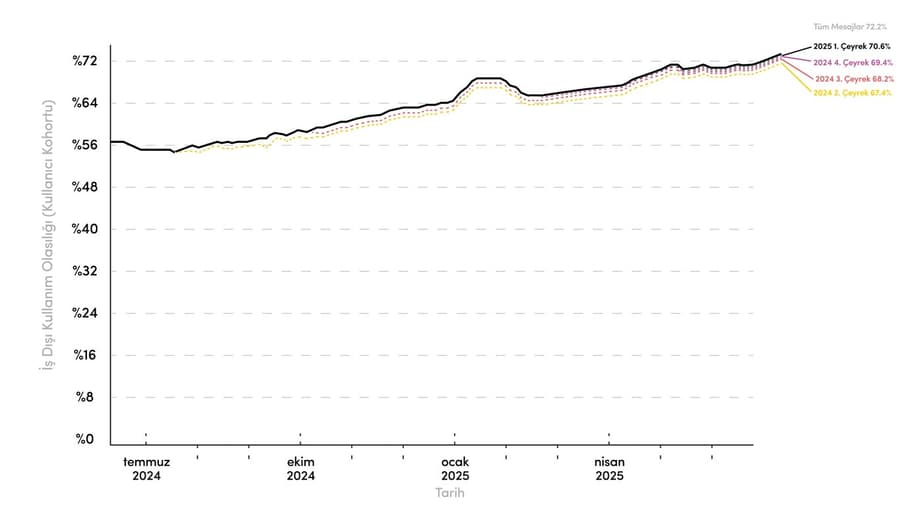
Figure 2: The thick black line shows the probability that a message sent on a given day is not work-related, as determined by an automated classifier. Values are calculated as a 28-day moving average. The dotted orange line shows the same calculation for messages from users who started using ChatGPT in Q2 2024 or earlier. The remaining lines are defined similarly for user cohorts starting in subsequent quarters, with cooler color tones for newer cohorts. Calculations are based on approximately 1.1 million sampled conversations collected between May 15, 2024 and June 26, 2025. Observations are reweighted to reflect total message volume on a given day. Sampling details are available in Section 3.
What people expect from ChatGPT
The report groups user intent into three categories: Asking, Doing and Expressing.
- Asking: 49 percent of users turn to ChatGPT with questions, to learn something or make better decisions.
- Doing: 40 percent want direct output: an email draft, a report, code or an image.
- Expressing: 11 percent use ChatGPT to share their feelings or thoughts.
In the workplace the picture shifts. There, Doing, meaning the production of concrete output, dominates. White-collar workers in particular use ChatGPT for reports, presentations and correspondence.
The most common topics
Roughly three quarters of all conversations fall into three main categories:
- Practical Guidance: education, tutorials, how-to guides and creative ideation.
- Seeking Information: search-engine-style information queries.
- Writing: drafting and editing emails, reports and content.
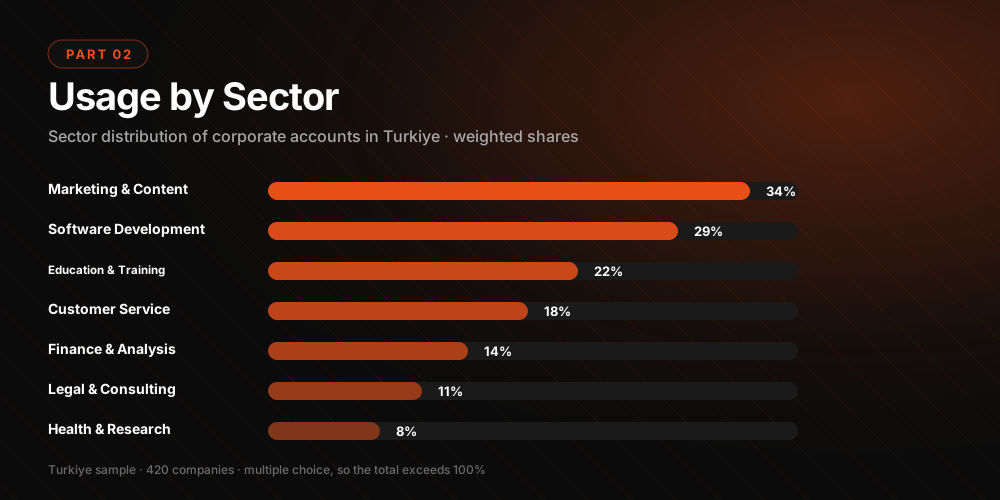
Strikingly, coding requests account for only 4.2 percent. Contrary to popular belief, ChatGPT's real strength shows up not in coding but in writing and information support.
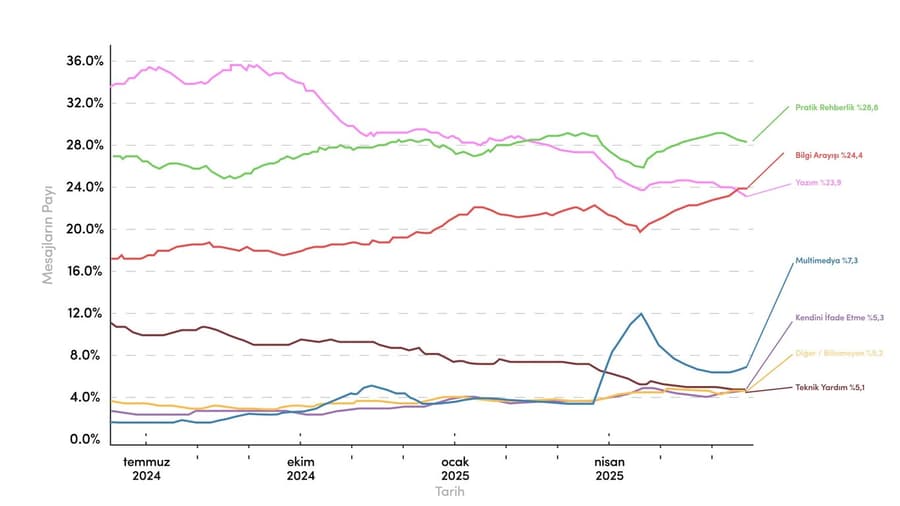
Figure 3: Distribution of consumer ChatGPT messages by high-level conversation topic, according to the classification in Table 3. Values are calculated as a 28-day moving average. Results are drawn from approximately 1.1 million sampled conversations collected between May 15, 2024 and June 26, 2025. Observations are reweighted to reflect total message volume on a given day. Sampling details appear in Section 3.
Demographic differences
Another headline finding is the intensity of interest among younger users. Nearly half of all users are between 18 and 25. As age rises, however, ChatGPT is used more for work.
Education level matters too. Users with undergraduate and graduate degrees lean toward professional use. By occupation, managers and business professionals use it primarily for writing, software specialists for technical help, and education and healthcare workers for guidance.
Implications for digital marketing and SEO
The way people use ChatGPT sends a clear message to the digital marketing world. People no longer turn only to Google for information; they turn to ChatGPT as well. That makes producing content optimized for AI a requirement for brands.
ChatGPT is also a powerful assistant for SEO teams, offering speed and efficiency gains in content production. Used correctly, it makes both faster content creation and better audience fit possible. The rapid spread in middle-income countries in particular opens new market opportunities for brands.
Conclusion: AI is now part of everyday life
The NBER report makes clear that ChatGPT plays a powerful role not just in the business world but in daily life. People have made the tool part of their routines for making decisions, finding information and producing content.
For digital marketing professionals, the lesson is simple but powerful: 'You now need to be visible not only to search engines but to AI as well.'
That means brands must invest in AI-driven visibility alongside classic SEO. Brantial tracks this shift closely, helping make content clearer and more accessible not only to search engines but to AI engines as well, so brands can hold a strong presence in the digital conversations of the future.
References
Chatterji, A., Cunningham, T., Deming, D., Hitzig, Z., Ong, C., Shan, C. Y., & Wadman, K. (2025). How People Use ChatGPT. NBER Working Paper No. 34255.
Collis, A., & Brynjolfsson, E. (2025). AI's Overlooked $97 Billion Contribution to the Economy. Wall Street Journal.
Pew Research Center. (2025). U.S. adults' use of ChatGPT.
Sources