A GEO-Friendly URL, Title and Meta Tag Strategy
Boost your visibility in AI search with GEO-friendly URL, title and meta tag strategies. Send the right signals and shape how LLMs read your content.

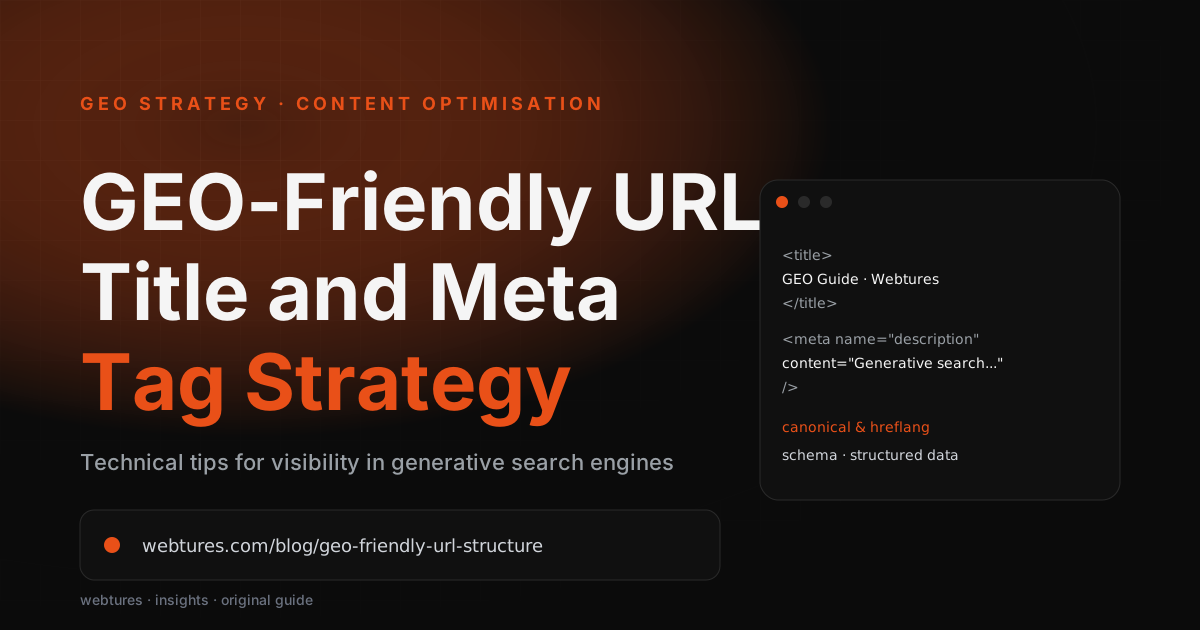

GEO (Generative Engine Optimization) is a new generation of optimization built around how AI-powered search engines process and present content. Traditional SEO focuses on helping crawler bots understand a page; GEO focuses on guiding how LLM-based search systems read and summarize your content through the right signals.
That shift turns URL structure, title tags and meta descriptions into more than technical requirements. They are now critical signals that help AI models detect a page's category, intent and context. A GEO-friendly setup positions your content correctly both in classic search results and in AI-driven surfaces such as AI Overviews, Bing Copilot, Perplexity and ChatGPT Search.
What should a GEO-friendly URL structure look like?
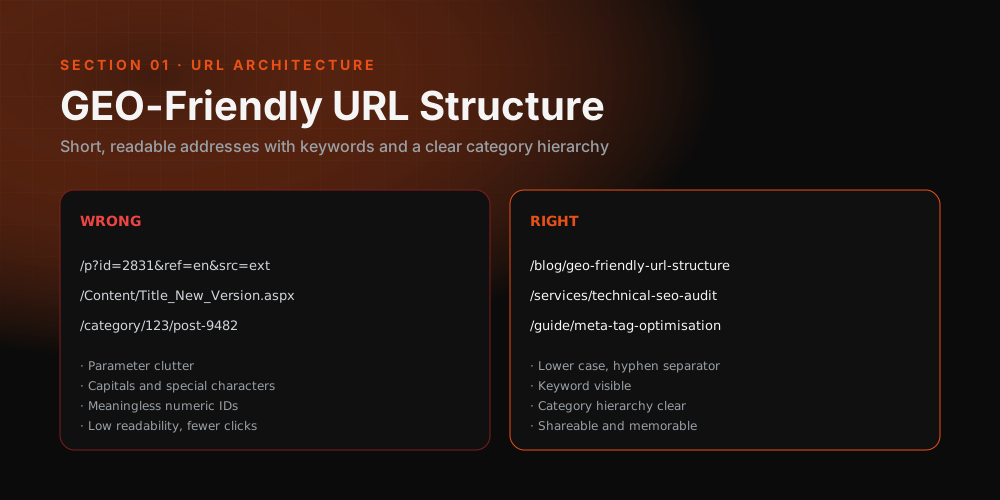
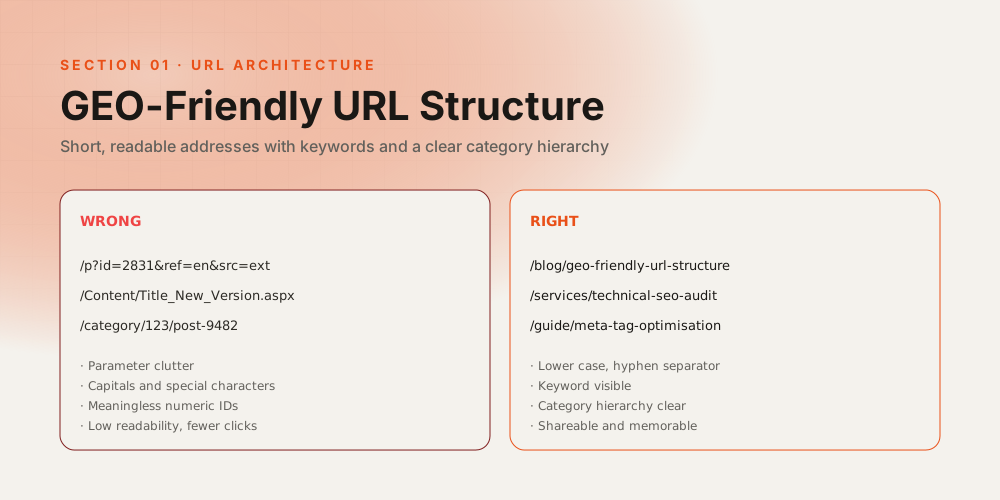
Within GEO (Generative Engine Optimization), URLs are more than an address; they are one of the core signals AI models use to decide which topic a page belongs to. LLM-based search systems interpret the URL as a signal of location, context and subject, so clean, short, meaningful and conceptually accurate URLs help content surface in the right place in AI results.
Making a URL structure GEO-friendly means building an architecture that preserves semantic coherence, exposes topic clusters clearly and leaves no room for noise. That approach positions content far more strongly in both traditional SEO and AI search.
The role of URL structure in AI search
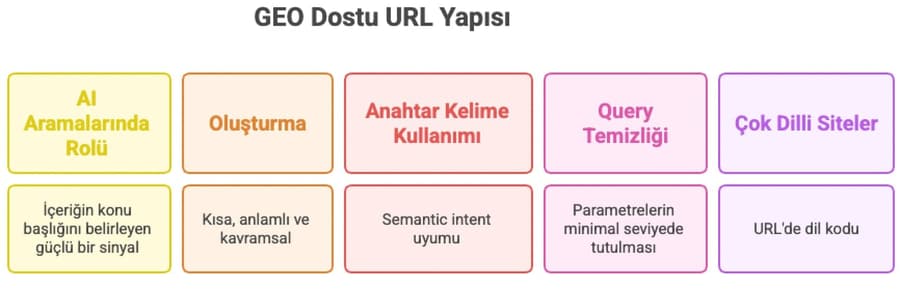
AI-based search engines treat URLs not merely as addresses but as strong signals of which topic a page belongs to. Short, clear URLs that match the subject help LLMs grasp the page's context more accurately and place the content in the right position within AI summaries. That is why URL structure is considered a cornerstone of content architecture in any GEO strategy.
Creating short, meaningful and conceptual URLs
GEO-friendly URLs should be stripped of unnecessary folders, dates, IDs, page numbers and descriptive filler. Carrying the single concept that best expresses the content into the URL makes it easier for AI models to categorize the page at a glance. This improves user experience and speeds up how AI systems make sense of the content.
Keyword use in URLs and semantic intent alignment
In the classic SEO era, adding a keyword to the URL was considered enough. In the GEO era, what matters is accurately reflecting the page's semantic intent. A URL should do more than contain a word; it should indicate the scope in which the topic is covered. That lets LLMs position the content under a higher-level concept and select it as a source in the right scenarios.
Query and parameter hygiene (so AI bots read the page correctly)
Parameterized URLs (utm, ref, id and similar) are often read by AI bots as separate page variations or signal noise. That makes content matching harder, and when canonical structures get tangled, it weakens the page's context. Clean URLs and minimal parameters help AI interpret the content correctly and produce a single, unambiguous signal.
A GEO-friendly URL approach for multilingual sites
On multilingual sites, including the language code in the URL helps LLMs quickly detect which language a page was created in. Different language versions of the same content match correctly, hreflang setups work smoothly, and the risk of surfacing content in the wrong language in AI results disappears. A clear language-based URL structure also aligns your content architecture with a global GEO strategy.
Title strategies: how do you write a GEO-ready title?
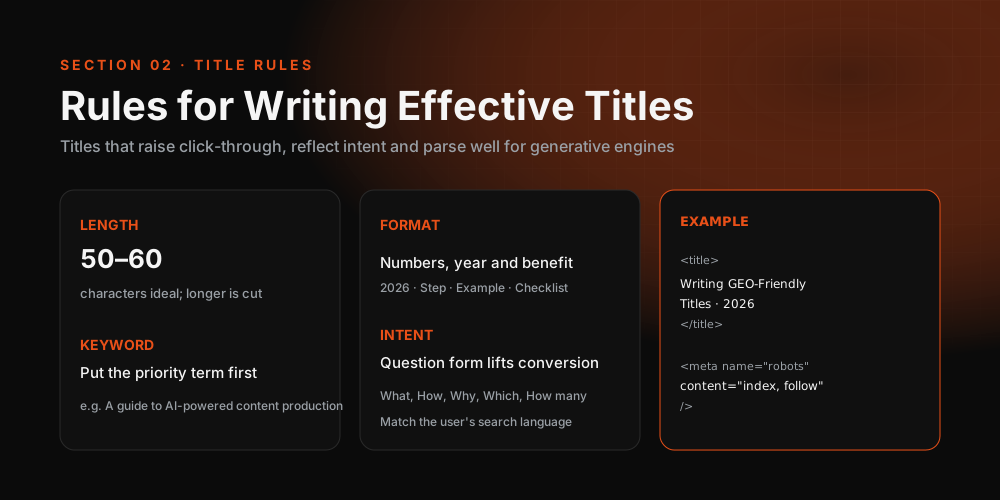
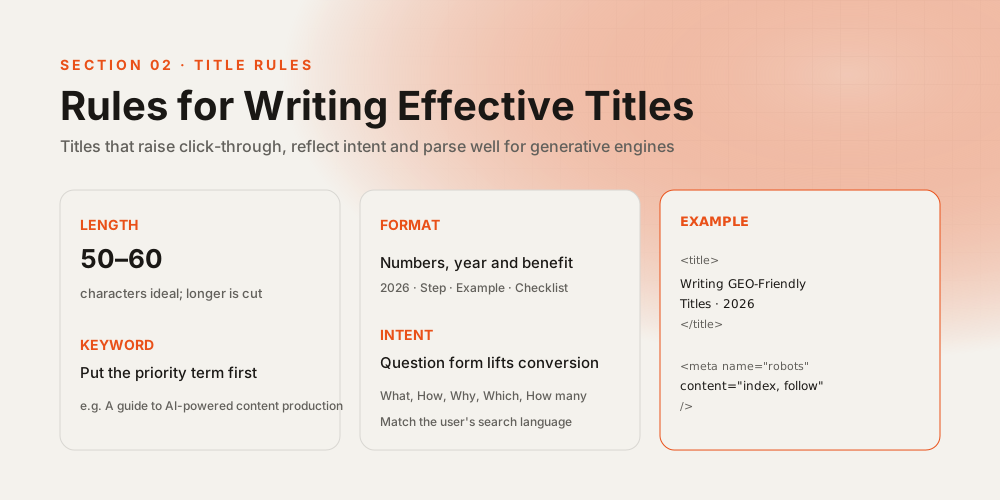
In the GEO era, title tags have moved beyond their classic click-through role and become one of the primary context signals AI models use to make sense of content. AI-based search engines rely heavily on the title to interpret a page's core topic, the question it answers and the content group it belongs to. Titles therefore need a more advanced approach built on intent, context and topical scope rather than a single keyword.
GEO-ready title strategies help content land in the right category, appear more often in AI summaries and increase the chance of being selected as a recommended source on platforms such as ChatGPT Search, AI Overviews and Bing Copilot. A well-crafted title sends LLMs a strong, unambiguous signal, shows the perspective the content takes and helps AI represent the page accurately.
How LLMs read titles
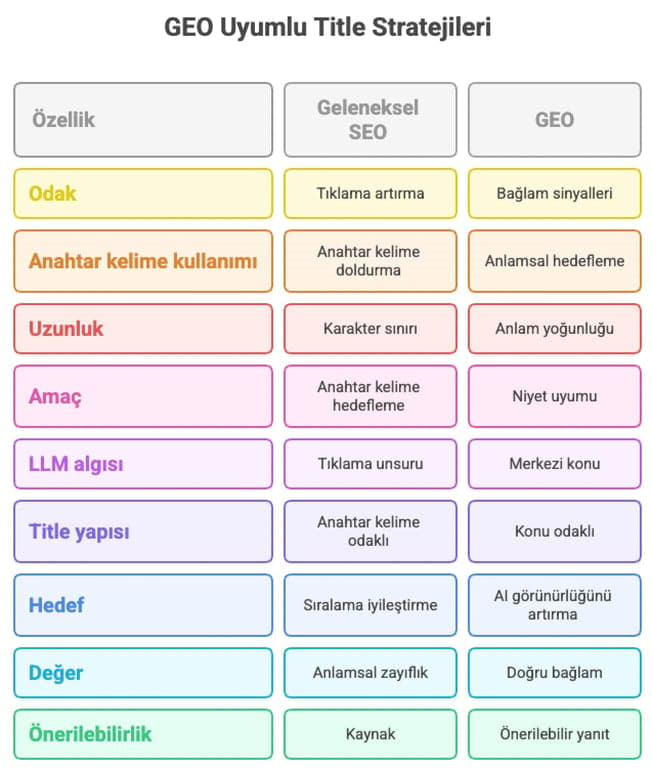
LLM-based search engines (ChatGPT Search, AI Overviews, Bing Copilot, Perplexity) treat a page's title not as a click magnet but as the content's central topic. The title is the first signal that tells AI what the content explains, which question it answers and which context it carries. It should define the content's scope explicitly, hold together conceptually and let AI classify the page under the right topic.
Producing topic-focused, conceptual titles
GEO-ready titles frame the whole topic instead of chasing a single keyword. A strong title defines the subject clearly and shows the perspective the content takes. LLMs then classify, summarize and surface the content with higher accuracy, and can present it as a source recommendation in search scenarios. That is why a title needs to form a conceptual whole that represents the topic.
Length, intent and semantic density
Where traditional SEO obsessed over character limits, GEO prioritizes semantic density and intent alignment. Titles in the 45 to 70 character range that take a broad view of the topic and state the page's purpose clearly register as stronger signals with AI. Avoid needless keyword repetition; balance user intent, descriptive boundaries and content scope in the title instead.
Semantic targeting instead of keyword stuffing
Repeating the same keyword over and over no longer adds value; LLMs now flag that pattern as semantic weakness. The key to a GEO-focused title is semantic targeting: addressing the topic naturally within a conceptual frame. One keyword is enough; the rest should be meaningful phrasing that explains the subject. This structure helps AI place the content in the right context.
The action, context and solution trio in titles
AI search engines favor titles that explain a topic while also providing context and a solution. Titles that combine action (what it is, how it works, how to do it), context (when to use it) and solution (which problems it solves) send LLMs a clearer signal about the content. The page can then be treated not just as a source but as a recommendable answer in AI results.
Meta description strategies: descriptions optimized for AI search
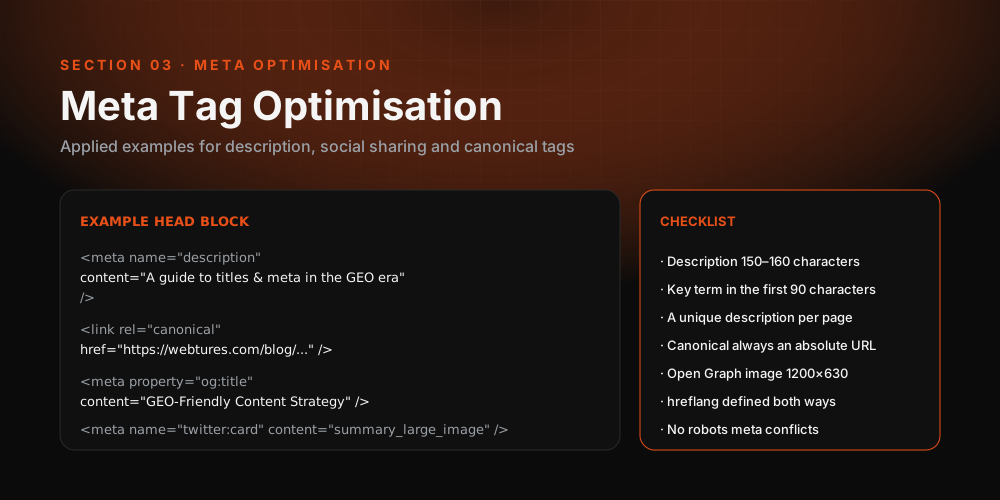
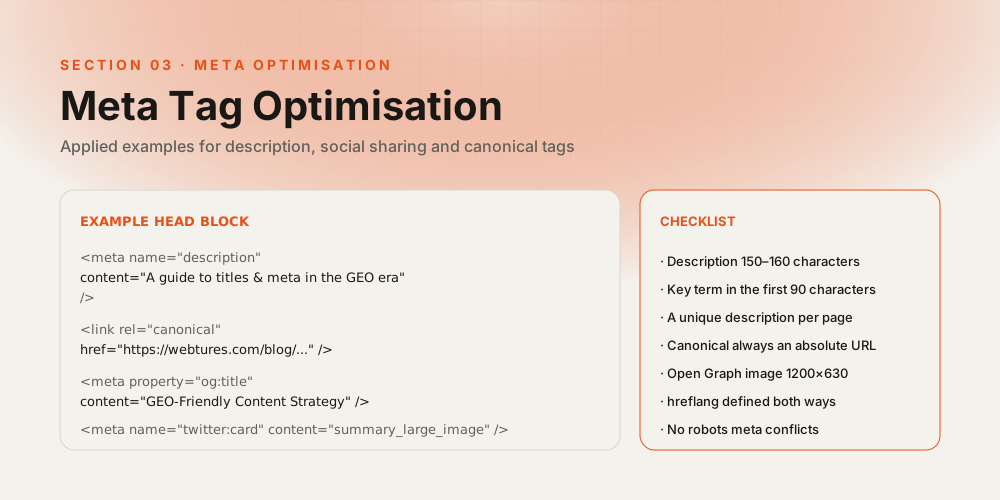
In the GEO era, the meta description is no longer just a CTR lever in the SERPs; it has become one of the most important signals AI search engines consult when building content summaries. When LLM-based systems (AI Overviews, Bing Copilot, ChatGPT Search, Perplexity) want to recommend or summarize a page, they use the meta description as the content's short, clear definition.
Modern descriptions should therefore move away from keyword stuffing and toward information-focused writing that serves the user's goal, states the topic's scope explicitly and shows which questions the content answers. A GEO-ready meta description gives both search engines and AI models strong context, making the content visible in more scenarios.
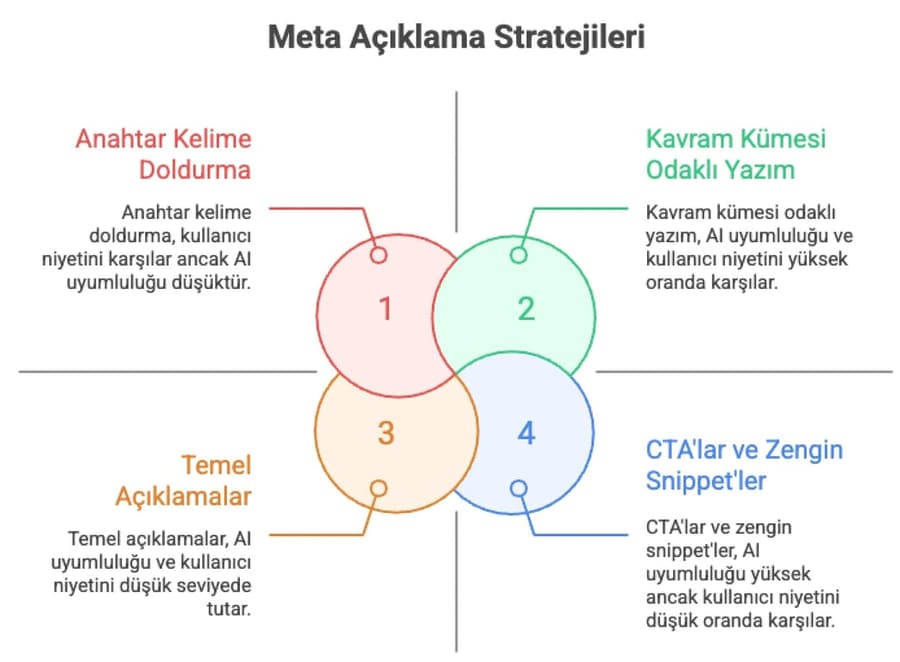
How do LLMs use the meta description?
AI search engines treat the meta description as a page's short content summary. When a description is explanatory and its context is clear, LLMs extract information more accurately while summarizing the page and are more willing to use the content in answer recommendations. The description should clearly convey the content's core purpose and the problem it solves.
Writing descriptions that reflect user intent
The meta description's first job is to frame an answer to the user's search goal. If someone is searching with an intent such as what it is, how it works or what it does, the description should deliver a clear message aligned with that goal. LLMs pick up on intent-aligned descriptions faster and position them higher in summary results.
Writing around concept clusters, not keywords
Cramming specific keywords into a description no longer pays off. Meaning-focused descriptions that bring together the concepts representing the content perform better. A concept cluster helps AI models understand the content's scope in a wider context and file the page under the right topic group.
The effect of CTAs in AI results
In GEO-ready meta descriptions, calls to action (get the details, explore more, read the full guide) lift click-through rates and position the content as a complementary source. Even in AI-driven search results, descriptions with a CTA make content easier to reference.
Rich snippet and AI summary compatibility
The meta description is the base data source for rich snippets, AI summaries and the short information boxes in search results. A clear, explanatory description that aligns with the title helps content get represented accurately across AI Overviews, Bing Copilot and Perplexity. The page gains stronger visibility in both classic SERPs and AI results.
The new role of URLs, titles and meta structures in the GEO era
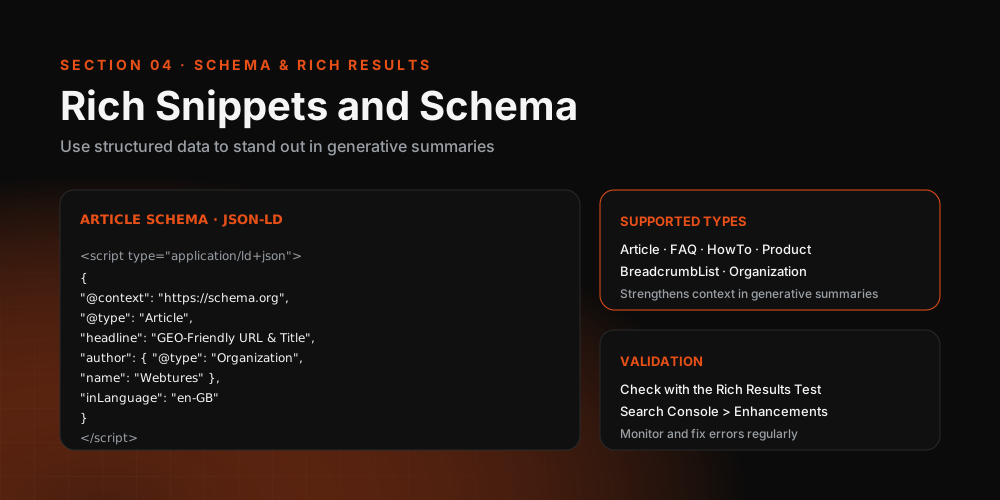
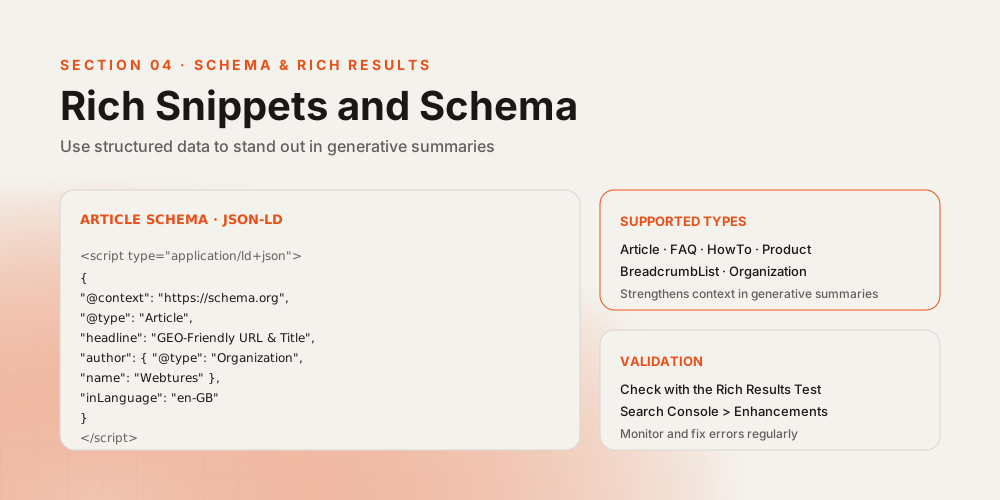
GEO (Generative Engine Optimization) is not a passing trend. As search behavior shifts to AI-powered systems, it has become a core component of digital visibility strategy. In this new era, the URL, title and meta description have moved far beyond their technical duties in classic SEO to become the most critical signals AI models use to make sense of content.
Clean, meaningful URL structures help LLMs interpret which topic group a piece of content belongs to. GEO-ready title strategies define exactly which context AI should present the content in. The meta description passes a short but powerful summary to both search engines and AI systems, helping the page earn a spot among recommended sources.
When these three come together, you gain strong representation not only in classic SERPs but also in next-generation AI search engines such as AI Overviews, Bing Copilot, ChatGPT Search and Perplexity. In short, GEO-friendly URL, title and meta strategies have become the foundational optimization layer for competing in both today's and tomorrow's search ecosystem.
Built on sound information architecture, meaning-focused content and clean signal delivery, this approach lets brands appear more often in AI-driven search results, get positioned more accurately and build stronger authority.