The GEO Roadmap for 2026
Update your GEO strategy for 2026 with measured data, 2027 forecasts, a practical checklist, and clear priorities for earning citations in AI search results.

Generative Engine Optimization (GEO) is the discipline of getting a brand cited as a source in the answers produced by generative search engines. As of 2026, this is no longer an experimental topic: 67% of Fortune 500 marketing executives rank GEO among their top three digital priorities for fiscal year 2026. In 2024, that figure was 18%.
This article lays out a roadmap brands can follow, grounded in what has been measured in 2026 and in published forecasts for 2027. The figures below are compiled from research firms and industry analysts; those that are forecasts are labeled as such.
What the 2026 data shows
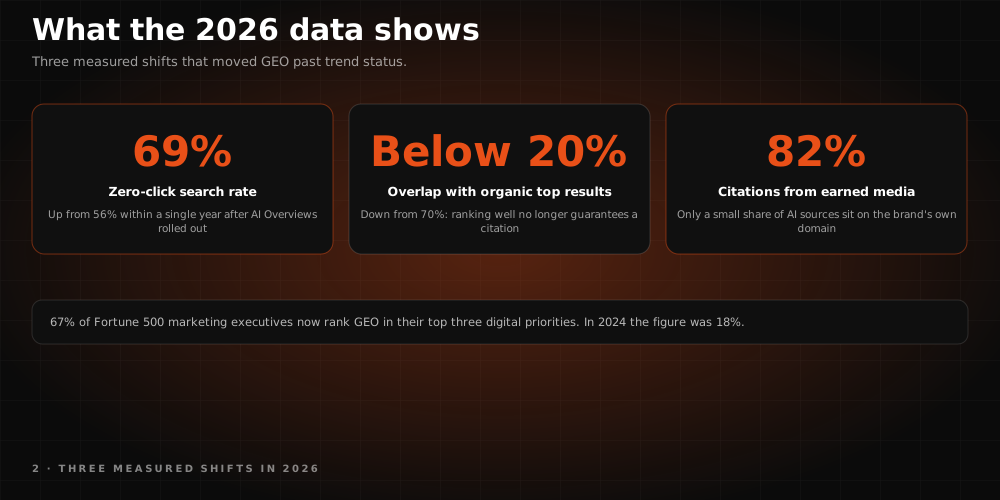
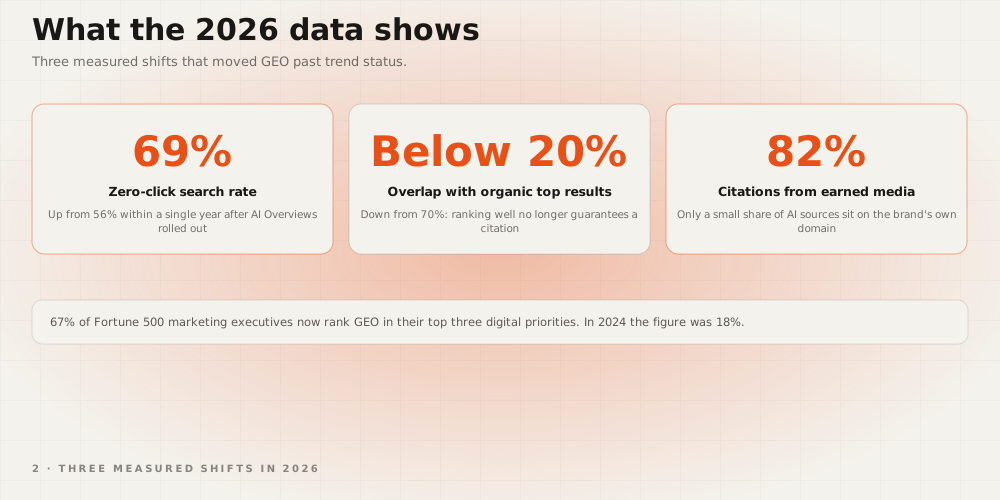
What moved GEO past trend status is that the shift in search behavior is now measurable. Following the rollout of Google's AI Overviews, the zero-click search rate rose from 56% to 69% within a single year. Two out of three users now get their answer without ever leaving the results page.
The second, less discussed finding sits on the sourcing side: the overlap between Google's top-ranking organic results and the pages cited in AI answers has fallen from 70% to below 20%. The implication is clear; ranking well in classic search no longer guarantees being cited in generative answers. The two surfaces are diverging and demand separate measurement.
The third finding concerns content ownership: 82% of citations in AI answers come from earned media, not from the brand's own pages. Content on your own domain accounts for only a small share of the sources feeding these answers.
Forecasts for 2027
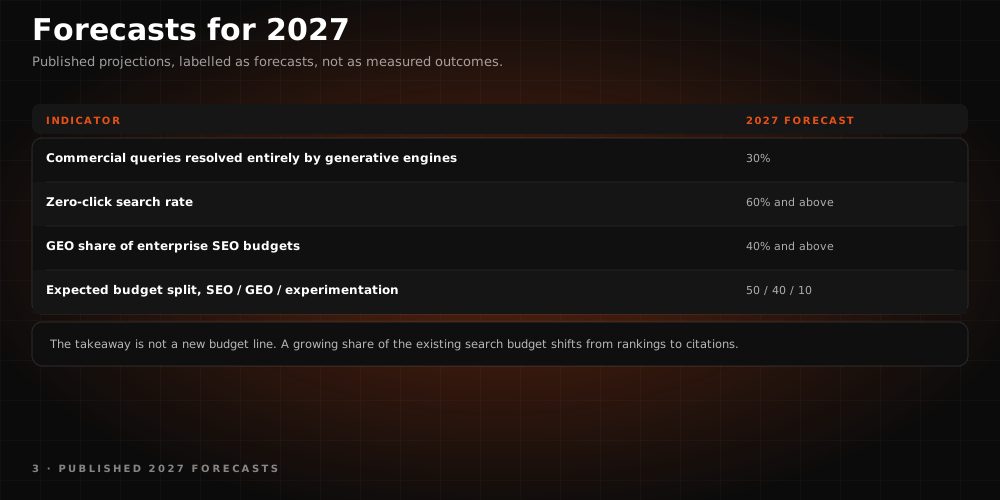
| Indicator | 2027 forecast |
|---|---|
| Commercial queries resolved entirely by generative engines | 30% |
| Zero-click search rate | 60% and above |
| GEO share of enterprise SEO budgets | 40% and above |
| Expected budget split (SEO / GEO / experimentation) | 50 / 40 / 10 |
The practical takeaway from this table is not to rename budget lines. When GEO is set up as a separate budget item, most brands end up doing the same work twice. The healthier reading is this: a growing share of the existing search budget will be spent on earning citations rather than rankings.
GEO, the next evolution of digital visibility: the 2026 perspective
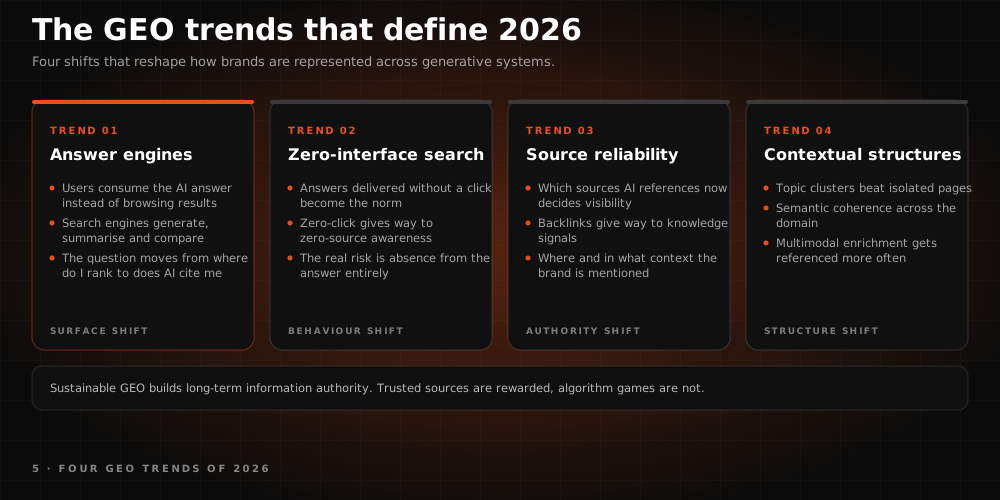
As of 2026, the classic SEO mindset in digital marketing has begun giving way to GEO (Generative Engine Optimization). Visibility is no longer shaped by search rankings alone but by how generative AI systems such as ChatGPT, Google AI Overviews, Perplexity, and Gemini perceive, summarize, and reference brands.
Alongside algorithm updates, the way LLMs (Large Language Models) process information, shifting user behavior, and agent-based search experiences are rewriting the rules of digital visibility. In this period, success depends far less on keyword density and far more on context, consistency, authority, and machine-interpretable content.
For brands that want a strong digital presence in 2026, GEO is no longer optional. It is a baseline requirement.
The GEO trends that stand out in 2026
The GEO trends defining 2026 directly shape how brands are represented across the generative AI ecosystem, not just through their websites but through every digital asset they own.
-
AI-Powered Answer Engines: Users consume AI answers directly instead of browsing search results.
-
Zero-Interface Searches: Queries answered instantly, without a click, are becoming the norm.
-
Source Reliability and Citations: Which sources AI systems reference is now the core determinant of visibility.
-
Contextual Content Structures: Topic clusters and semantic coherence matter more than isolated pages.
These trends open an optimization frontier for brands that goes well beyond classic SEO.
AI-powered generative search systems
As of 2026, search engines are no longer mere result-listing systems; they have become engines that generate, summarize, and compare answers. These generative search systems rely on large language models and advanced contextual analysis to understand user intent.
Within this structure, GEO's core objective is for content to be read in the right context by LLMs, judged trustworthy, and selected as a source during answer generation.
The critical question for brands is therefore no longer:
"Where does my website rank?" but rather
"Does AI cite me on this topic?"
From zero-click to the zero-source era
In 2026, the zero-click concept has given way to zero-source awareness. While users get many answers without clicking, the real risk for brands is being absent from AI answers altogether.
From a GEO perspective, the target is not just featured-snippet-style placements but:
-
Getting the brand name mentioned in AI summaries
-
Being referenced in comparisons
-
Serving as the source for "best," "how to," and "which" queries
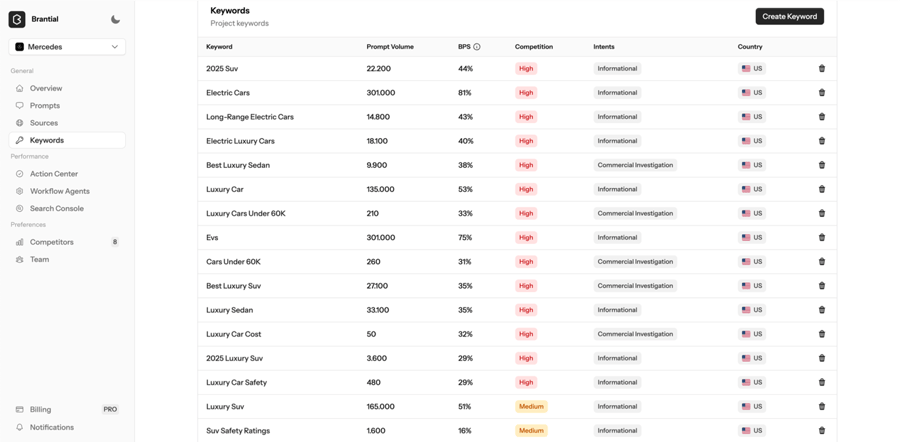
Short, clear, verifiable content with strong context forms the foundation of this visibility. To monitor whether your brand appears inside these answers, that is, your citation frequency, you can use ai visibility tools. Brantial is a fitting example.
With Brantial, you can check how both your own brand and your competitors appear across the models, and build data-driven strategies based on prompt volumes in the AI ecosystem as we move from keyword targeting to prompt answers.
Image, video, and multimodal GEO optimization
In 2026, generative systems analyze more than text; they process images, video, tables, and structured data together. This multimodal capability has widened GEO's scope.
-
Contextual descriptions for images
-
Video transcripts and topic clarity
-
Diagrams, tables, and comparisons
all help LLMs understand content more accurately. Content enriched multimodally gets referenced more often in AI answers.
Technical GEO in 2026: machine readability
While it does not fully replace technical SEO, the concept of technical GEO has moved to the foreground in 2026. The core goal is a site that is not merely crawlable but interpretable by machines.
-
Clear URL and content hierarchy
-
Structured data usage
-
Consistent internal linking and topic clusters
-
Speed and accessibility
These elements play a critical role in whether LLMs treat a site as a reliable source of information.
What should a GEO-ready content strategy look like in 2026?
In 2026, content strategy should be built on information architecture rather than production speed. GEO-ready content:
-
Focuses on a topic, not a single question
-
Serves not only user intent but also AI's need to generate answers
-
Delivers current, verifiable, well-sourced information
Blog posts, guides, and landing pages are now designed to produce AI visibility, not just traffic.
Answer intent replaces search intent
In GEO, the classic notion of "search intent" has expanded into answer intent. When LLMs decide on the user's behalf, they look for answers to these questions:
-
Who explains this topic most clearly?
-
Is the information consistent, or does it contradict itself?
-
Is the source trustworthy?
Content should therefore be structured to be fit for answer generation, beyond simply being informational, commercial, or navigational.

Local GEO and context-based visibility
Local SEO has evolved into context-based GEO in 2026. AI systems weigh more than location; they evaluate:
-
The user's context
-
Their previous questions
-
Their location-related needs
all together. For local businesses, visibility is therefore measured less by map rankings and more by presence inside AI answers.
From backlinks to knowledge signals
In 2026, link building has given way to the concept of the knowledge signal.
For LLMs, what matters is not just who links to whom, but:
-
Where the brand is mentioned
-
In which contexts it is referenced
-
How consistent the information is
GEO strategies should therefore be planned together with digital PR, expert content, and authority building.
Data analytics and visibility measurement in GEO
Classic traffic and ranking metrics are not enough for GEO. In 2026, measurement focuses on:
-
Frequency of appearing in AI answers
-
Citations and being selected as a source
-
Contextual use of the brand name
-
Prompt-level visibility
These metrics reflect the true performance of a GEO strategy.
A sustainable GEO approach for 2026
Sustainable GEO aims to build long-term information authority rather than chase short-term tactics.
Ethical, transparent content that delivers real value to users gets rewarded by both AI systems and people.
In 2026, digital success will come not from gaming algorithms but from being a trusted source in the production of knowledge.
Implementation checklist
Use the checklist below to turn the roadmap into operations. The items are grouped into four areas; each is the on-the-ground counterpart of the trends above.
Technical foundation
- Evaluate your server and infrastructure not only for speed but for accessibility, stability, and uninterrupted indexability. Continuous AI bot access to the site is critical.
- Your content management system must be able to output structured data, schema, and clean HTML.
- Keep URLs short, meaningful, and contextual; unnecessary parameters and arbitrary folder structures dilute content value.
- Configure your XML sitemap and robots.txt with AI crawlers' habits in mind, not just classic bots.
- Design the site with machine-first clarity; build a simple, logical hierarchy instead of complex navigation.
Content
- The benchmark for content production should be "will AI cite this" rather than "how much traffic will it get."
- Convert text into answer-ready formats with tables, lists, definitions, and examples.
- Define the core concept clearly in the introduction; LLMs use the first paragraph to establish context.
- Structure content as topic-based clusters close to the root domain; prefer deep topic pages under a single domain over subdomains or separate sites.
- Build internal links on semantic relationships, not keywords; connect new content to existing content to form a knowledge network.
- Provide clear descriptions and transcripts for video content; AI systems reference the text.
Off-site signals
- Ensure your brand name is mentioned consistently across trusted local and industry sources.
- Design promotional content as a knowledge contribution and expertise signal, not as a backlink play.
- In forums and communities, build a brand identity that answers and explains rather than chases links.
- Share content on social channels with its context; a bare link is a weak signal.
Measurement
- Track how often you are used as a source in AI systems instead of counting backlinks.
- Instead of chasing links from competitor sites, analyze the contexts in which competitors appear inside AI answers.
- Add platforms that measure AI visibility alongside classic tools like Search Console.
GEO cannot be managed without measurement
Measurement is where GEO breaks most sharply from classic SEO. A page's rank is a single number; a generative answer must be read across four layers at once: which questions the brand enters the answer for (coverage), where in the answer it is mentioned (position), in what tone it is mentioned (sentiment), and which sources feed the answer (source share).
Monitoring these four layers regularly is not a manual job. Webtures measures brand visibility against a category-specific question set with Brantial, comparing ChatGPT, Gemini, and Perplexity answers within the same framework. The most surprising output of this measurement is usually not coverage but source share: brands are often mentioned in the answers, yet the source feeding the answer is not their own site.
For the citation side of earned media, see digital PR for AI answers; for the transaction side of agent-assisted commerce, Agentic Commerce Readiness; and to benchmark how agents read your site, the AI Agent Readiness scan.
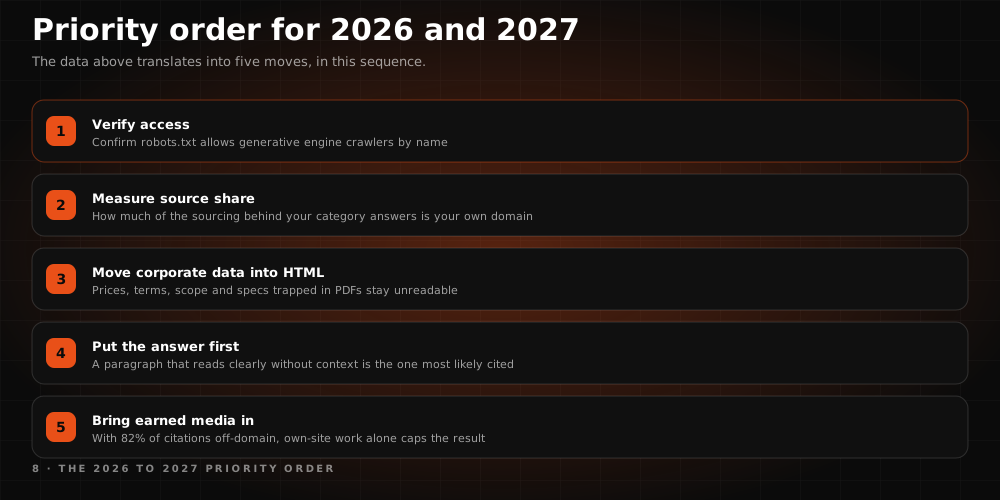
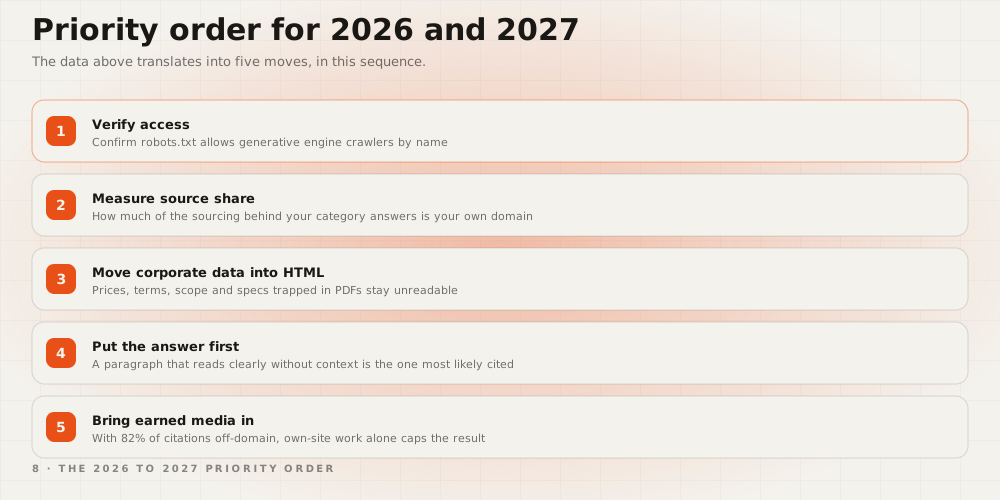
Priority order for 2026-2027
The data above translates into the following order of priorities.
- Verify access. First confirm that your robots.txt explicitly allows the crawlers of generative engines by name. While access is blocked, nothing else you do will produce results.
- Measure source share. How much of the sourcing behind the answers to your category questions is your own domain? GEO work done without knowing this number is aimless.
- Move verifiable corporate data into HTML. Prices, terms, scope, and technical specifications trapped inside PDFs or images are unreadable to the engines.
- Put the answer in the first sentence. A paragraph that reads clearly without context is the structure most likely to be cited.
- Bring earned media into the program. If 82% of citations come from outside your own pages, optimizing only your own site sets a ceiling on results.