2026 GEO Trends: Generative Engine Optimization and Brand Visibility
2026 GEO trends: answer engines, agentic commerce, Google's official AI guidance, maturing measurement and PR for citations; five moves to become an AI source.

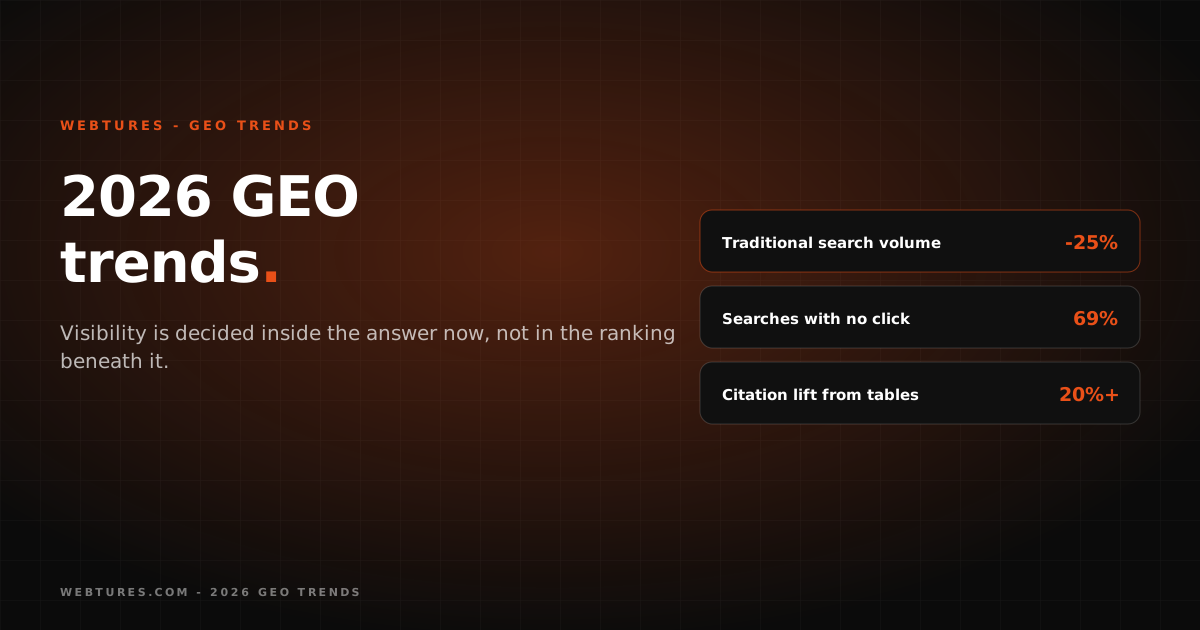
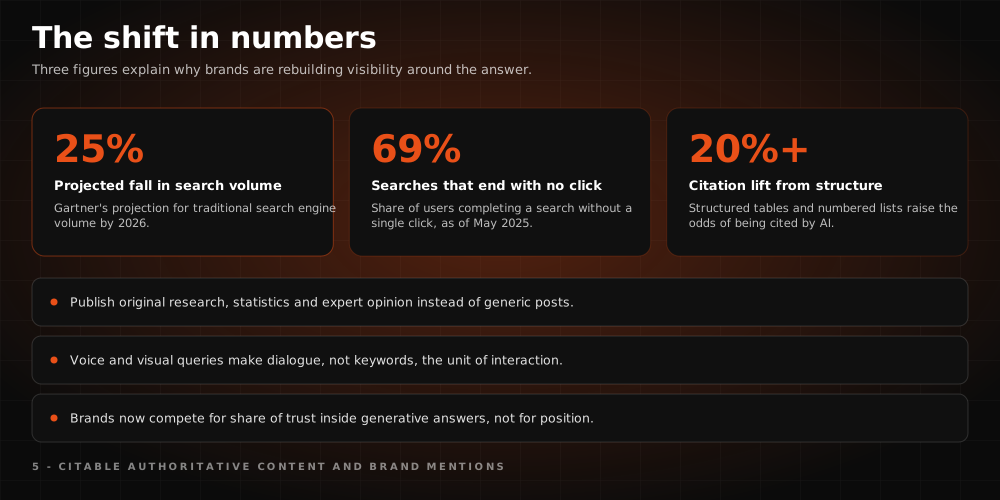
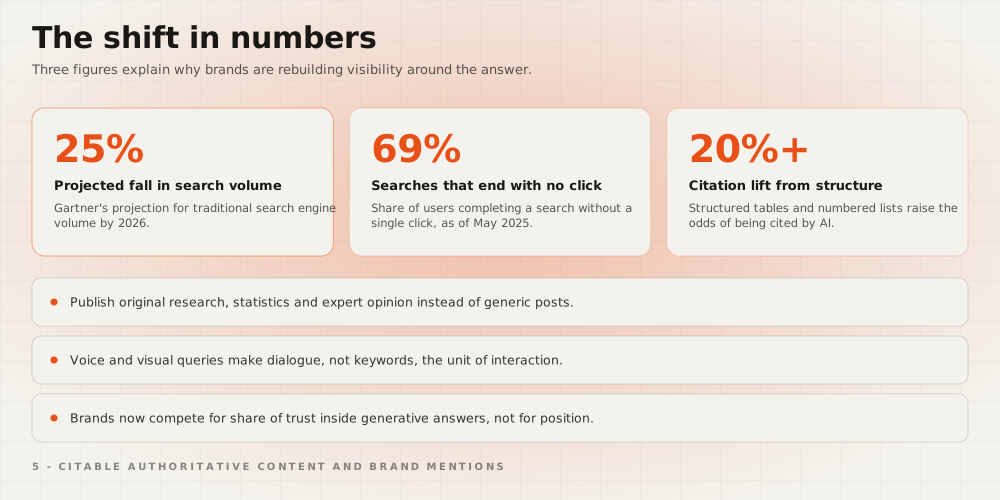
Connecting your brand with your audience is no longer just a ranking contest. It is a battle to be cited and recommended by artificial intelligence. Gartner projects a 25% decline in traditional search engine volume by 2026, and as of May 2025, 69% of users complete their searches without a single click. The goal is no longer to appear among the blue links. It is to stand as the single trusted source inside the synthesized answers produced by answer engines such as ChatGPT, Perplexity, Gemini, and Claude.
Below are the strategies for dominating visibility by speaking the language of AI models (LLMs) directly, rather than chasing algorithms.
Five trends that sharpened in the second half of 2026
The rows below summarise what became clear after the August 2026 version of this article; the detailed strategies follow in the sections below.
| Trend | What changed in 2026 | What to do |
|---|---|---|
| Agentic commerce | Purchases inside ChatGPT, the ACP and UCP protocols, AP2 payment mandates | Produce the product feed and page data from one source; measure agent readiness |
| Google's official AI guidance | AI Overviews and AI Mode rest on the core ranking systems; llms.txt is ignored by Google | Good SEO plus passage-level citability; llms.txt only as multi-engine hygiene |
| Measurement matured | Search Console generative AI report; the built-in GA4 AI Assistant channel (13 May 2026) | First-party data instead of estimates; server-side setup via GTM in the agent era |
| PR for citations | Most citations come from earned media, not the brand's own site | Original data and expert opinion instead of releases; digital PR for AI answers |
| New surfaces | Gmail Gemini summaries, LinkedIn's 360Brew ranking, agents that read email | Structural signals per surface; LinkedIn and the AI inbox |
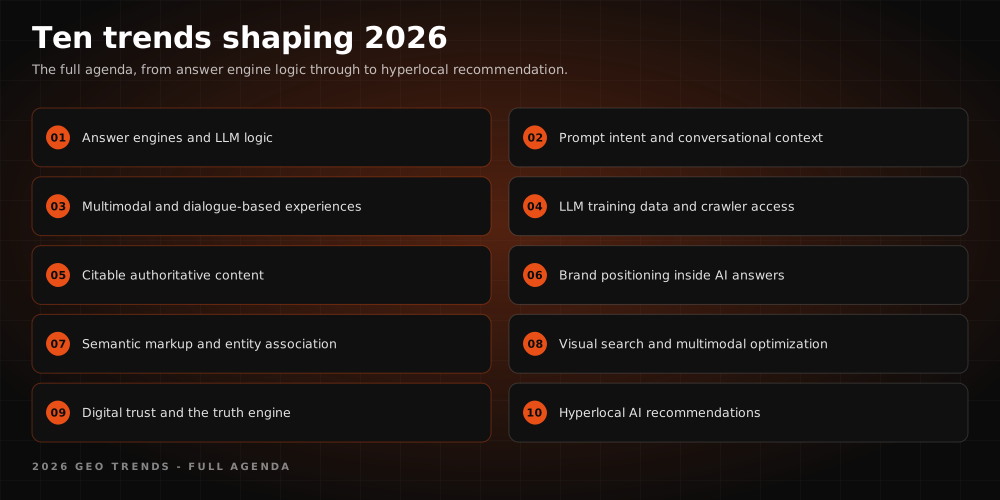
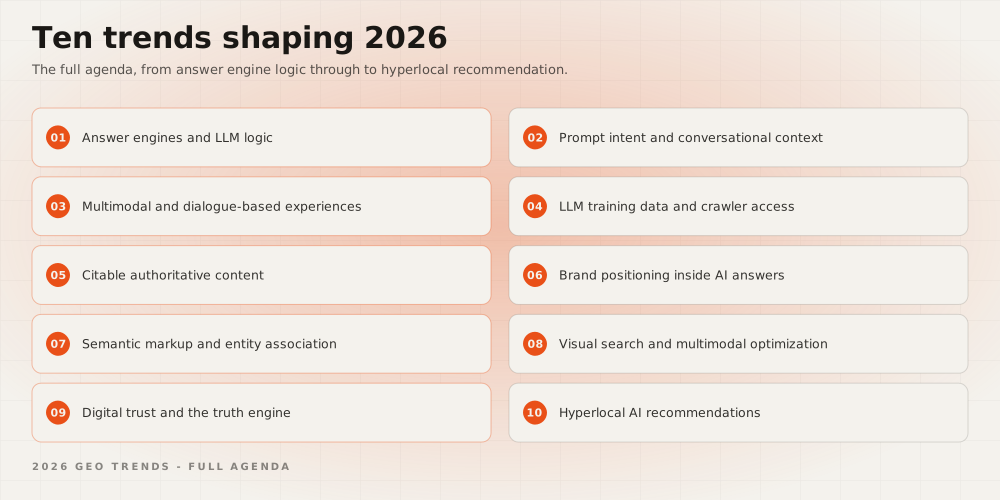
Understanding answer engines and LLM logic
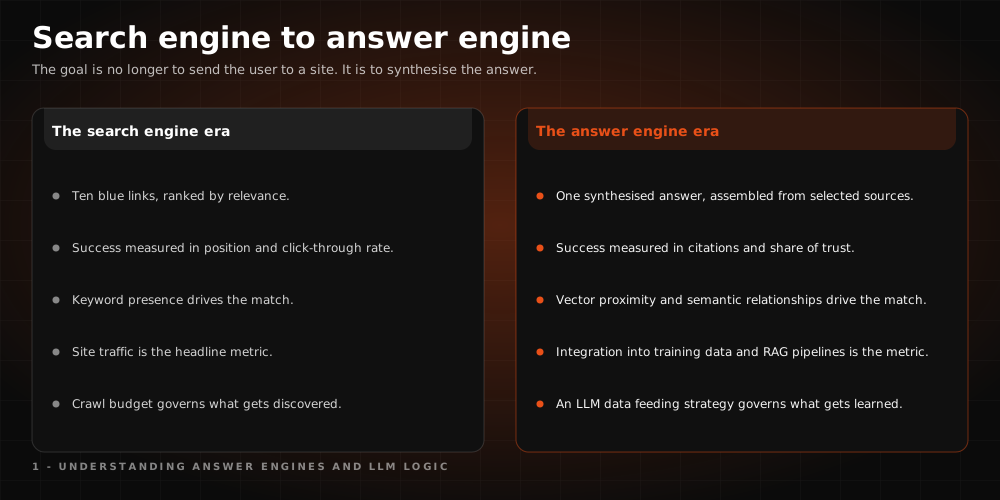
The primary goal of Google AI Overviews and other AI models is not to send users to a website but to synthesize the answer and deliver it directly. In this new era, the concept of the "search engine" has given way to the "answer engine." AI scans billions of data points, selects the information it judges to be accurate, and presents it to the user.
In our analyses at Webtures, we see that a brand's digital presence is now measured by how deeply it is integrated into the training data and RAG (Retrieval-Augmented Generation) pipelines of LLMs. What matters is less your site traffic and more whether AI models recognize your brand as an authoritative, hallucination-free source. As of 2025, brands are competing not only for visibility but to protect their share of trust inside generative answers.
Decoding prompt intent and conversational context
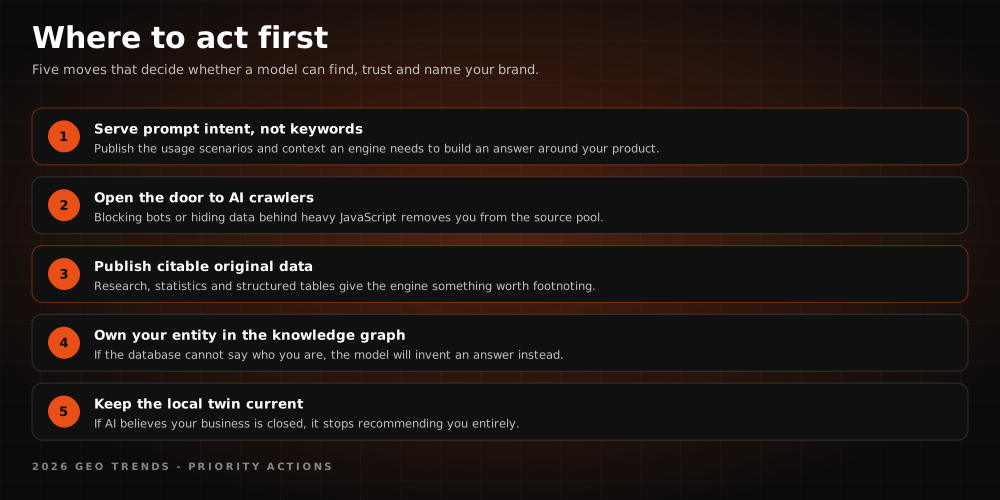
Traditional keyword tracking has given way to prompt intent analysis. Instead of static searches like "red shoes," users now ask complex, context-rich questions such as "What are some red shoes that are both stylish and comfortable for a weekend trip to Cappadocia?"
Your site's content structure must be deep enough to serve these long-tail, conversational queries. AI does not just check whether your content contains a keyword; it evaluates the semantic relationships between words, their vector proximity. If you run an e-commerce site, publish more than product specs: provide data that explains the scenarios in which a product is used, making it easy for AI to build context.
Adapting to multimodal and dialogue-based experiences
According to 2025 data, voice and visual searches account for a significant share of total query volume. The critical shift is that users are now talking to their devices. Interactions with Siri, Google Assistant, or ChatGPT Voice Mode have become dialogues rather than queries.
Your strategy should position the brand as the trusted recommendation inside these dialogues. Your content needs the structural integrity to answer a command like "Siri, find the highest-rated Italian restaurant near me and book a table," and it must be readable not only as text but by voice and image processing algorithms as well.
Entering LLM training data and controlling access
The concept of "crawl budget" has been replaced by an LLM data feeding strategy. How often and how deeply the Perplexity or OpenAI bots crawl your site determines your brand's future visibility. The biggest technical mistake we observe at Webtures is brands blocking AI bots entirely or hiding their data behind complex JavaScript.
For AI models to learn your content, you need clean code, a clear hierarchy, and flawless schema.org markup. Your information must be retrievable within the model's answer latency window; otherwise, even if you hold the most accurate information, a faster competitor will be shown as the source.
Citable authoritative content and brand mentions
The era of "content is king" is over; citations are now king. Generative AI cites sources in its footnotes to prove the reliability of the information it presents. In the world of GEO (Generative Engine Optimization), the new metric of success is how often your content is cited.
To stand apart from competitors, publish original research, statistical data, expert opinions, and structured data tables (HTML tables) rather than generic blog posts. Analyses show that structured tables and numbered lists increase the probability of being cited by AI by more than 20%. Your brand name should become synonymous with accurate information in your industry.
Positioning your brand inside AI answers
Being mentioned in answer engines matters, but the identity you are mentioned with matters just as much. AI systems prefer to reference sources that produce industry knowledge, analysis, and educational content over sources that only promote products. This positions the brand as an expert rather than a seller and increases the odds of being recommended in decision-stage queries.
Content structured in question-and-answer and FAQ formats raises the likelihood of being surfaced by automated answer systems. Direct question headings such as "how to," "what is," and "what are the benefits" make it easier for models to parse the content and use it as part of an answer. Clear heading hierarchy, consistent narration, and audience-specific solutions all feed this visibility.
Semantic markup and entity association
AI models perceive the world through entities and the relationships between them (the knowledge graph). Defining your brand, products, and authors as distinct entities prevents AI from hallucinating about them.
Go beyond rich snippets and take ownership of your brand's knowledge graph. If Google's or Bing's database does not clearly define who your brand is, what it does, and who it serves, AI can invent false information about you. Use structured data not just to earn stars in search results but to teach AI your brand's identity.
The evolution of visual search and multimodal optimization
Technologies like Google MUM and GPT-4o can analyze and interpret images and videos pixel by pixel. An alt tag is no longer enough; AI reads the image's content, its context, and its relationship to the surrounding text.
In a world where users search by pointing their phone camera at a product or a storefront, your visual assets must be high resolution, original, and contextually labeled. Transcribing the speech inside your videos and marking it with timestamps lets AI "watch" your video content and serve the specific answer it contains directly to the user.
Digital trust and accuracy: becoming a truth engine
E-E-A-T (Experience, Expertise, Authoritativeness, Trustworthiness) has become a vital filtering mechanism in the AI era. To protect themselves from fake news and manipulative content, AI models prioritize sources whose reliability can be mathematically verified.
As we emphasize in Webtures strategies, equipping your brand with academic references, verified user reviews, transparent author profiles, and industry certifications closes the trust gap for AI. You should act not just as a provider of information but as a truth engine that guarantees its accuracy.
Hyperlocal AI recommendations
Local search has evolved from "nearest cafe" to "recommend a quiet place for 8 pm tonight with vegan options and easy parking." To make that recommendation, AI looks beyond the map listing: it reads social media check-ins, current menu photos, user reviews from the last 24 hours, and even traffic data.
To grow your local visibility, your business's digital twin must stay current at all times. If AI believes your business is closed, it will not recommend you to millions of potential customers. Local GEO is the art of managing real-time data accuracy.
None of these trends can be managed without measurement. You can track which questions mention your brand, where you appear inside the answer, and how much of the sourcing behind those answers comes from your own domain with Brantial.