Google Assistant GEO guide
Learn how to prepare content for Google Assistant and Gemini voice search, with GEO principles that make your brand a citable source in AI-generated answers.

An important update: the shift from Google Assistant to Gemini
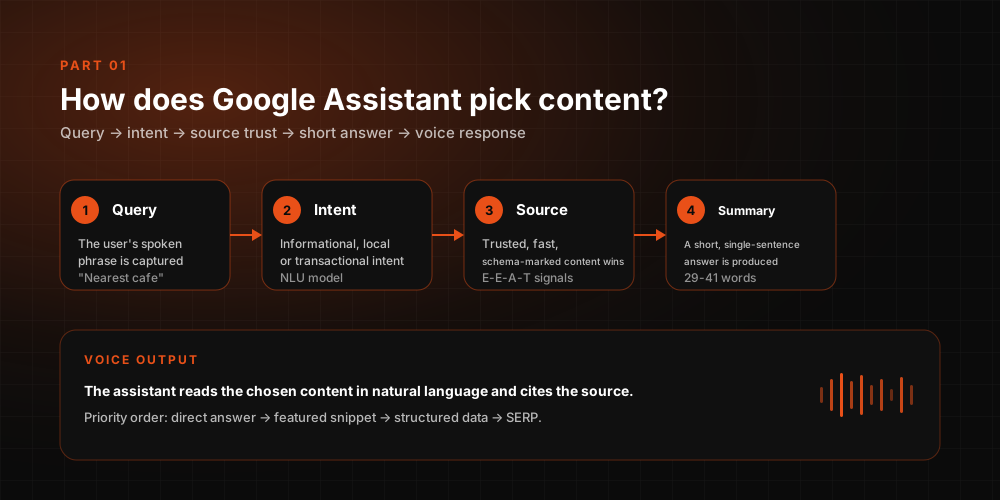
Before reading this guide, one development is worth knowing: Google is gradually replacing Assistant with Gemini. On new Android devices the default assistant is now Gemini, and the Assistant brand is being phased out. This does not invalidate the principles in this guide; it strengthens them. Content prepared for voice and dialogue-based search works by the same rules whether the target is Assistant or Gemini: a clear answer to a clear question, conversational headings, structured data, and paragraphs that stand on their own. Read the sections below with this transition in mind, and treat every mention of "Assistant" as shorthand for Google's voice surfaces, Gemini included.
In its early years, Google Assistant was seen as a tool users simply gave commands to. Today, merged with Google's AI models, Assistant has become an information hub that shapes users' daily questions, preferences and decisions. When a user asks about a topic, Assistant no longer just shows links; it scans multiple sources and generates a meaningful, concise, context-aware answer. In this new order, brands, content creators and organizations need to make themselves sources the AI can select.
What is GEO, and why is it critical for Google Assistant?
GEO takes a fundamentally different approach from classic visibility techniques. The goal is not to sit at the top of a ranking; it is to understand how the AI decides which information to use when generating an answer, and to prepare content that fits that behavior. Because Google Assistant answers the user directly, certain signals stand out among the content the model scans in the background: clarity, accuracy, source reliability, expertise and contextual coherence.
When a user asks Assistant "Why does my ankle hurt when I wake up in the morning?", Assistant builds an answer by selecting the most logical, most consistent and most summarizable information from hundreds of web pages. What matters is which source proves more reliable in the answer-generation process and easier for the AI to process. GEO exists to optimize exactly those criteria. Because of how Google Assistant works, content must be prepared not just to be read, but to be digested, verified and regenerated by machines.
That is what turns GEO from an option into a requirement for Google Assistant. In a period when AI-generated results heavily influence user behavior, brands need to position themselves as selectable sources.
How does Google Assistant work? The background logic from a GEO perspective
Understanding how Google Assistant works clarifies why a GEO strategy is necessary. Assistant is no longer just a voice search app. Google's latest LLMs power its core, analyzing user intent to produce the answer that delivers the most value with the least effort.
Three components play a critical role in how Google Assistant generates answers:
First, Google's Knowledge Graph is still used heavily. It verifies a brand's core information, areas of expertise, locations and product categories. A brand missing from the graph, or listed with outdated information, cannot position itself as a sufficiently trustworthy source in Assistant's eyes.
The second component is how crawlable and summarizable web content is for AI. Whatever format the user's question takes (text, voice, dialogue), Google Assistant analyzes the whole web to produce the best answer. That process needs content that is not just readable but learnable. This is exactly where GEO comes in, making content easier for AI to understand.
The third component is AI safety and content reliability. Google checks quality, accuracy, expertise and risk before using content in AI results. In YMYL categories such as health, finance and law, Google Assistant draws only on trusted, competent sources. One of GEO's most critical functions for businesses is precisely this: making content safe, verifiable and authoritative for AI.
At this point, brands need advanced measurement tools to analyze how AI perceives them, which question clusters they appear in and in what role, and how strongly they are represented inside generative answers. Brantial is an AI-visibility platform that examines brand presence across AI-driven search surfaces such as Gemini, Perplexity and ChatGPT. It analyzes when, in what context and on the basis of which content signals AI models use a brand, and maps out where the brand is strong and where it falls short. With that data, a GEO strategy stops being theory and becomes a real, measurable, continuously optimizable process.
How to prepare GEO-friendly content for Google Assistant
The core principle of GEO-friendly content is making it easy for AI to extract meaning. Writing for humans and writing for AI are not the same discipline. Google Assistant finds it easier to summarize and use content that is cohesive, consistent, logically sequenced and covers every angle of a question on the same page.
Clarity is fundamental in GEO-friendly content. AI has little tolerance for vague phrasing. Instead of hedged statements such as "this condition may appear in some people", provide clear, well-defined information anchored in context.
Expertise signals are among GEO's most important criteria. When Google Assistant evaluates the source of a piece of information, it examines the competence of the person or organization behind it. Author information, institutional credentials, methodological explanations, referenced statements and verifiable claims all register as positive signals.
Content architecture also plays a critical role. Each subheading should answer one question, subheadings should build on each other, and user intent should deepen step by step. Google Assistant struggles to assemble a scattered structure into a whole, which makes deliberate structuring vital.
Technical and structural requirements for Google Assistant
Technical soundness matters as much as content quality. Before using a piece of content, Google Assistant examines its technical integrity and markup.
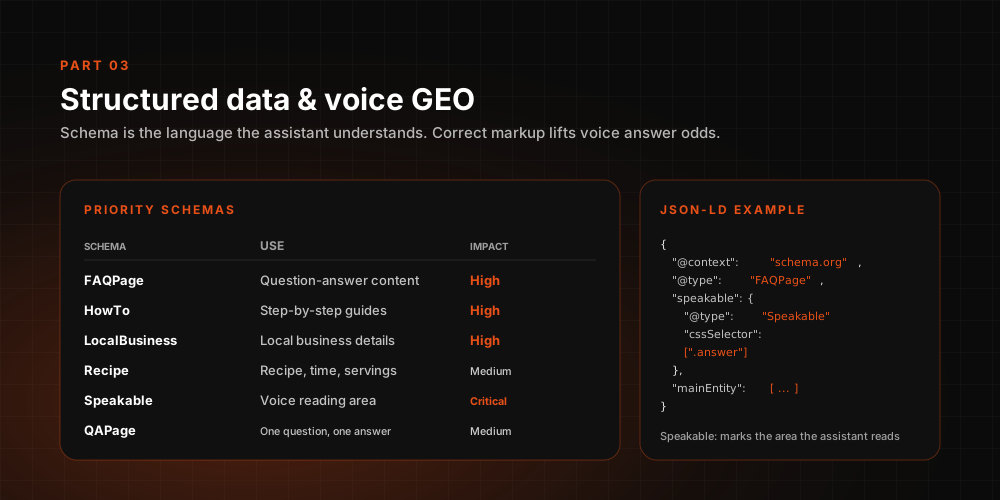
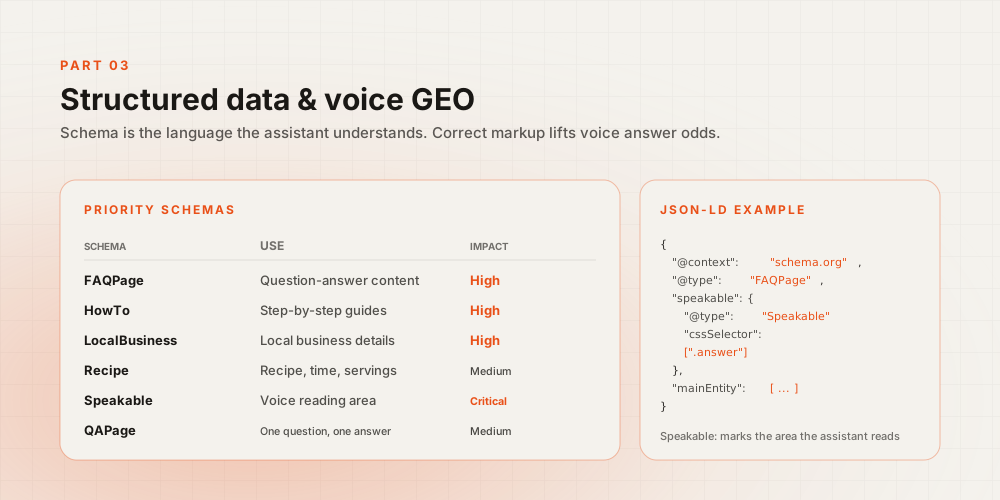
The first element is structured data markup. Markup helps Assistant understand and contextualize the information on the page. Marking up a question-and-answer format, or clearly declaring an organization's structural details, lets Google Assistant process that data with far less friction.
Another important structure is the explicit summary. Short, meaningful summaries at the top of the page and under subheadings make it easier for Google Assistant to quote the content directly. AI models show a clear preference for these crystallized blocks of information.
Plain, linear language is also critical. Layered, ornate or densely academic prose is among the hardest content for AI to process. GEO-friendly content uses language with clear semantic relationships, free of unnecessary metaphor and decoration.
One more factor matters for GEO: consistency across the brand's digital ecosystem. Google Assistant compares not only the information on the page but the brand's other digital profiles. Inconsistent facts, mismatched dates and incomplete corporate descriptions can all lead Google Assistant to judge the source unreliable.
Understanding user intent: the logic of Google Assistant queries
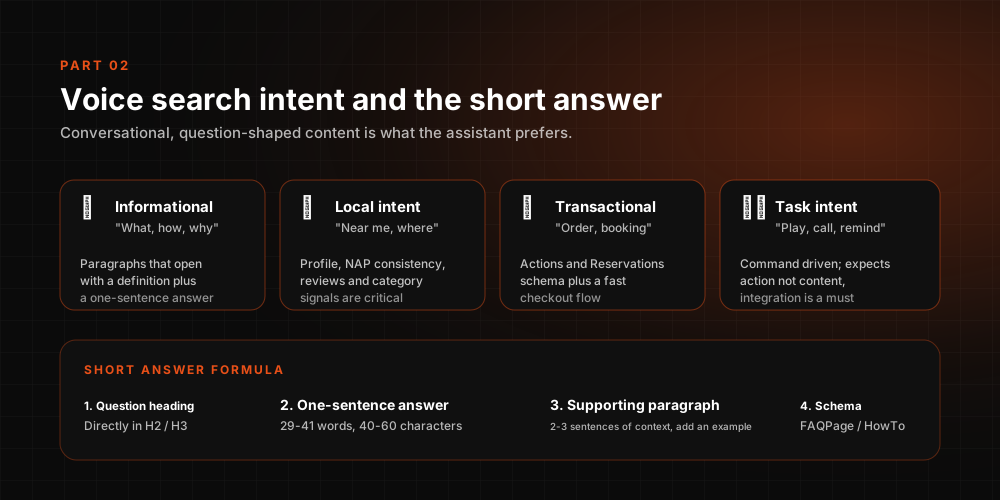
Google Assistant is designed to sit as close as possible to natural spoken language, so its queries look very different from typed searches. Users tend to form long sentences, combine several intents in a single question and often expect follow-up explanation.
Users ask things like "Can you explain this to me the easiest way?", "Which one would be better for me?", "Why does this happen?" and "What can I do about it at home on my own?". Queries like these push the AI toward specific content types. The content it prefers:
- defines a clear problem,
- presents cause-and-effect relationships,
- includes practical explanations,
- guides the user through a step-by-step flow,
- gives direct information instead of vague statements.
GEO-friendly content should anticipate the logic of these queries and settle naturally into their language. The goal is not to answer a single question but to build broad, cohesive content that covers every sub-question attached to it.
Strategic recommendations for Google Assistant
Over the next few years, Google Assistant's role will keep expanding. It is moving from a tool that provides information to a guide that shapes users' daily decisions. That makes GEO a long-term requirement for brands.
The most critical step for brands is redesigning content processes around an AI-first mindset. Content must be readable for humans and, at the same time, easily processable by AI. A clear information architecture, a strong reference structure and plain, direct writing form the foundation.
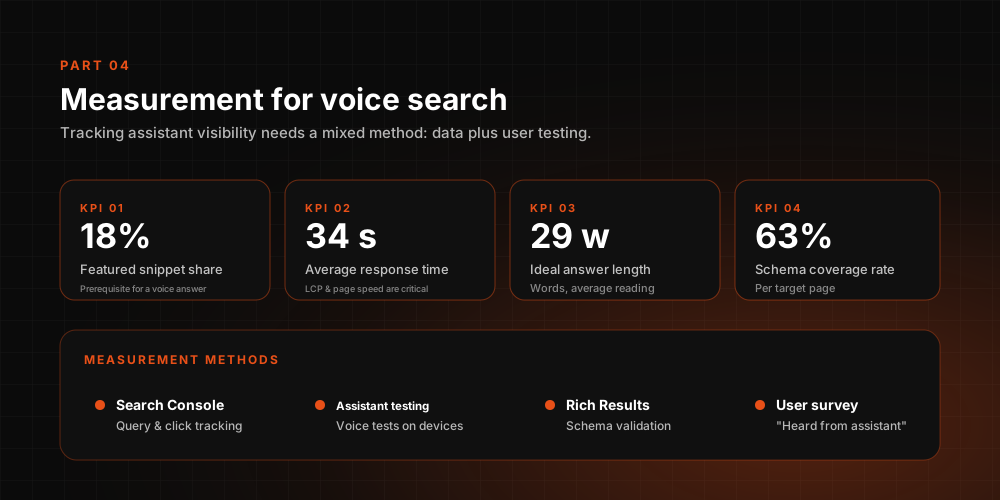
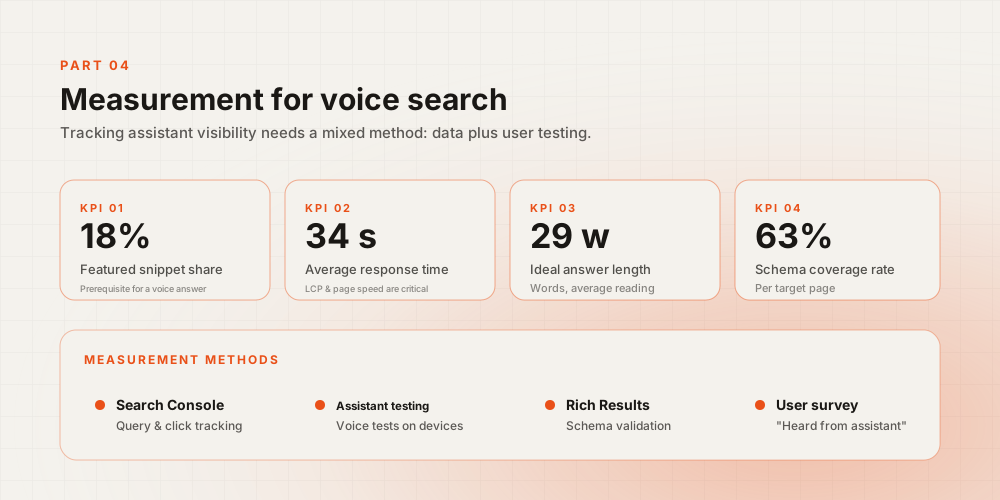
Another important practice is continuously testing your own visibility on AI platforms. Check regularly how Google Assistant summarizes a page, which sections it surfaces and where it loses context. GEO is a dynamic process and demands continuous improvement.
AI-assisted search will spread into every part of daily life. Brands therefore need to make their content more transparent, more explanatory and more cohesive. A GEO-friendly content strategy is the most effective way to appear in Google Assistant's answers.