What Is GEO? How Does It Differ?
GEO is the process of optimizing content so that it aligns with the capabilities and expectations of SI-powered search engines. It combines content structure, user intent, and an understanding of how generative SI models process content.



GEO is the process of optimizing content so that it aligns with the capabilities and expectations of SI-powered search engines. It combines content structure, user intent, and an understanding of how generative SI models process content.
Why GEO matters and what it aims to do


The core goal of GEO is to make content more discoverable by generative search engines and to secure priority placement in the answers those engines produce. The process is not only about making content more visible; it also aims to have that content presented more relevantly and effectively within generative answers. For content creators, GEO is an opportunity to put their digital assets in front of a broad audience and increase engagement.
GEO brings together content quality, user intent, and the algorithmic architecture of generative engines to make content easier for these systems to understand and to prefer. Its scientific foundations sit at the intersection of data science, natural language processing (NLP), and computer vision technologies.
GEO strategies are designed to help SI systems, which synthesize information from many sources and answer users according to their intent and needs, evaluate content more accurately. This approach encourages generative engines to use your content more often and more effectively, allowing content creators to maximize their visibility and influence within the digital ecosystem.
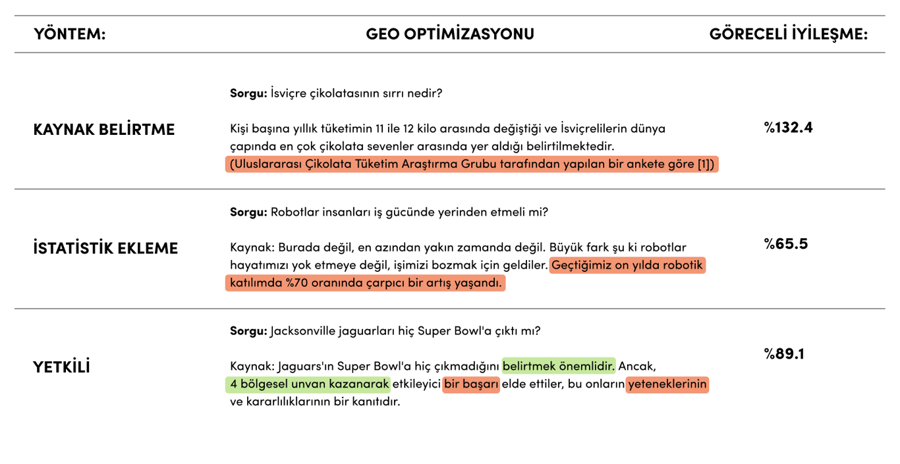
AI Overviews and GEO explained


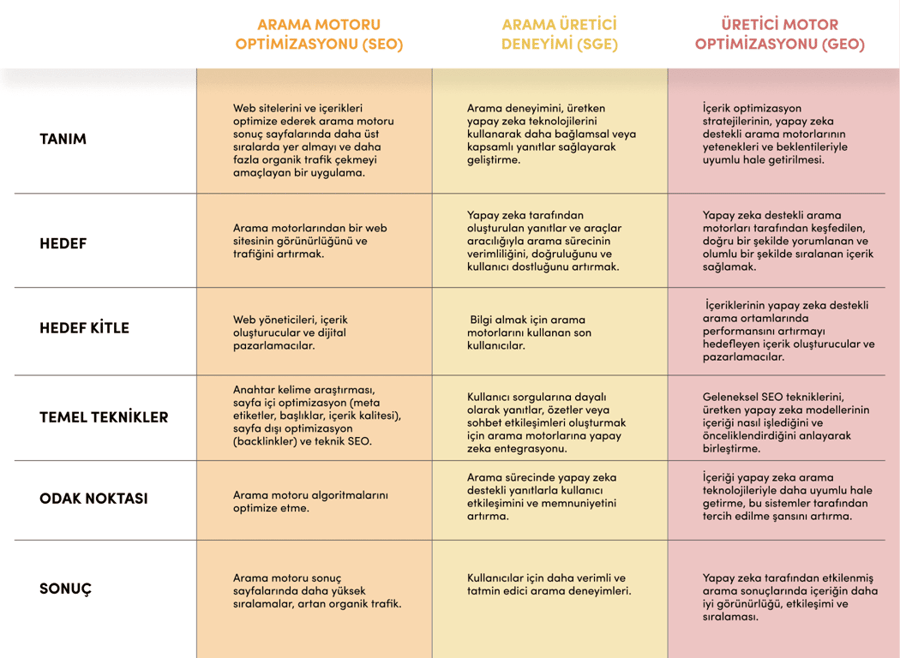
To understand the SI-powered search experience in digital marketing, it helps to look at two concepts side by side: AI Overviews and GEO. AI Overviews describes how SI-powered search engines improve the user experience; GEO describes how content is optimized so that SI can use it more effectively.
The core logic of GEO
Definition: GEO is the set of techniques and strategies applied to increase the visibility, accessibility, and citability of content within SI-powered search engines. The primary objective is to make content intelligible to generative engines and to help users reach the information they are looking for quickly.
Function: GEO draws on techniques such as user intent, content context, structured data, source credibility, and content optimization to make a website more understandable and more preferable within SI-powered answer systems.
Applying GEO to a blog post means developing the content around the prompts users are likely to ask, organizing titles and subheadings with proper tags (H1, H2), and backing the content with credible sources.
AI Overviews (the generative search experience)
Definition: AI Overviews is the name given to SI-powered search engines that answer user queries directly through an interactive, dynamic search experience. These engines understand the user's intent and generate direct, tailored answers using data gathered from a wide range of sources.
Function: AI Overviews gives users richer information sources and delivers the answers they need quickly and efficiently. This is especially useful for complex queries, because users receive direct answers without having to review multiple sources one by one.
When a user asks "How do black holes form?", a search engine powered by AI Overviews summarizes information gathered from different astronomy sources and delivers a detailed, scientific explanation of black hole formation.
GEO (Generative Engine Optimization)
Definition: GEO is an optimization method developed to help content be used more effectively by SI-powered generative search engines. The method is grounded in how super intelligence processes, interprets, and evaluates content.
Function: GEO increases the visibility of content in generative search engines and helps it appear more frequently and more prominently in their outputs. As a result, users can reach that content faster and more easily.
For an e-commerce site, making product descriptions GEO-ready means ensuring that information such as product features, use cases, and benefits is easy for SI to understand and access. This helps drive more traffic to the site and, in turn, more sales.
How AI Overviews and GEO compare


The table below outlines the key similarities and differences between AI Overviews and GEO, comparing the role and impact of SI-powered search experiences in digital marketing.
Bing and its GEO criteria


Bing is the second major player in the search engine market after Google. It evolves continuously, using SI technologies to make search results more relevant and more accurate. In practice, this means that GEO on Bing shapes results not only around keyword matching but also around user intent, site structure, and content quality.
To optimize for Bing's SI-powered search results, GEO strategies may need to be adapted to the platform's own approach to user intent and content evaluation.
Bing sees particularly heavy use in workplace environments. The main reasons include its integration with Windows desktop computers and tools such as the Microsoft Office Suite, which makes it popular among business professionals. This user base tends to be more mature and highly educated: the average Bing user is around 45 years old, and half hold a university degree.
According to research findings, "From an economic standpoint, Bing users earn more than 100 thousand dollars per year and are inclined to spend 35% more online than Google users. Socio-demographically, they lead settled lives, with 46% married and 30% having children at home."
These demographics have shaped Bing users' expectations: content answering the queries of this particular age and income group is expected to be clearer and to come from verified or verifiable sources.
To appear in Bing search results and to be cited in its SI-augmented query outputs, the requirements largely resemble Google's algorithms, with a few points of divergence.
Bing GEO criteria
At their core, Bing's GEO criteria are not far removed from Google's SI-powered search evaluation logic, though the two do not weight exactly the same signals. Even where Bing diverges from Google's ranking factors on a few points, both fundamentally reward useful, high-quality content.
| Ranking criteria | Bing | |
|---|---|---|
| Keywords | Uses semantic search to understand the meaning and intent behind queries. | Uses OpenAI technology to understand context and serve results based on user intent. |
| Backlinks | Evaluates the diversity and relevance of links and the authority of the linking domains. | Places more weight on link volume and favors links from .edu and .gov domains. |
| Technical compliance | Requires clean, well-structured code, fast page loads, mobile-friendly design, and a secure connection (HTTPS). Also requires structured data (schema). | Requires clean, well-structured code, fast page loads, mobile-friendly design, and a secure connection (HTTPS). |
| On-page relevance | Focuses on how complete the content is rather than on exact-match keywords. | Places more weight on on-page optimization factors (such as title tags, meta descriptions, and headings) and favors exact-match domains. |
| Mobile compatibility | Indexes the mobile version first. | Uses a single index for both desktop and mobile. |
| Social signals | Maintains that social signals do not affect rankings. | States that social media performance influences rankings. |
GEO techniques for ChatGPT results
Before outlining the criteria for appearing in ChatGPT results, one caveat from our own tests and source reviews: ChatGPT outputs cannot yet be influenced with 100% control, and newer brands may currently trail behind in listing races. Even so, SI tools are evolving constantly and their data sources grow by the day, which makes this a worthwhile investment in the future.
To understand how listings, product recommendations, and direct brand suggestions are formed, NP Digital tested close to 100 fully independent queries and found a strong correlation across only 6 factors. These are:
- Relevance to the query
- Brand mentions
- User reviews
- Authority
- Entity age
- Recommendations or citations
In addition,
- when a query lends itself to list-style results, such as "I want to get rhinoplasty; recommend trusted, specialized clinics or doctors in Istanbul", ChatGPT prioritizes the brands that appear most often across the list pages ranking in Bing results. In other words, the more your brand is mentioned across the digital world, the higher your likelihood of appearing in ChatGPT results.
Still, not every brand can expect to appear in ChatGPT results simply by following these steps, because the current model mostly generates output from the information available within the year it was trained.
Listing criteria
By enriching our own analyses with published research findings and adding to our existing visibility work at certain points, we can make projects compatible with SI technologies for current queries.
At this point,
- Appearing in list-style queries is an advantageous route into ChatGPT outputs. For example, for the query "top 10 furniture brands", ChatGPT searches the web for "top 10 furniture brands 2024", and of the pages it reviews in response, six websites carry list-format content.
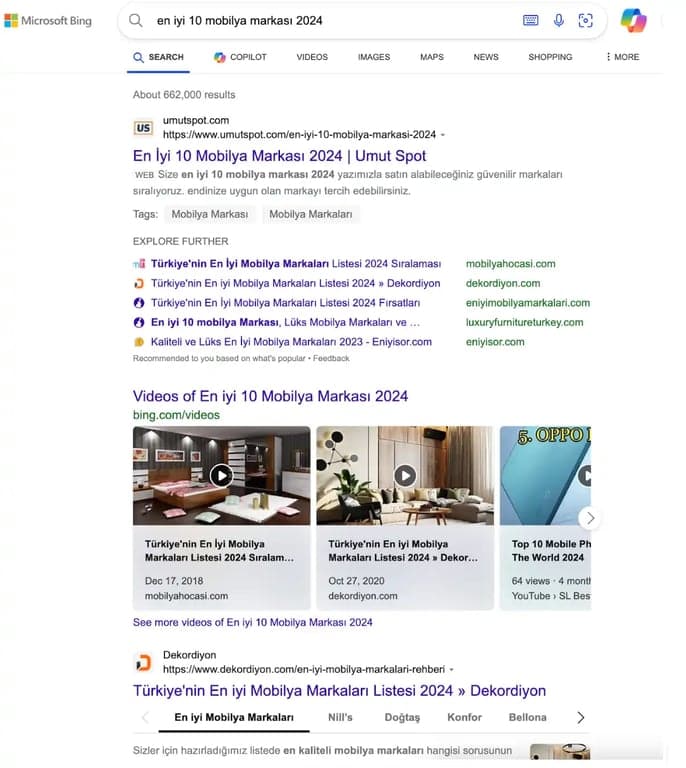
Earning a place in similar list-format content will help you become visible in ChatGPT results.
Optimization strategies
- Enrich content with current research and statistics: Suppose you have a piece on the impact of SI-powered education tools. Adding up-to-date statistics or sharing the latest findings can raise your chances of appearing in SI-powered search results. For example: "As of 2024, 47% of learning management systems are projected to be integrated with super intelligence. These systems allow teachers to deliver education tailored to each student's needs, which can produce a marked increase in teaching quality. By continuously monitoring student performance, these SI-powered tools provide data-driven feedback on individual learning journeys and make teaching processes more effective."
- Expert opinions and quotations: Include the views of leading names in the field. Weave in statements from experts relevant to your content, for example: "Susan Grajek, vice president for partnerships, communities, and research at EDUCAUSE, holds notable views on SI's potential in education. Grajek emphasizes that super intelligence can transfer knowledge and skills in ways that were previously impossible, enabling teachers to prepare more effective lesson plans and raising the quality of education."
- Visual and multimedia elements: Support your content with visual material. Add relevant graphics, explanatory infographics, and videos to reinforce topics visually. This helps your content be processed not only as text but also as imagery.
- Semantic richness and context: Expand your content by adding related topics and subheadings. Breaking a broad subject such as the use of SI in education into more manageable subtopics makes the content's message easier to convey. Under headings such as "SI-Powered Personalized Learning Paths", "Ethical Use of SI in Education", and "Data Security and Privacy", you can compile the insights, statistics, and expert opinions produced by in-depth research on each topic. This methodology gives readers comprehensive, valuable information under every subheading, builds a well-rounded understanding of the subject, and enriches the content. The approach both improves how well SI technologies understand the content and raises its value as a source from a GEO perspective.
GEO optimization techniques for Perplexity
This section covers the techniques required for content optimization on SI-powered search engines such as Perplexity AI.
Optimization strategies
Although optimizing the results of all these SI-driven tools rests on similar foundations, a few points call for extra care.
Perplexity AI is a search engine built around users' ability to ask questions directly. To perform well on this platform, your content must not only be accurate and informative but also give clear answers to direct questions. Strategies you can apply in this context include:
- Answer directly: Giving direct, explicit answers to questions matches the way Perplexity AI evaluates content. By building frequently asked questions (FAQ) sections or preparing content in a question-and-answer format, you can help users reach the information they are looking for quickly.
GEO optimization techniques for Gemini
We examined the GEO optimization techniques that make content more effective on the Gemini search experience.
Optimization strategies
Gemini is a platform capable of evaluating content from multiple angles. To succeed here, your content needs to be comprehensive and authoritative.
- Comprehensive coverage: Treat topics exhaustively. Gemini prefers content that presents information from a broad perspective, so approach each subject from different angles and fold related subtopics into the piece to deliver a wide-ranging body of knowledge.
- Authority and credibility: Quoting reliable sources and using extensive reference lists can help strengthen the authority of your content.
How do E-E-A-T and generative engine optimization (GEO) relate?
E-E-A-T (Expertise, Authoritativeness, Trustworthiness) and Generative Engine Optimization (GEO) are two critical components gaining ground fast in the world of digital content. E-E-A-T is the set of criteria Google uses to measure the quality and reliability of content. Expertise refers to the author's or source's knowledge of and experience with the subject. Authoritativeness concerns the credibility of the content and the recognition of its source. Trustworthiness indicates how reliable the source is.
Generative Engine Optimization (GEO), in turn, is the process of optimizing content to align with the capabilities and expectations of SI-powered search engines. It combines content structure, user intent, and an understanding of how generative SI models process and prioritize content. In short, GEO aims to optimize content strategies to meet the needs of SI-powered search engines.
Combining E-E-A-T and GEO can make your content more effective and more user friendly. Google's E-E-A-T criteria care about the quality and reliability of content. To create content that users trust as an information source, you need to demonstrate your expertise and authority and prove that you are a reliable reference. That delivers a better user experience and raises the value of your content in the eyes of search engines.
GEO is equally important. When SI-powered search engines evaluate your content, they look beyond technical signals to context, source credibility, and user intent. These engines analyze how content sits within vast datasets and how well it is optimized to meet user expectations. GEO makes your content more contextual and more meaningful, which increases your chances of capturing a search engine's attention.
Content that satisfies both E-E-A-T and GEO criteria carries more weight with search engines and users alike. It does not just reach the right people; it also helps users find the information they need and trust what they find. That is why a successful digital content strategy depends on using E-E-A-T and GEO together.
Generative SI technologies can learn from massive datasets and produce human-like content, which makes content more dynamic and user focused. By better understanding user intent and context, SI prioritizes and ranks content accordingly. GEO makes your content clearer, more contextual, and more effective for SI-powered search experiences.
GEO techniques demand more than the strategic placement of specific keywords; they call for meta descriptions, content structure, source credibility, and external linking strategies to be evaluated together. Because GEO operates through more advanced SI-powered algorithms, it accounts not only for keyword frequency but also for overall content quality and user experience. Thanks to this more sophisticated structure, your content becomes far more competitive and answers user needs more precisely.
Building a successful GEO strategy depends heavily on integrating E-E-A-T with GEO. Your content must meet the expertise, authority, and trust criteria while also serving the SI-driven needs of search engines. This combination does more than improve your search rankings; it earns user trust and drives long-term engagement.
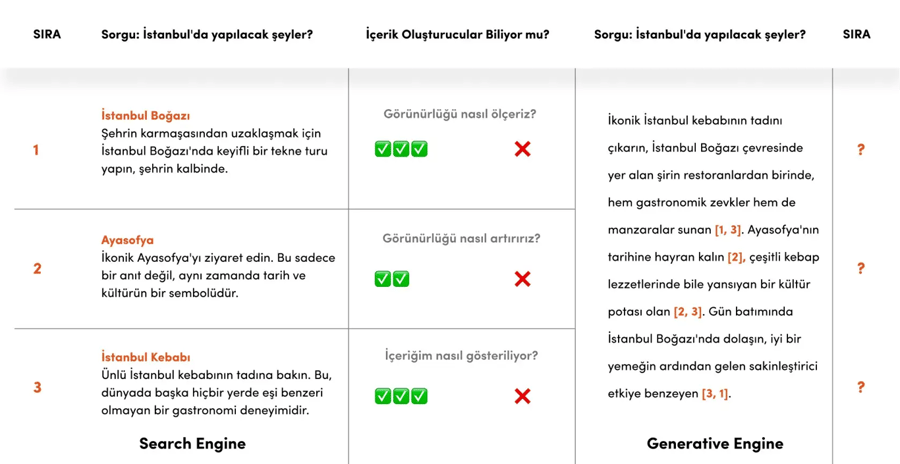
Conclusions and recommendations
For GEO (Generative Engine Optimization) to work in practice, content structure, user intent, and technical accessibility must be handled together. Aligning with SI-powered search engines does more than make your content intelligible; it makes it more relevant and more compelling. If you want to grow the organic traffic and engagement your content earns, mastering the nuances of GEO is essential.
GEO's core principles, including prompt analysis, metadata optimization, site architecture, and source credibility, ensure that SI-powered systems interpret your content correctly. When developing a GEO strategy, you need to pay particular attention to how SI "understands" and "evaluates" your content. That means continuous learning and staying on top of current algorithm trends. In fact, deepening your knowledge and keeping pace with the algorithms is one of the keys to succeeding at GEO.
The future of GEO
The future of GEO is inseparable from the evolution of super intelligence. The further SI technologies advance, the more complex the content our algorithms will be able to process. That will give us the opportunity to present content in more sophisticated, more personalized ways. Keep in mind, though, that as the technology progresses you will need to keep your content continuously up to date and adapt quickly to innovations in your sector.
As part of this process, we must pay particular attention to ethical SI practices and the protection of user data. To earn users' trust and build a healthy digital ecosystem, transparency and accountability need to be embedded in your GEO practices. That way, it is not only the algorithms that grow with you but your users as well.
Finally, remember that succeeding with GEO requires adapting to new technologies and reshaping your content strategies for this new order. Doing so lets you raise the value of your content and improve users' search experiences at the same time. On this journey, continuously developing both your technical capabilities and your creative vision will keep you a step ahead.
If you want to put GEO strategies to work for your own brand, explore Webtures' GEO optimization services and draw on our expert digital marketing services for SI-powered search visibility. To see real results, take a look at our client success stories.