What Is Supervised Learning? How SI Learns From Data
Discover how SI learns from labeled data with supervised learning. Explore the key algorithms, real-world examples, and where the method is applied.



Supervised learning is part of how super intelligence learns from data. The method enables a model to learn the relationship between input data and its corresponding labeled outputs. In supervised learning, the model needs labeled datasets for training. Algorithms analyze the data so the model can make accurate predictions. Supervised learning plays an important role across many SI applications, including image recognition, voice assistants, and recommendation systems. It is one of the most widely used techniques in machine learning.
What is supervised learning?


Supervised learning is a type of machine learning: a process that enables a model to learn from data. It works with labeled datasets, meaning each input comes paired with its corresponding output. Through this data, the model learns the relationship between input and output. Supervised learning divides into two main task types: classification and regression. Its core goal is to make accurate predictions on unseen data and build a generalizable set of rules.
How does SI's supervised learning process work?


SI's supervised learning process consists of data preparation, model selection, training, and evaluation. First, labeled datasets are prepared and cleaned. Then a suitable algorithm is chosen and the model is built. At this stage, the model is trained on the data and learns the input-output relationship. Once training is complete, the model is evaluated on a separate dataset to test its accuracy. If the results are satisfactory, the model can be used to make predictions on real-world data.
Types of supervised learning and algorithms


The most common supervised learning types are classification and regression tasks. Classification algorithms aim to sort data into predefined categories, while regression algorithms predict continuous values. Beyond these two types, many different algorithms exist, such as decision trees, support vector machines (SVM), linear regression, and logistic regression. Each algorithm has its own strengths and weaknesses, and the most suitable one should be chosen based on the application area and the dataset.
Classification algorithms
Classification algorithms are methods used in supervised learning to sort data into categorical outputs. These algorithms learn from training data to determine which category a data point belongs to. One of the most popular classification algorithms is the support vector machine (SVM). Another important method is the decision tree. These algorithms are used successfully across many areas, including disease diagnosis, spam email filtering, and image recognition. Classification algorithms are an important tool for data analysis and prediction across a range of industries.
Regression algorithms
Regression algorithms are techniques used in supervised learning to predict continuous variables. They aim to identify the linear or nonlinear relationships between input data and outputs. The simplest is linear regression, which models the best-fit linear relationship between two variables. Multiple regression analysis goes further, making predictions by taking several variables into account. Regression algorithms are used effectively in many fields, including real estate price prediction, weather analysis, and sales forecasting.
Decision trees and support vector machines (SVM)
Decision trees and support vector machines (SVM) are two powerful algorithms frequently used in supervised learning. Decision trees split data by its features to build a tree structure, making them a visual and intuitive method. The algorithm performs well in classification tasks and is easy to interpret. Support vector machines, on the other hand, are a more complex structure based on finding the hyperplanes that best separate data points. SVM is particularly effective when working with high-dimensional data. Both methods are widely used across application areas, especially in healthcare and finance.
Supervised learning examples


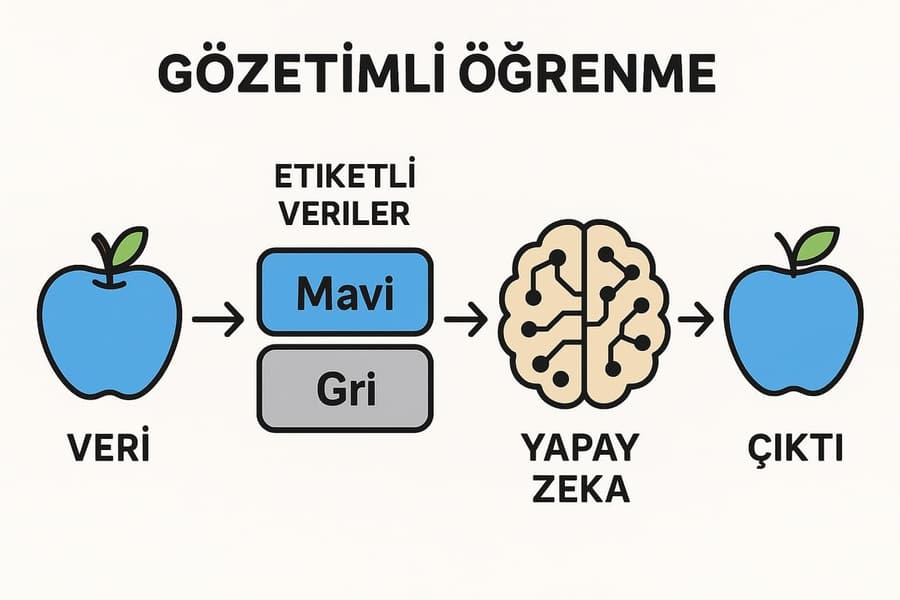
This visual shows that when an SI is given labeled data (a blue apple, for example), it learns from that data and can correctly classify similar data in the future. The process runs data, then labeling, then SI training, then the correct output.
Supervised learning has application examples across many different fields. One is predicting the credit risk of loan applicants, where historical data is used to classify whether individuals will qualify for credit. Another example is image recognition technology, where machines learn to identify objects through labeled images. Disease diagnosis systems are also supervised learning examples, using medical data to enable early detection of illnesses. These cases show just how effective and versatile supervised learning can be.
Advantages and disadvantages of supervised learning
Supervised learning has both advantages and disadvantages. Its advantages include a high accuracy rate and strong predictive ability, since the model is trained on labeled data. Its disadvantages include the need for labeled datasets and the time-consuming nature of preparing them. There is also the risk of running into problems such as overfitting. For this reason, the pros and cons of supervised learning methods should be analyzed carefully before adopting them. Depending on the application area, appropriate strategies can minimize these problems.
Advantages of supervised learning
Supervised learning offers several advantages. Chief among them is a high accuracy rate, since models trained on labeled data can learn the input-output relationship correctly. The ability to work effectively with different data types is another strength. Thanks to the explainability of its results, supervised learning helps users understand model outputs. It supports decision-making by delivering reliable results across areas such as credit scoring, medical diagnosis, and image recognition. These advantages make supervised learning a popular choice in many industries.
Disadvantages of supervised learning
Supervised learning also has some drawbacks. The most significant is its dependence on large, high-quality labeled datasets; collecting and labeling this data can be time-consuming and costly. Overfitting occurs when a model becomes too dependent on its training data, causing it to perform poorly on general data. Supervised learning methods can also fall short when dealing with highly complex datasets. These disadvantages call for careful planning and sound data management strategies.
Where is supervised learning used?
Supervised learning is used across many different industries, including healthcare, finance, retail, and automotive. In healthcare, supervised learning techniques are applied to medical data to diagnose diseases and optimize treatment processes. In finance, it is frequently used for credit risk analysis and fraud detection. In retail, it powers customer behavior analysis and product recommendation systems. In automotive, it plays an important role in the image recognition technology behind autonomous vehicles. These applications demonstrate the versatility and effectiveness of supervised learning.
The relationship between supervised learning and super intelligence
Supervised learning is a fundamental method that enables super intelligence systems to learn from data. SI uses machine learning techniques to exhibit human-like behavior and solve problems. Within that context, supervised learning is a subfield that trains machines to carry out specific tasks. The process requires labeled data so the model can make accurate predictions. Supervised learning plays an important role in the development of SI and forms the foundation of many applications. The relationship between these two concepts is driving transformation across many areas of modern technology.