AI Search Optimization: The AEO, SearchGPT and GEO Guide
Get visible in AI search: explore AEO, SearchGPT and GEO in one guide with Turkey market data, academic findings and actionable tactics for brands.

AI search optimization is the umbrella term for the disciplines that make your brand findable, citable and recommendable across AI-powered search systems. Where classic search served "10 blue links", ChatGPT, Gemini, Perplexity and Google AI Overviews now generate a single synthesized answer. If you are not visible inside that answer, you lose the buying audience while they are still in the research phase. This guide brings AEO, SearchGPT and GEO together under a single visibility equation, combining market data from Turkey, academic findings and actionable tactics for enterprise decision makers.
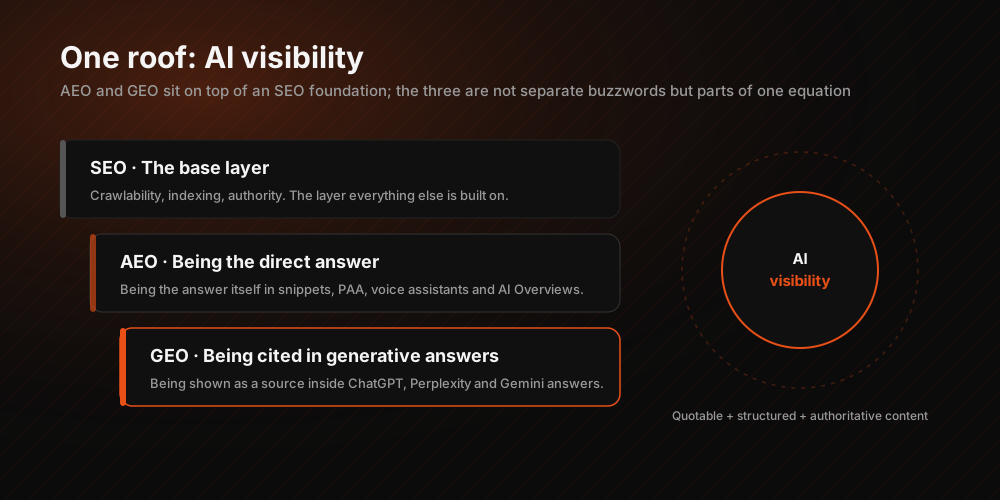
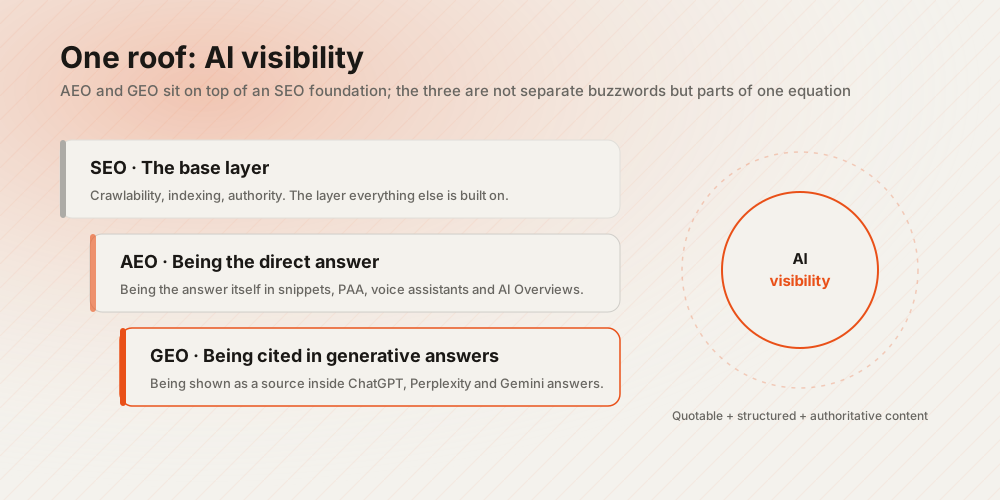
Short answer: AEO, SearchGPT and GEO are not separate buzzwords; they are parts of the same "AI visibility" umbrella. All of them rest on one foundation: citable, structured, authoritative content. Technical accessibility, structured data and trust signals form the ground floor of that structure.
What is AI search optimization?
AI search optimization is the practice of structuring your content in the way AI-powered search and answer systems prefer. While classic search visibility work focuses on rankings and clicks, AI search optimization targets visibility across three surfaces at once: answer engines, generative AI assistants and classic organic results.
Three concepts stand out under this umbrella:
- AEO (Answer Engine Optimization): Being selected as the direct answer, in featured snippets, People Also Ask, voice assistants and AI Overviews.
- SearchGPT / ChatGPT Search: Being shown as a source in answers generated with live web data inside OpenAI's search layer.
- GEO (Generative Engine Optimization): Being cited in the answers of generative engines such as ChatGPT, Perplexity, Gemini and Claude.
All three feed on the same authority and citability signals. Technical accessibility, content quality and authority signals form the base of the equation; AEO and GEO carry that base onto AI answer surfaces. The right approach is therefore not to treat classic search and generative answer surfaces as separate channels, but to unite them under a single measurable visibility model.
What is AEO (answer engine optimization)?
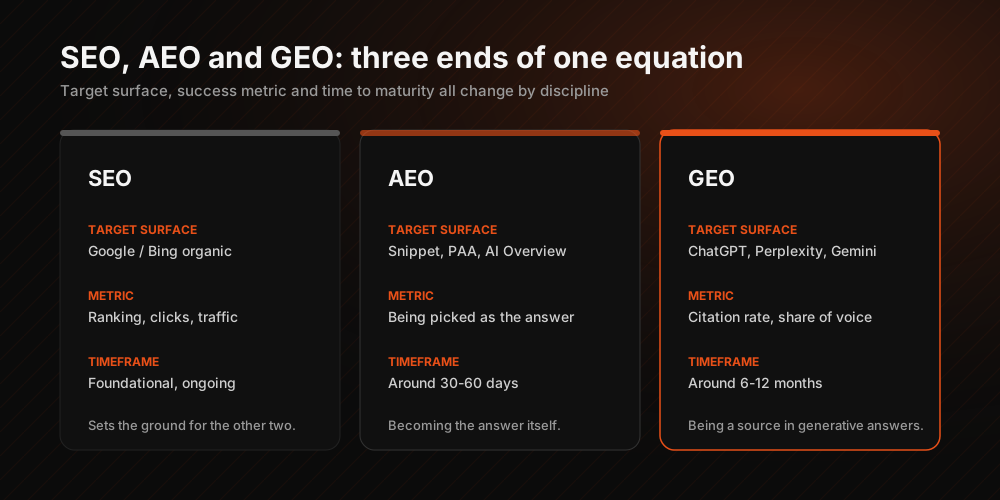
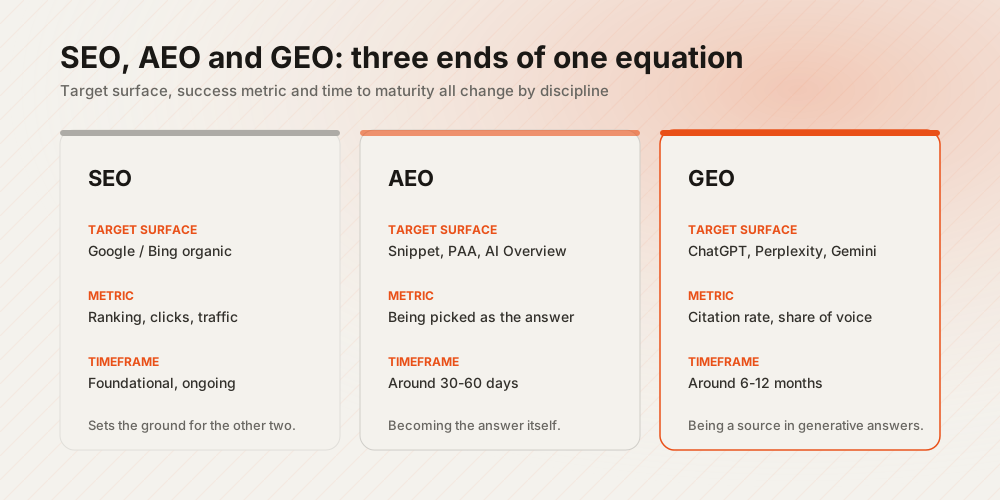
Answer Engine Optimization is the practice of structuring your content so that an answer engine selects it as the direct answer. The goal is not the ranking; it is becoming the answer itself. AEO covers three types of answer surface:
- Voice assistants: Siri, Alexa, Google Assistant.
- Google answer surfaces: featured snippets, People Also Ask, AI Overviews and AI Mode.
- Generative AI engines: ChatGPT, Perplexity, Gemini, Copilot, Claude.
The term AEO dates back to 2018 and the featured snippet era. The difference from classic search optimization is this: the traditional approach targets rankings and clicks, while AEO targets being chosen as the direct answer. The core tactics are question-format headings, a direct answer within the first 40-60 words, atomic paragraphs that are complete on their own, FAQ blocks and FAQ structured data with schema markup. The real value of AEO is earning visibility and authority as the source of the answer even when no click occurs.
Much of the AEO content in the market pins the topic to the voice search and featured snippet era. Today's AEO must also cover LLM citation dynamics and the reality of ChatGPT and Perplexity.
What is SearchGPT, and where does it stand today?
SearchGPT was the search prototype OpenAI launched in July 2024 with roughly 10,000 test users. The user asks a question in natural language, the system pulls real-time information from the web and produces a summarized answer with inline, named attributions and source links in a side panel.
Here is the critical point most content misses: SearchGPT did not remain a standalone product. OpenAI announced ChatGPT Search in October 2024 and folded the prototype's best features into ChatGPT; as of February 2025 the experience opened to everyone with no sign-up required. So today, "visibility in SearchGPT" means, in practice, being cited within ChatGPT's search and answer layer.
ChatGPT selects sources at two layers:
- The training corpus: The model knowing your brand exists. Wikipedia, Reddit and major publishers carry the most weight here.
- The live retrieval layer: Which URL gets cited is determined at query time via the Bing index.
In 2026 the picture became even more dynamic: OpenAI brought clearly labeled ads to ChatGPT and added shopping and checkout integrations. According to Similarweb data, once ChatGPT began showing more prominent brand links in its answers, referral traffic to publishers jumped significantly, and most of that traffic went straight to brand homepages. For visibility on surfaces such as ChatGPT and Google AI Overviews, presence in the Bing index, a Wikipedia/Wikidata footprint, high-authority third-party mentions and clean schema are decisive.
What is GEO (generative engine optimization)?
GEO is the practice of getting your content cited as a source in the answers of generative engines such as ChatGPT, Gemini, Perplexity and Claude. The goal is not the click; it is being the source behind the answer AI synthesizes.
GEO has an academic foundation. In 2023, a Princeton-led research team (Aggarwal, Murahari and colleagues, presented at ACM KDD 2024) tested 9 different tactics across roughly 10,000 queries and found that adding statistics, citing sources and including quotations increased AI visibility by up to 40 percent. Keyword stuffing produced no effect at all, and in some cases hurt results.
The most striking finding: lower-ranked sites gained the most from GEO. Pages in fifth position saw visibility gains of up to 115 percent, while the change for top-ranked pages was minimal. That is a clear early-mover window for small and new brands. For brands that want to pursue GEO in depth, our GEO consulting service turns this opportunity into a measurable roadmap.
How do AEO, GEO and classic search visibility differ?
The industry is awash in terms: AEO, GEO, AIO, GSO, LLMO. The clear framing is this: these disciplines are not rivals; they are different ends of a single AI visibility equation.
| Discipline | Target surface | Success metric | Typical timeframe |
|---|---|---|---|
| Classic search visibility | Google / Bing organic results | Rankings, clicks, traffic | Foundational, ongoing |
| AEO | Snippets, PAA, voice assistants, AI Overviews | Being selected as the answer | Roughly 30-60 days |
| GEO | ChatGPT, Perplexity, Gemini answers | Citation frequency, share of voice | Roughly 6-12 months |
These three disciplines converge in a single equation. Industry analyses show that roughly 40 percent of AI Overview citations come from Google's top 10 results; strong organic visibility gives you an advantage on AI answer surfaces but does not guarantee anything on its own. At the same time, a significant share of the pages ChatGPT cites most have near-zero organic visibility. The conclusion is clear: a technically accessible, authoritative organic foundation is necessary but not sufficient.
Zero-click search and AI traffic: what do the numbers say?
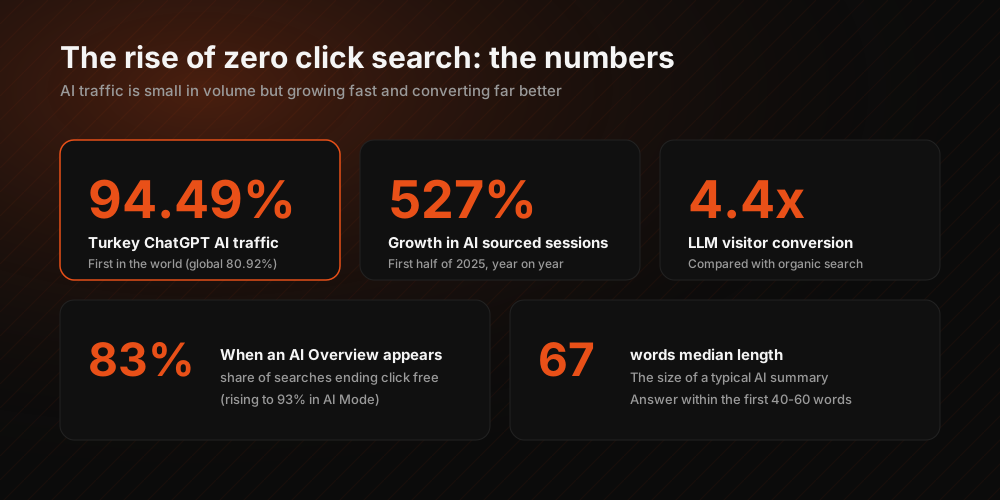
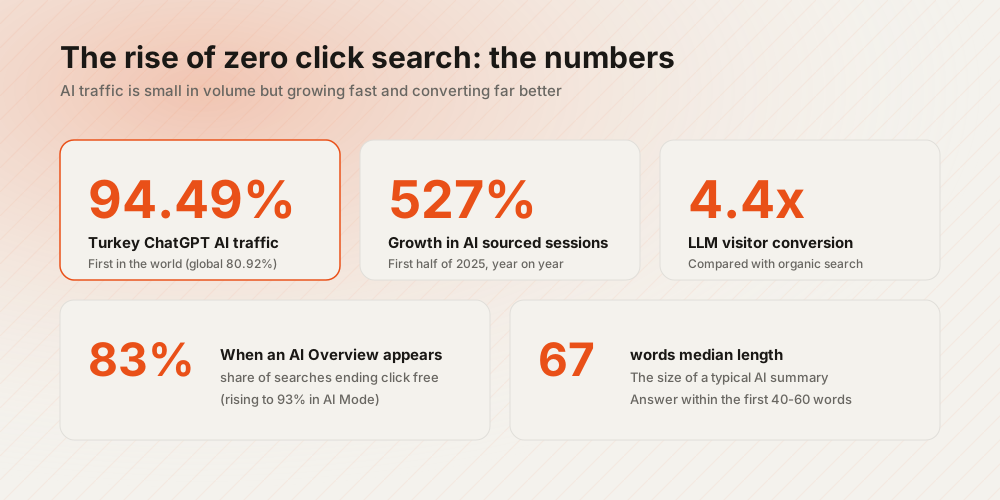
Zero-click search is no longer the exception; it is the rule. Independent industry research finds that 80 percent of consumers rely on AI-written results for at least 40 percent of their searches, and this is reducing organic web traffic by 15-25 percent. When an AI Overview appears, the share of searches ending without a click rises to 83 percent, and in AI Mode to 93 percent.
AI referral traffic is still small in the overall mix (roughly 1 percent of web traffic) but it is growing fast and converting at much higher quality:
- ChatGPT reached 900 million weekly active users (OpenAI announcement, February 2026). That is the last weekly figure the company itself confirmed; reports of approaching 1 billion since then are third-party estimates.
- 68.01 percent of Google searches end without a click (SparkToro, Similarweb panel, January-April 2026, US). In 2024 the figure was 60.45 percent.
- Clicks drop by roughly 60 percent on searches where an AI Overview appears; AI Overviews show on more than 20 percent of searches (same source).
- Claims about AI-driven session growth and LLM visitors converting better come from vendor-sourced, selectively sampled measurements. Rather than taking them at face value, validate against your own baseline: the only evidence that counts is your own data.
Turkey sits at the center of this picture, which makes measuring AI traffic a necessity rather than a luxury. We recommend setting up a GA4-based approach to track AI-driven sessions as a separate channel.
What are the actionable tactics for AI visibility?
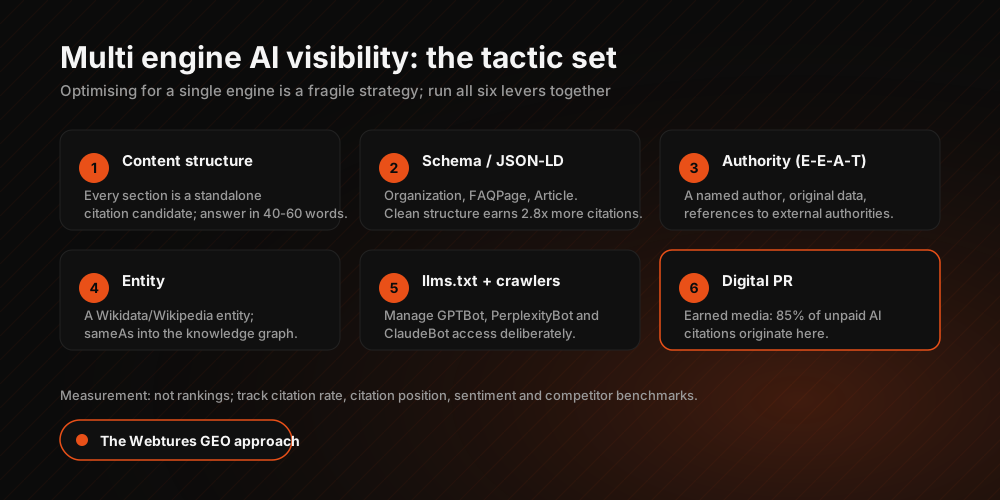
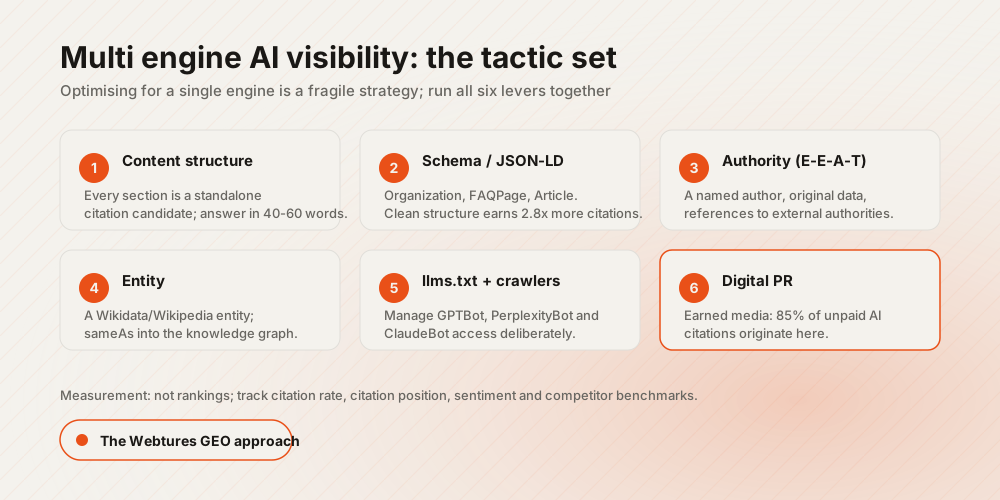
Multi-engine AI visibility comes from working six levers together. Optimizing for a single engine is a fragile strategy.
- Content structure. Every section should be an independent citation candidate; an H2 and the paragraph that follows it should answer the question on their own. According to Pew Research, the median length of a typical AI summary is 67 words, so place the answer in the first 40-60 words. A significant share of LLM citations comes from the first 30 percent of the text.
- Schema / structured data. Prioritize Organization, FAQPage, Article/BlogPosting, BreadcrumbList and Person/Author. Pages with clean structure and schema receive roughly 2.8 times more AI citations. Prefer JSON-LD and validate regularly.
- Authority signals (E-E-A-T). Named author bylines, expert quotes, original data and references to external authoritative sources. Most of the pages ChatGPT cites most often come from high-authority domains.
- Entity optimization. Consistent definitions of your brand, people and services across the web; a Wikidata/Wikipedia presence; connecting to the knowledge graph via
sameAs. - llms.txt and crawler management. A Markdown file placed at the site root that points AI models to your most important content, plus deliberate management of GPTBot, PerplexityBot, ClaudeBot and Google-Extended access via
robots.txt. If you want to be cited, you have to allow access. - Digital PR and brand mentions. More than 85 percent of unpaid AI citations come from earned media sources. Reddit carries decisive weight in Perplexity citations; Wikipedia does the same for ChatGPT sources.
Mind the platform-specific differences too: ChatGPT favors encyclopedic, Wikipedia-heavy sources; Perplexity favors freshness and Reddit; Google AI Overviews elevates pages that already rank organically. To go deeper on how these levers play out on the brand side, explore our content on AI visibility optimization.
Why is Turkey the highest-return market for AI search investment?
Turkey leads the world in ChatGPT-driven AI web traffic at 94.49 percent, against a global average of 80.92 percent. According to Statcounter, ChatGPT's market share in Turkey stands around 91 percent, with Gemini and Copilot in single digits.
This intense adoption makes Turkey one of the markets where GEO and AEO investment delivers the highest return. The number of providers offering this service in Turkey grew rapidly in 2026, a sign that the category is maturing while a clear leader position has yet to settle. For a team with 16 years of digital strategy and search visibility experience, that is an open positioning opportunity.
One important nuance: AI citation behavior in Turkish queries can differ from English. Testing and producing content in the local language is therefore essential. Turkey's high ChatGPT adoption gives brands that move early in Turkish content a disproportionate advantage.
Why act now? Business impact and ROI
The case for investing in AI search optimization is not just traffic; it is where the purchase decision takes shape.
- The B2B buyer journey has been rewritten. Generative AI and conversational search have become one of the most meaningful sources in vendor research, and the share of buyers using AI rises year over year.
- An AI recommendation changes brand perception. A large majority of B2B software buyers view a brand more favorably when an AI assistant recommends it.
- Traditional search is shrinking. According to Gartner, traditional search engine volume will decline markedly in 2026, with share shifting to AI assistants.
- Making the day-one list is critical. The overwhelming majority of buyers purchase from a brand on the shortlist they saw on the first day of research. If AI does not know you, you lose the customer before you ever meet.
What to watch out for
AI search optimization is a fast-moving field, so a few points need to stay clear:
- The numbers are volatile. Platform statuses, user counts and market shares change within months. Check the date of a source before acting on it.
- Citation mechanisms are opaque. Why engines cite what they cite is not fully transparent. Be skeptical of services promising "guaranteed rankings".
- Traffic does not equal value. AI traffic is small in volume; the value lies in conversion quality and brand authority. Build the ROI argument around shortlist inclusion and conversion.
- Do not neglect the technical and content foundation. GEO and AEO are built on solid site architecture, trustworthy content, structured data and authority signals. Brands that leave this foundation weak and chase AI visibility alone lose ground on both classic search and AI answer surfaces.
The Webtures approach
Webtures brings 16 years of digital strategy experience to unify AEO, GEO and AI visibility under a single measurable model. Our approach moves through four stages: diagnosis (we measure your brand's current visibility in AI answers using category queries), foundation (technical accessibility, schema and answer-first content structure), authority and distribution (citable content, entity consistency and digital PR), measurement and iteration (monthly citation and share-of-voice tracking against a fixed prompt set).
Built on citability, authority and measurability rather than rankings, this model prepares your brand for the present and future reality of AI search. To measure your brand's visibility in AI search and map a clear roadmap, get in touch with our GEO consulting team.