Best AI Search Performance Monitoring Tools
Discover the most effective tools for measuring AI search performance, comparing features, and building the GEO strategy that keeps your brand visible.


The search landscape is changing fast. Brands need to know how they rank not only on classic results pages but also across AI-powered search surfaces. As AI-driven systems such as AI Overviews, ChatGPT Search, and Perplexity generate answers by interpreting user intent, visibility is now measured in a far broader context than clicks, positions, and traffic data.
In this guide, we cover the best tools that help brands measure their AI search visibility, analyze competitors, and build strategy through the lens of GEO (Generative Engine Optimization).
What is AI search performance?
AI search performance is a new-generation metric that measures how often, for which queries, and in what context a brand appears in AI-powered search engines, meaning LLM (Large Language Model) based systems.
Visibility in AI search is not judged by a single result position. What matters here is which queries and prompts your brand gets selected for, in what context it is referenced, and how often it is used as a trusted source in answer generation. The more frequently and accurately a piece of content is used by AI to produce answers, the more valuable it is.
The main factors that influence this visibility:
- The entity structure of your content and its alignment with the knowledge graph
- E-E-A-T++ signals (Experience, Expertise, Authoritativeness, Trust)
- Accuracy and completeness of structured data
- Citation rate across AI models
- Prompt alignment and content contextuality
In short, AI search performance answers the questions "Does AI recognize me, does it recommend me, and in what context?"
Why does monitoring AI search performance matter?
The logic of measuring digital visibility is shifting. The focus is no longer just organic clicks but your capacity to be visible across AI search surfaces.
Brands that fail to track this shift can drift out of AI results without realizing it.
Regularly monitoring AI search performance is critical for several reasons:
- You can identify which queries surface your brand in systems like ChatGPT, Gemini, and Perplexity. This data illuminates areas that classic analytics tools cannot show directly.
- With tools like Brantial, you can analyze which queries lead AI to recommend competing brands more often. That lets you fill content gaps strategically.
- AI looks at "context" and "trust" signals when selecting content. AI performance data therefore gives you concrete evidence for optimizing structured data, content tone, and entity relationships.
- When a brand becomes invisible on AI surfaces, the impact hits organic traffic a few weeks later. That makes AI performance monitoring an early warning system.
In short, AI search visibility is one of the earliest and most strategic indicators of digital visibility.
What to look for in AI search performance monitoring tools
Measuring AI search is a fundamentally different process from analyzing classic results pages. The tool you choose must analyze not only visibility positions but also the AI's decision mechanism.
A strong AI search performance tool should offer the following:
- It should track entity visibility across platforms such as ChatGPT Search, AI Overviews, and Perplexity.
- It should recognize your brand's schema structure and show how AI models interpret it.
- It should analyze which brands appear alongside you for the same queries on AI surfaces.
- It should unify all AI search surfaces in a single panel and deliver a correlation-based visibility map.
- It should report clearly which metrics you need to improve to earn more AI recommendations.
Ultimately, the ideal tool answers not just "are you visible?" but "why are you visible, or why are you not?"
The best AI search performance monitoring tools
Measuring AI search visibility is no longer just a trend. It has become a necessity for sustaining a brand's digital presence.
Below you will find the best tools for professionals who want to analyze AI-powered search performance, benchmark against competitors, and strengthen their GEO (Generative Engine Optimization) strategies.
Brantial: AI search visibility platform
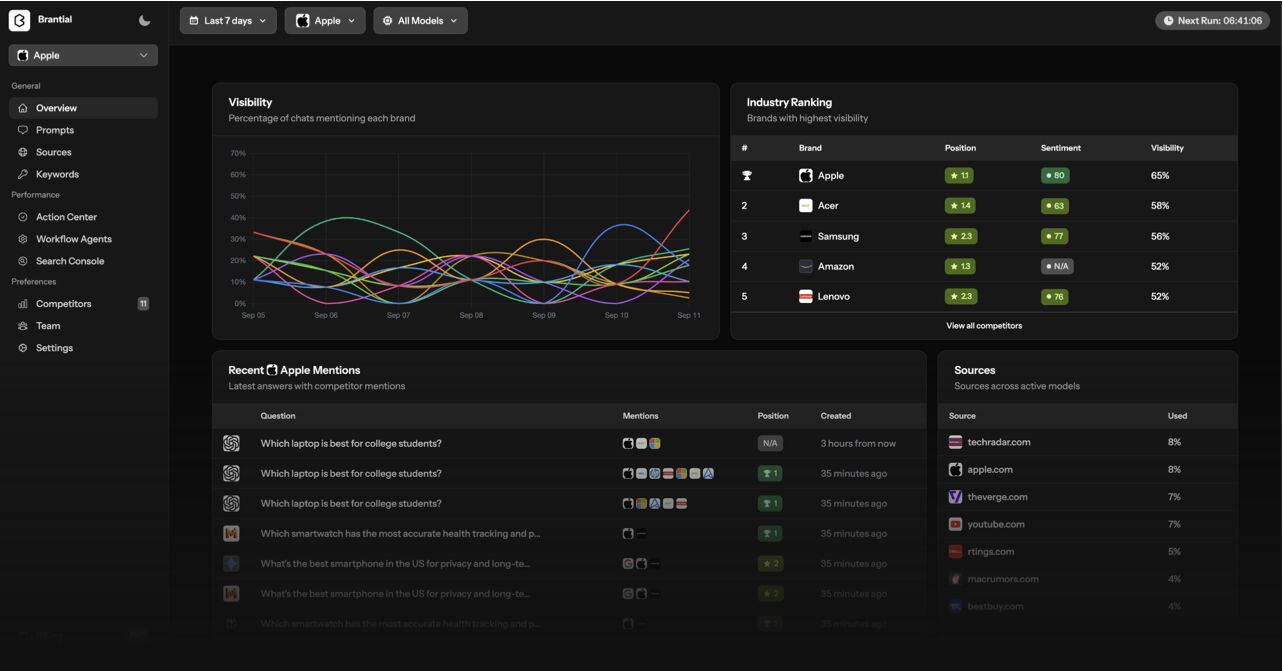
We are in an era where AI-powered search results have become decisive. Brantial is an advanced AI Search Visibility platform designed to measure, analyze, and improve a brand's visibility across AI search surfaces.
The platform goes beyond the data classic analytics tools provide, showing you clearly how your content ranks in LLM (Large Language Model) based systems such as AI Overviews, ChatGPT Search, Perplexity, Grok, and Mistral. In other words, you can now measure not just traffic data but how often AI "recommends" and "cites" you.
Brantial runs on a fully cloud-based infrastructure and enables brands to make data-driven decisions without technical expertise. Its user-friendly interface lets digital marketing teams, content creators, and managers work within the same ecosystem.
Key features:
- It integrates with AI models including OpenAI, Google AI, Perplexity, Grok, and Mistral, so brands can track visibility across every AI surface from a single place.
- It analyzes competitor visibility through specific prompts, showing which brands appear for the same queries and how often their content gets recommended.
- It identifies low-visibility content, analyzes why it underperforms, and delivers improvement recommendations.
- Its subscription plans include multi-brand, team member, and competitor tracking features, a major advantage for consultancies and multi-brand organizations.
- It evaluates your content's structured data (schema), analyzes its alignment with AI models, and surfaces entity relationships.
- It monitors competitor performance on AI surfaces, shows which competitors get recommended more often, and generates strategic recommendations from that data.
- Scaling from the Starter plan to the Enterprise tier, it serves user profiles ranging from small teams to large brands.
Brantial moves past classic visibility metrics and gives brands a new visibility map. You can see how your brand ranks in AI-generated answer areas, summaries, and generative search results. That lets you measure how AI perceives your content, which queries surface it, and where you intersect with competitors.
Market Brew: search engine simulation with AI
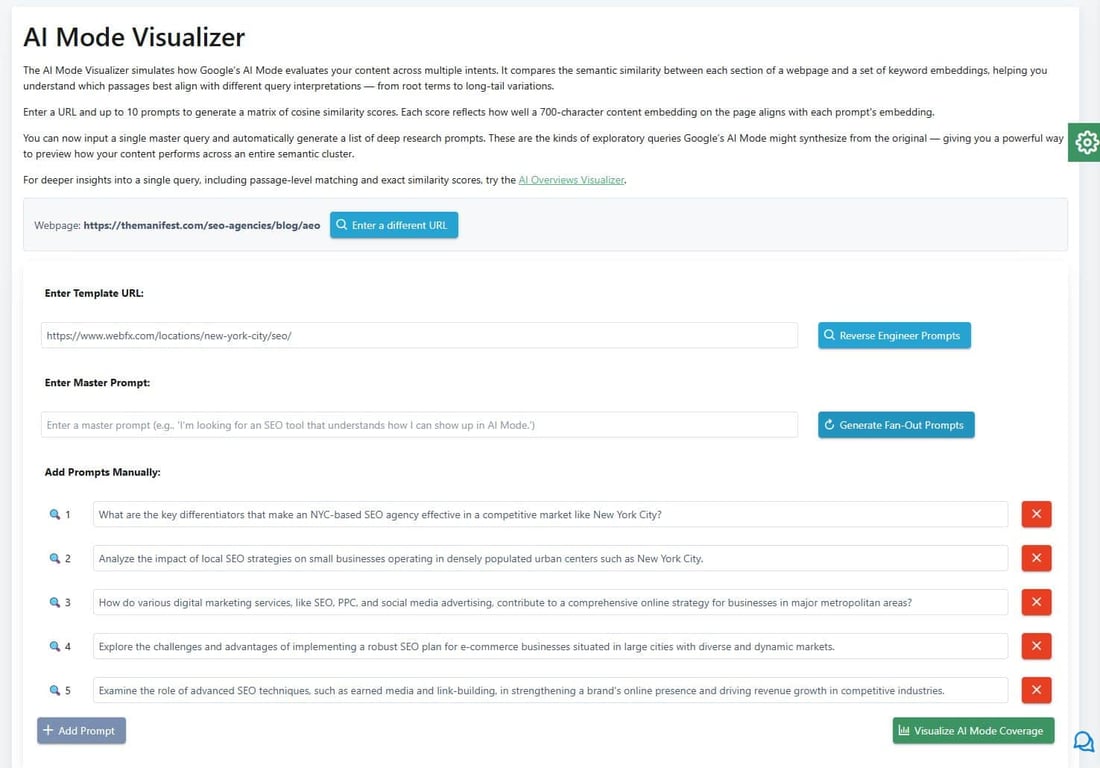
Market Brew uses AI to simulate search engine algorithms and answers the question digital marketing teams keep asking: "what impact could this change have on visibility?" It lets you test changes before pushing them live.
Features:
- It models how search engines evaluate pages and delivers visibility forecasts.
- It analyzes which factors carry the most weight for each results surface and highlights the areas to optimize.
- It uses multiple blueprints for similar page types to recommend structural optimization site-wide.
- Its models retrain after algorithm updates, keeping the analysis aligned with the latest changes.
- It shows which factors competitors lead on and which changes could give your page the advantage.
Writesonic AI Visibility Tracker: LLM visibility analysis tool
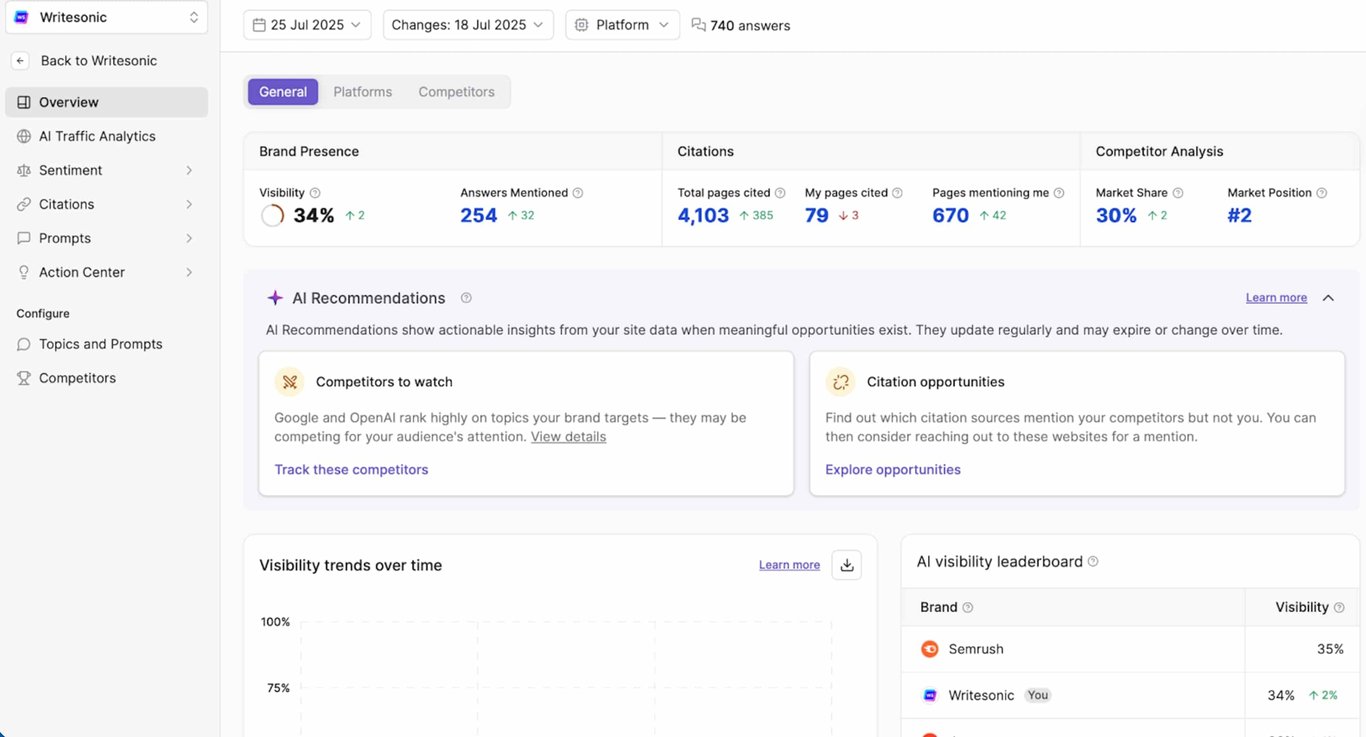
Writesonic AI Visibility Tracker measures how much presence your content earns on LLM (Large Language Model) based search surfaces. It strengthens content strategy by tracking AI search trends and where content ranks within generative search results.
Features:
- It measures content visibility across AI platforms such as ChatGPT, Perplexity, and You.com.
- It reports visibility frequency across different queries.
- It recommends content formats better suited to AI models.
- It combines blog, web, and social channel data in a single report.
- It analyzes engagement rates within AI-generated results.
Otterly.AI: generative search monitoring tool
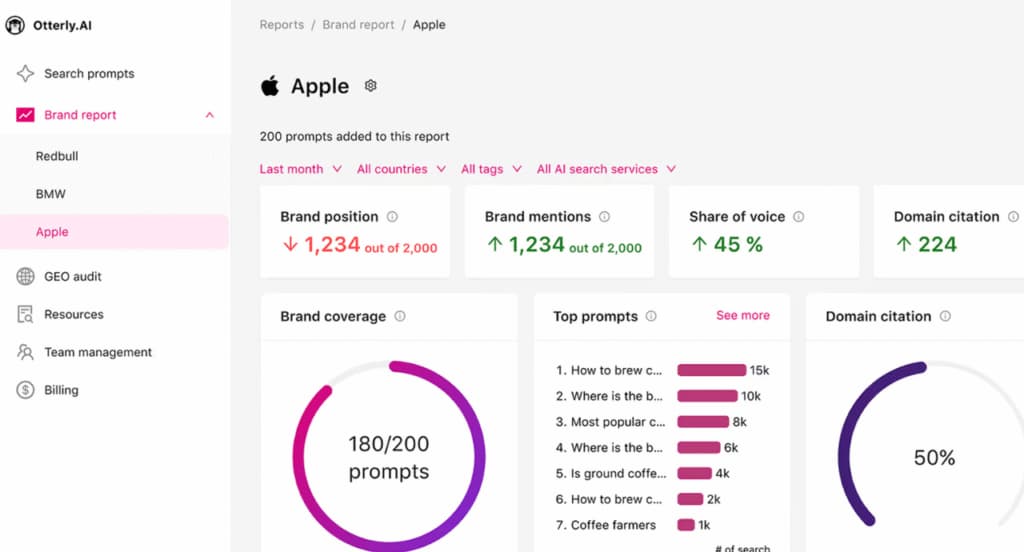
Otterly.AI tracks where brands and content appear within generative search results. With a simple yet efficient system, it enables small and mid-sized teams to monitor their AI search visibility.
Features:
- It measures brand visibility within AI-generated results.
- It presents visibility changes as a time series.
- It analyzes which queries your brand matches in AI answers.
- It runs fast with a low system footprint.
- It provides top-level visibility comparisons against similar brands.
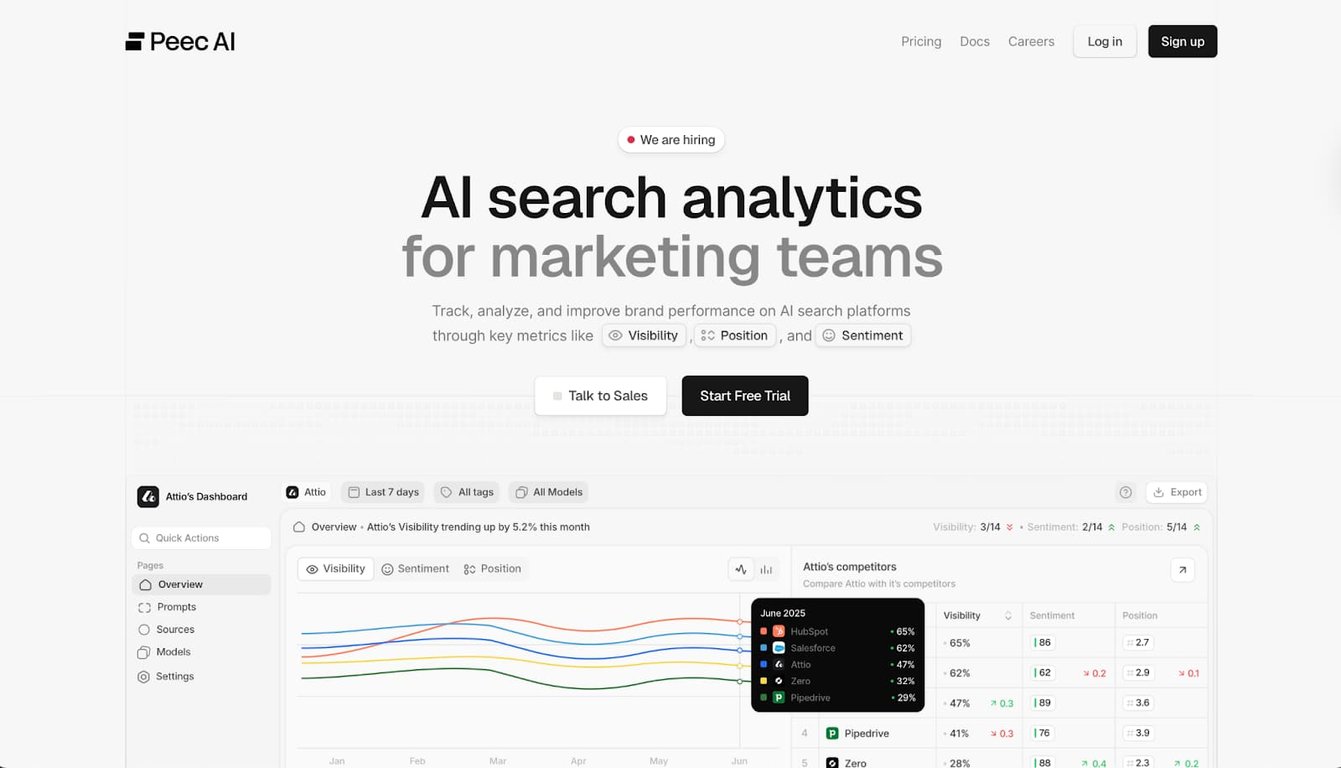
Peec AI: prompt-based visibility tracking
Peec AI measures how frequently brands appear in AI search engines across specific prompts. Its no-code setup makes quick visibility checks possible without technical knowledge.
Features:
- It lists visibility rates for every prompt.
- It measures how keyword variations influence AI answers.
- It shows how many AI answers mention your brand.
- Its simple reporting structure delivers instant results.
- It offers low-cost visibility tracking for SMB-level teams.
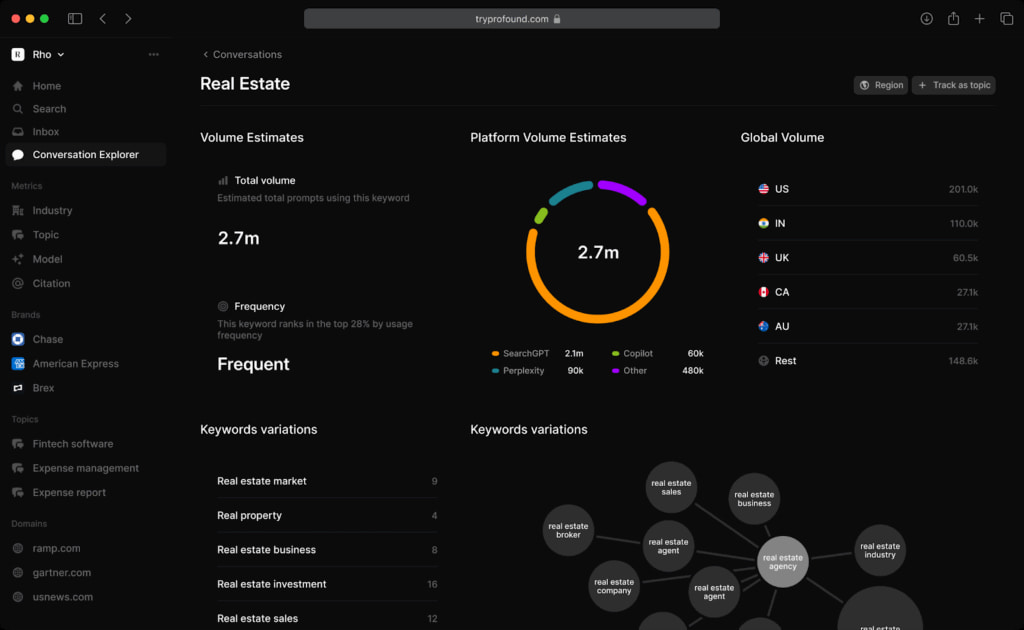
Profound AI: enterprise LLM analytics platform
Profound AI delivers LLM analytics solutions at enterprise scale. It analyzes the large datasets generated by AI models, giving brands insight at the visibility, content, and strategy level.
Features:
- It collects and processes high-volume data from multiple models.
- It offers REST API support that integrates with custom systems.
- It analyzes entity-based visibility relationships.
- It provides real-time LLM performance monitoring.
- It delivers flexible infrastructure for high-volume enterprises.
AI-powered search systems have become one of the strongest forces reshaping digital visibility. Visibility is no longer measured only by appearing in classic results areas but by being recognized, recommended, and cited in the right context by AI models.
When monitoring AI search performance, the goal is not just to track visibility rates but to understand why you are visible or invisible. Brands that track the right metrics and focus on entity and content alignment can now build a strong position not only in search engines but across AI-based knowledge ecosystems.
In short, the GEO strategy of the future depends on building brands that do not just produce content but are correctly understood by AI.

Let us make your brand visible in AI search.
Share your goals, we'll come back with a custom growth plan within one business day. A strategy lead will reach out personally.
Get in touch