AI Integration in the Travel and Hospitality Industry
Discover the transformation created by artificial intelligence in the tourism and hospitality industry with a 2026 focus, supported by data and research from Webtures.
For the travel and hospitality sector, artificial intelligence is no longer “a topic of the future”; due to pressures related to scale, speed, margins, and service quality, it has become one of today’s key competitive factors. According to data from the World Travel & Tourism Council, the sector contributed $11.7 trillion to the global economy in 2025, accounting for 10.3% of global GDP and supporting 371 million jobs. UN Tourism reports that international tourism has returned to pre-pandemic levels in 2024, with growth expected to continue in 2025. During the same period, the World Economic Forum emphasized that labor shortages, supply-demand imbalances, and pressure on productivity persist in the travel and tourism sector. This landscape is positioning artificial intelligence as one of the sector’s core operational infrastructures, spanning from customer experience to revenue management, and from self-service to operational optimization.
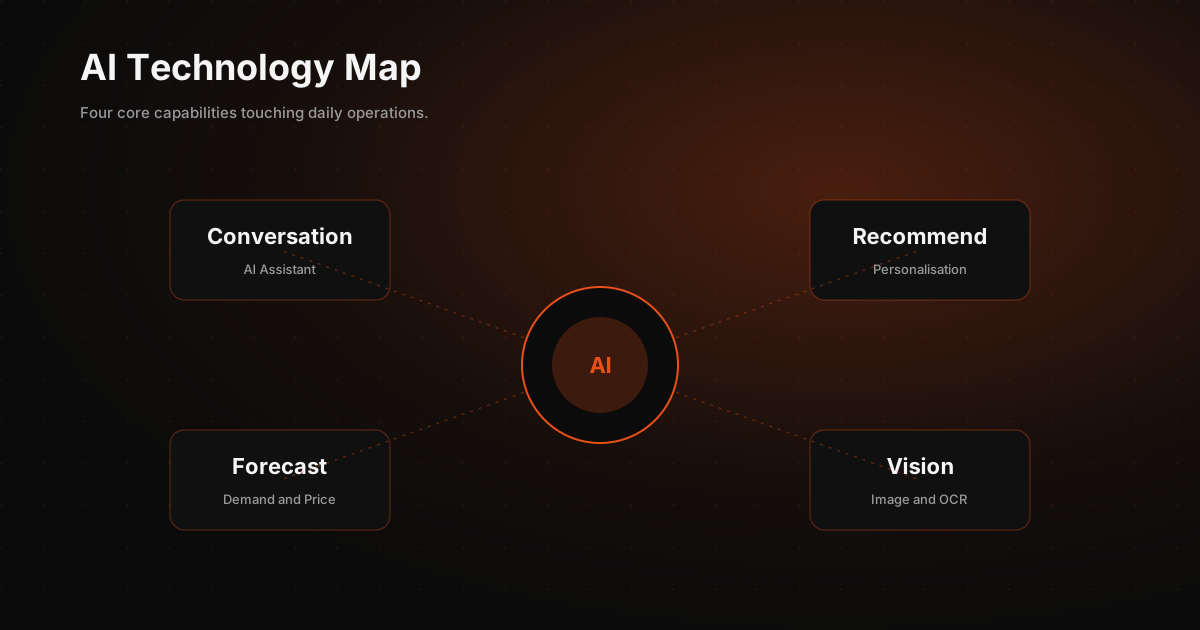
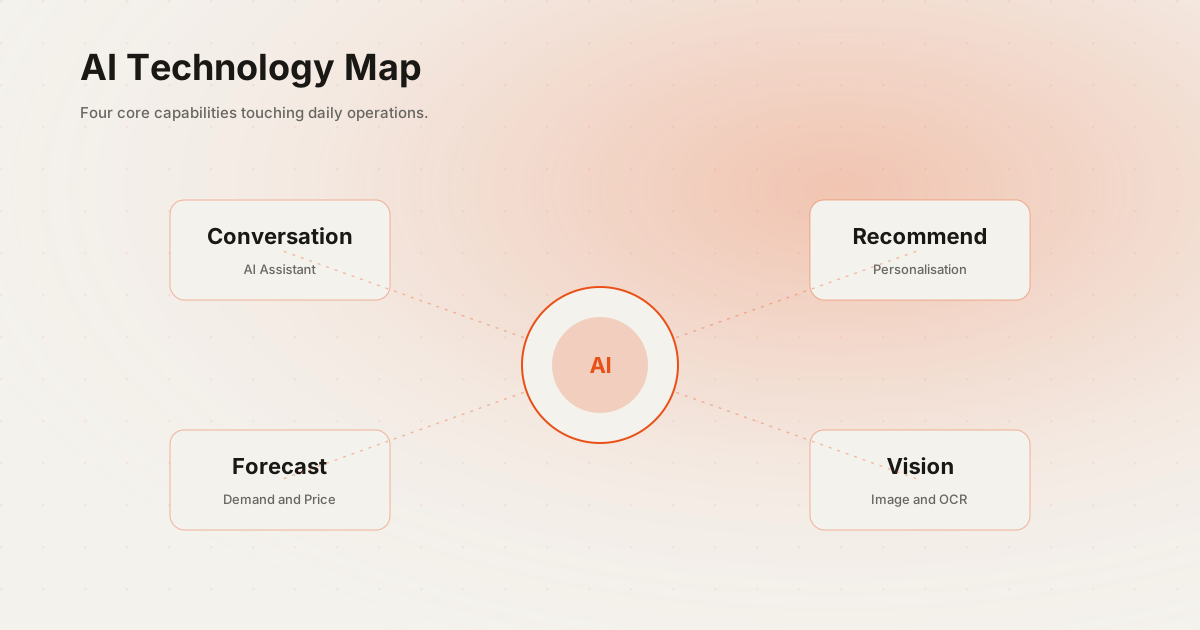
AI Technologies in the Travel and Hospitality Industry
The current state of the industry can be summarized in one sentence: in travel and hospitality, artificial intelligence has largely moved beyond the experimentation phase; however, end-to-end enterprise-scale adoption has not yet been fully achieved.
In Amadeus’ research conducted with more than 300 industry leaders, generative AI ranks first as the most important technology priority for 2025, with 46%. While 51% of leaders say the technology already has a “significant presence” in their markets, only 41% state that their companies have sufficient budget and resources for implementation. In PwC’s regional research with tourism and hospitality leaders, 91–94% of respondents say they are either piloting or using AI; however, only 3% have moved to full-scale enterprise-wide implementation.
Demand-side behavior also confirms this transformation. According to Deloitte, by the end of 2025, approximately one in four travelers will be using generative AI tools for travel planning, nearly three times the rate recorded in 2022. In SiteMinder’s research conducted with more than 12,000 travelers across 14 major markets, the share of people willing to use AI at any stage of the accommodation journey rises to 78%, while the share of those who want all hotel functions to be managed by machines remains at only 12%. The same company’s 2026 report states that the use of AI in accommodation research increased almost fourfold within one year.
In other words, the market is no longer asking, “Does AI exist?” Instead, it is asking, “At which stage should AI be involved, and where should the human role remain?”
Dynamics Making AI Essential in Travel and Hospitality
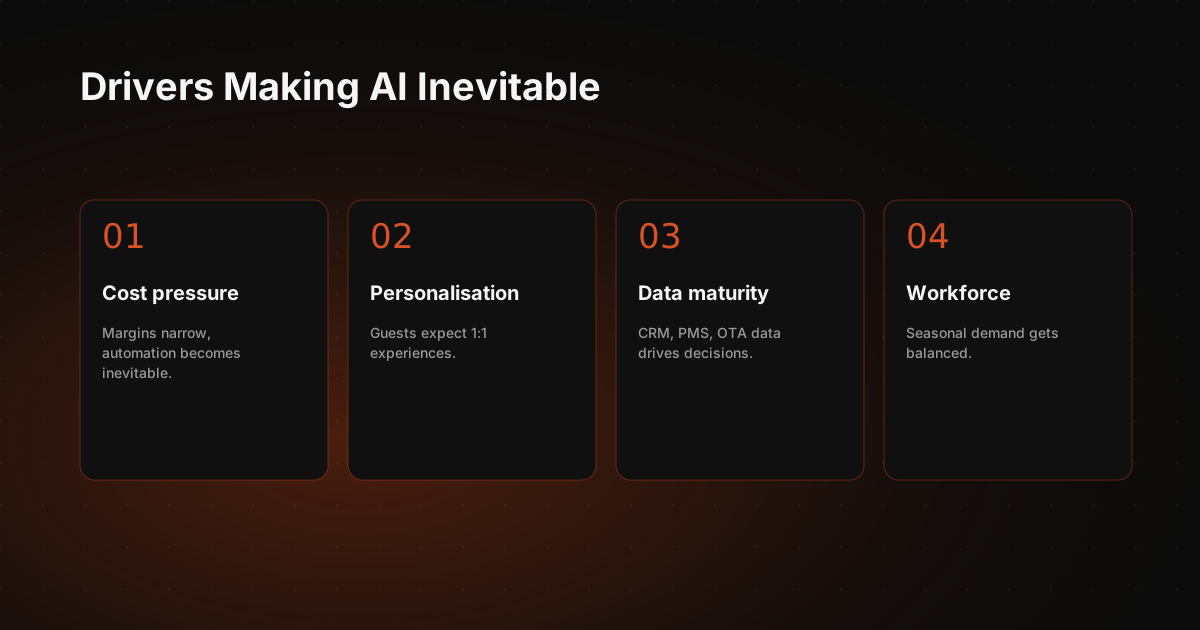
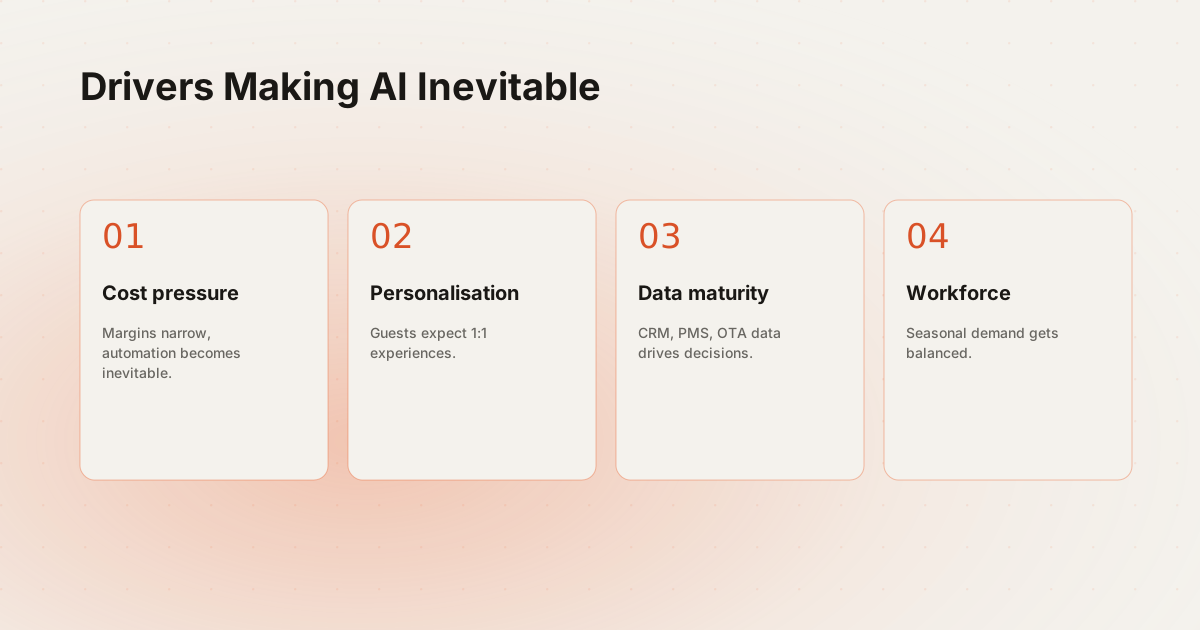
The first pressure point is scale and channel complexity. Academic reviews and industry data show that the online travel economy has now become the main battleground for distribution. In 2023, the global online travel market reached $600 billion and is expected to exceed $800 billion by 2028. During the same period, bookings from hotel websites generated an average revenue of $519 per booking in 2024, while the OTA average remained at $320. This gap turns artificial intelligence into not only a service technology, but also a technology for distribution, direct bookings, and margin optimization.
The second pressure point is the pace at which customer expectations are changing. According to Mews research, 70% of American travelers are open to using an app or kiosk for self check-in instead of the hotel reception desk; among Gen Z, this rate rises to 82%. The same research shows that guests who use kiosks are three times more likely to purchase upsells and generate approximately 70% more upsell revenue per check-in. This reveals that the demand for speed, control, and frictionless experiences is no longer only a matter of service quality, but directly a matter of revenue.
The third pressure point is labor and productivity. International institutions emphasize that, due to the labor-intensive nature of tourism, the sector is vulnerable to pressures around staff recruitment, retention, and productivity. For this reason, the industry uses artificial intelligence in most cases not to eliminate humans entirely, but to reduce repetitive tasks, create a 24/7 service standard, facilitate multilingual communication, and shift employees toward higher-value responsibilities. Turkish academic literature also groups the use of artificial intelligence in tourism businesses mainly under uninterrupted service, operational efficiency, cost reduction, and personalization.
Dynamic | Data / Insight | Business Impact |
Distribution & Channel Competition | The online travel market reached $600 billion in 2023 and is expected to exceed $800 billion by 2028 | Competition is intensifying across digital channels |
| Hotel website booking revenue: $519 | Direct bookings are more profitable |
| OTA booking revenue: $320 | Dependence on intermediaries reduces margins |
Customer Behavior & Experience | 70% of users are open to self check-in; Gen Z: 82% | Expectations for contactless experiences are increasing |
| Guests using kiosks generate 3x more upsells | Experience is directly connected to revenue |
| 70% more upsell revenue per check-in | Operations become a sales channel |
Operations & Labor | Need for 24/7 service | AI → enables uninterrupted service |
| Pressure around staff recruitment and productivity | Automation becomes essential |
| AI use cases: efficiency, cost reduction, personalization | Operational transformation |
Where AI Stands in the Industry Today
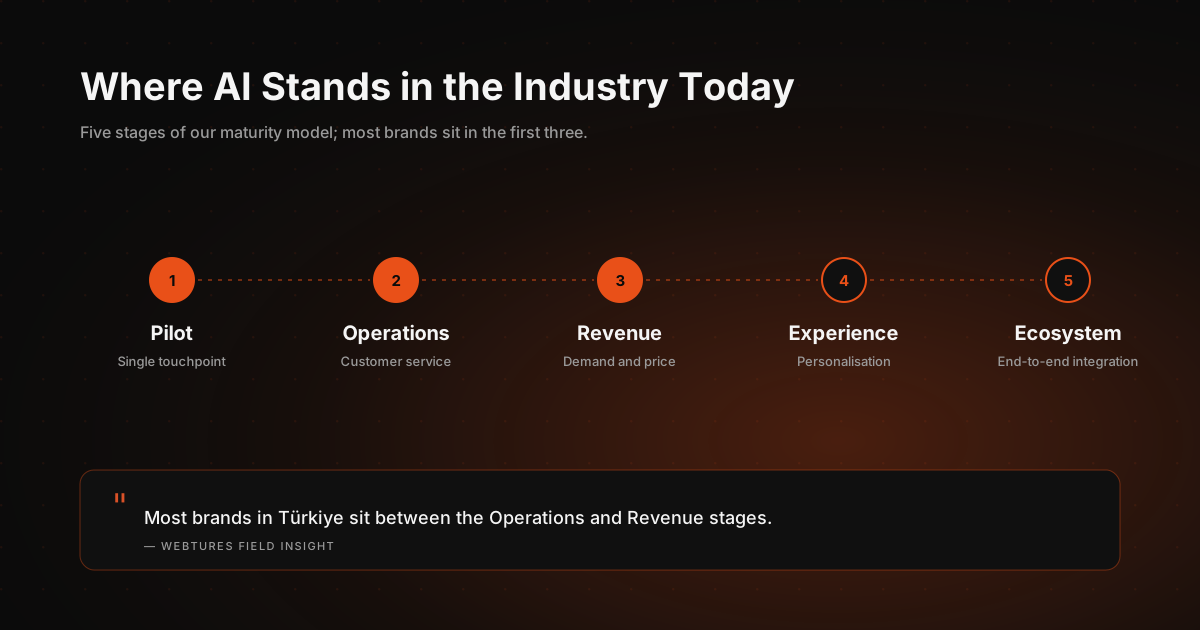
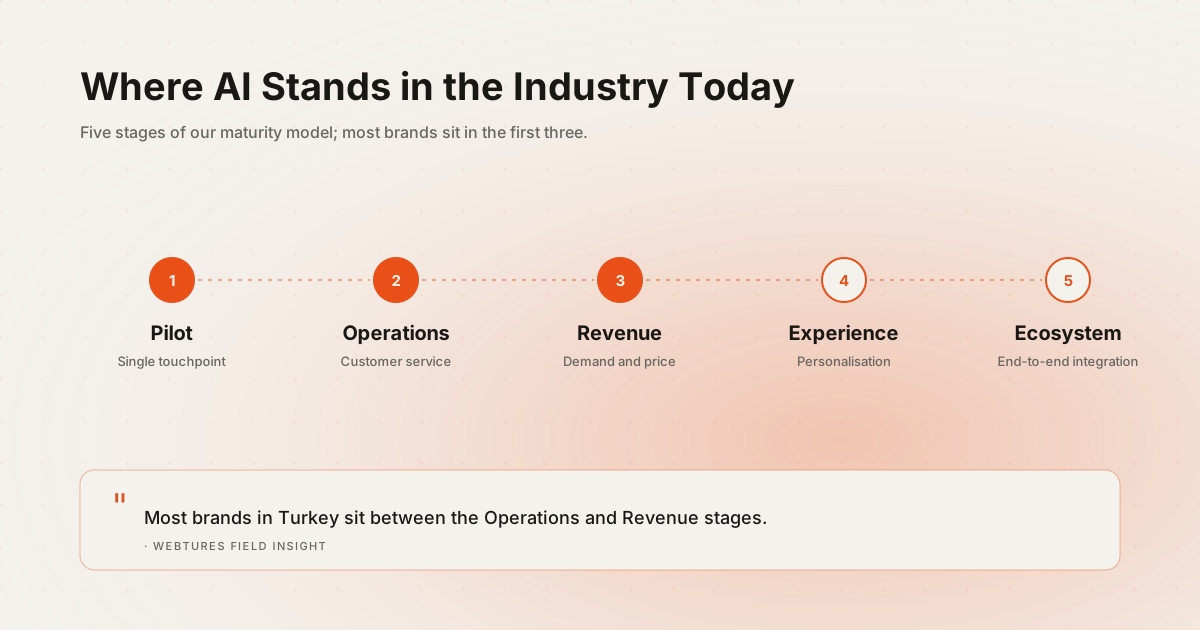
Academic interest clearly shows that the industry’s relationship with artificial intelligence has become permanent. The bibliometric study you shared identifies 307 publications at the intersection of the hotel industry and artificial intelligence, with an annual growth rate of approximately 8.7%, and shows that 2024 was the peak year with 79 publications. The studies cover 74 countries, with China standing out with 95 publications, the United States with 55, and Türkiye with 16. Among the most frequently used keywords are service robots, sustainability, dynamic pricing, operational efficiency, and e-commerce. This picture shows that the industry is no longer discussing artificial intelligence through isolated chatbot case studies, but through broader themes such as revenue, operations, experience, and sustainability.
The maturity level on the company side reflects a similar picture. In the Amadeus research, travel companies use generative AI most commonly for digital assistance during booking at 53%, activity and venue recommendations at 48%, content generation at 47%, helping employees provide better customer service at 45%, and summarizing post-travel feedback at 45%. In the PwC research, personalization currently ranks as the most common use case at 57.6%, while revenue management, customer service, and forecasting form a second cluster of around 39%. However, usage rates remain low in areas such as energy management, maintenance and asset management, loyalty analytics, and back-office optimization. In other words, there is rapid AI scaling on the front end of the industry, but enterprise-level deepening is not progressing at the same pace.
On the consumer side, behavioral transformation is happening much faster. In Amadeus’ 2025 traveler survey, 42% of users say AI saves them time in travel planning, 37% use it to receive more personalized recommendations, and 36% turn to it to discover new destinations. However, trust remains a challenge within the same ecosystem: the 2026 trend report shows that 25% of travelers received outdated or incorrect information during planning, and only 46% are willing to trust AI systems. For this reason, the industry’s current stage can be described as one caught between high usage intent and limited trust: a structure that is accelerating on the front end, while moving more cautiously toward full integration.
Highest-Impact Use Cases
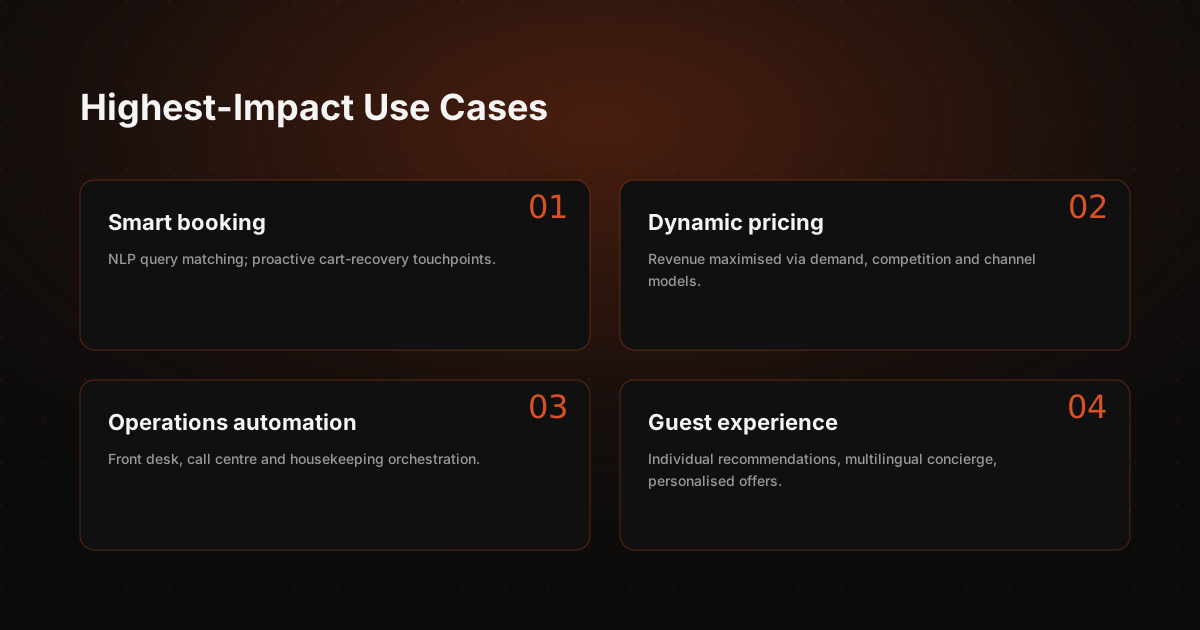
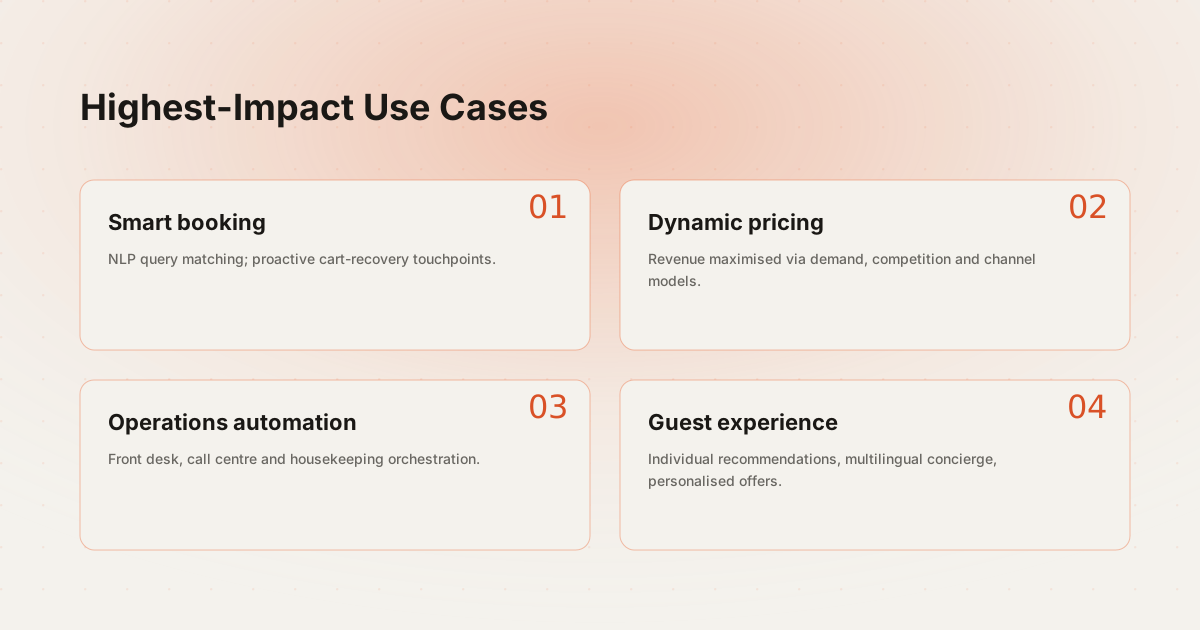
The most mature area is revenue management, demand forecasting, and dynamic pricing. EY emphasizes that artificial intelligence can create new direct booking experiences in hotel distribution and revenue management, while improving net operating income through more dynamic pricing. NetSuite states that AI optimizes room pricing and ancillary revenue strategies by processing occupancy, cost, historical trend, and even weather data together. At the more advanced end, McKinsey & Company research shows that existing AI applications can deliver approximately 5% revenue growth through segment-based personalization, while agentic structures can increase this to 15–25% in loyalty offers and 20–30% in dynamic bundle setups.
The second area of concentration is guest communication, self-service, and personalization. EY notes that AI-powered assistants and chatbots have become the primary touchpoint for hotel interactions, helping customer representatives provide more accurate responses and resolve requests faster. On the NetSuite side, chatbots, virtual assistants, voice-enabled devices, and real-time translation have a wide range of use cases, from reservation Q&A to Wi-Fi passwords, wake-up calls, and multilingual digital concierge services. Consumer interest is also strong: in Booking.com research, 41% of travelers say they are interested in AI-generated travel plans, while 66% say they want AI tools that provide suggestions around delays, crowd levels, and quieter areas.
The third area is back-office and field operations. NetSuite lists the automatic synchronization of housekeeping plans with real-time occupancy data, the detection of maintenance needs before failures occur through IoT and predictive analytics, and the optimization of energy consumption through smart systems among AI’s core operational contributions. McKinsey’s agentic scenarios project a potential 5–15% reduction in housekeeping hours with current AI, and a 10–30% reduction with more autonomous task assignment. However, PwC data shows that usage rates in energy and sustainability management, as well as maintenance and asset management, still remain below 25%. The industry sees high ROI potential in these areas, but integration is still at an early stage.
The fourth area is visibility and distribution architecture. PwC states that travelers are now discovering and booking experiences through AI platforms and assistants, partially bypassing traditional channels. The 2026 outlooks from Mews and Amadeus show that discovery and booking are becoming increasingly conversational, multi-source, and AI-mediated; for brands to remain visible, they will need not only advertising budgets, but also clean data, connected systems, and structured content that AI can read. For this reason, the new competitive arena in travel and hospitality is no longer only classic search visibility; it is becoming AI search, AI visibility, and an AI-ready content and data layer. This final sentence is an inference derived from the shared direction of the sources.
Measurable Commercial and Operational Gains
The commercial rationale for the investment is clear. In the PwC research, 85% of respondents state that AI applications have delivered measurable improvements in cost savings and operational efficiency, while 74% say they now have dedicated budgets for AI. In another SiteMinder study conducted with 700 hoteliers, 65% of respondents believe that faster and fully integrated systems could increase annual revenue by at least 6%; 39% expect this increase to fall within the 6–10% range, and 79% of hoteliers say they spend more than 11 hours per week on tasks that could be handed over to automation. In this context, AI is not merely “convenience at the end of the day”; it is a business issue that directly affects time, labor, and revenue loss.
The picture is even more concrete on the distribution and basket value side. According to SiteMinder data, direct bookings generated an average revenue of $519 per booking in 2024, while the OTA average remained at $320; in other words, the direct channel created approximately 60% higher value. Mews data also shows that the self check-in experience delivers not only operational speed, but also revenue growth: guests using kiosks purchase three times more upsells and generate approximately 70% more upsell revenue per check-in. Therefore, seeing AI only as “cost-reducing automation” is incomplete; when designed correctly, it becomes a commercial lever that simultaneously increases conversion rate, direct bookings, and ancillary revenues.
Market expectations also support this investment thesis. According to third-party market research, the AI market in tourism was approximately in the $2.95–3.37 billion range in 2024 and is expected to reach $13.38–13.87 billion by 2030; this corresponds to a compound annual growth rate of approximately 26.7–28.7%. These forecasts are not definitive reality on their own; however, they provide a strong directional indicator explaining why capital, software vendors, and operations teams are rapidly concentrating on this area.
Dimension | Before AI | After AI |
Operations | Manual processes, time loss | Automation, 11+ hours saved |
Revenue | Static growth | 6–10% revenue increase |
Distribution | OTA dependency | Direct channel growth |
Experience | Standard service | Personalized experience |
Upsell | Low | 3x increase |
Margin | Under pressure | 60% higher value |
Risks, Limitations, and the Need for Governance
The biggest test for artificial intelligence is not technical capability, but trust. In SiteMinder data, although 78% of travelers say they would like to use AI at some point in the accommodation journey, only 12% prefer all hotel functions to be managed by machines. In Expedia Group’s April 2026 research, 66% of respondents say they do not trust an AI assistant to make purchases or bookings on their behalf, while only 8% say they are comfortable booking through an AI platform. Amadeus also states that 25% of travelers have encountered outdated or incorrect information during planning. For this reason, the natural direction of the industry is not “dehumanization,” but a supervised and visible AI model that preserves a trusted human touch.
The second layer of the risk set is data protection and regulation. The JOTAGS study lists privacy and security concerns, high investment and maintenance costs, employees’ job security concerns, and the lack of human touch among the sector’s main limitations. In its 2025 guide, the Turkish Personal Data Protection Authority draws attention to personal data processing risks throughout the lifecycle of generative AI systems, while the European Union’s AI Act timeline shows that the regulation entered into force on August 1, 2024, and that the main obligations will begin in 2025 and gradually progress toward the general application date of August 2, 2026. Especially in travel and hospitality applications that process facial recognition, biometric data, and sensitive personal data, collaboration between legal and technology teams is now a fundamental requirement.
The third risk layer is organizational readiness. In PwC’s findings, legacy systems stand out as the most critical barrier to scaling at 85%; the talent gap follows at 76%; cybersecurity and data privacy risks at 64%; employee acceptance at 61%; and customer trust at 58%. In the same research, 60% of organizations state that they allocate 10–25% of their AI budgets to reskilling employees. These data points show that successful AI programs in travel and hospitality will not be won simply through technology procurement, but through data architecture, integration, change management, employee training, and a governance model.
Outlook for Türkiye and Strategic Roadmap
For Türkiye, the picture is clear: because tourism is already large in scale, the impact of artificial intelligence will also be multiplied. According to official data, the country’s tourism revenue increased by 6.8% in 2025; in the first nine months of the year, the threshold of 50 million visitors was exceeded, while average spending per person rose to $103. During the same period, following Türkiye’s first national artificial intelligence strategy, the 2024–2025 action plan was also put into effect. This framework moves AI investments for travel and hospitality businesses beyond the level of “trend tracking” and into the realm of efficiency, revenue, and competitive strategy.
For hotels, agencies, chains, and destination brands operating in Türkiye, the most rational path is to first organize the data and systems foundation, and then progress step by step toward high-return use cases. Looking at the common direction of the sources, the first wave includes multilingual digital concierge, customer service chatbots, revenue management, self check-in/out, and CRM-based personalization. The second wave includes housekeeping optimization, maintenance forecasting, energy management, and channel-based margin optimization. The third wave highlights agentic reservation flows and AI-supported discovery and visibility architecture. This sequence is a recommendation derived from the shared trends across the sources.
As a result, artificial intelligence in the travel and hospitality industry is no longer an experimental “extra”; it is a new operating layer that simultaneously affects customer experience, distribution, operations, and margins. The industry’s current stage shows a structure that is scaling rapidly on the front end, while still progressing in a fragmented way in the back office due to integration and trust issues. In the coming period, the businesses that differentiate themselves will be those that use artificial intelligence not to eliminate human contact, but to make it faster, more consistent, more personalized, and more profitable.
Growth & GEO