ChatGPT Ads Has No Search Terms Report
Stop running ChatGPT Ads like Google Ads. See why search terms reports, negative keywords, and Quality Score are missing, and what to build in their place.

When a specialist with ten years in Google Ads opens the ChatGPT Ads panel for the first time, the feeling is familiarity. Campaign, ad group, ad. Bid, budget, geographic targeting. Everything that looks familiar is right where it should be.
That is exactly the problem. Because the interface is familiar, the fact that the mechanism underneath is different gets noticed late; usually after the first thirty days and the first five thousand dollars are spent.
This article walks through, point by point, where the Google Ads mental map breaks down in ChatGPT Ads management. It is not a strategic debate; it is a translation guide written for the person sitting in front of the panel.
First things first: ChatGPT Ads has no search terms report. You cannot see which conversation triggered your ad. Nearly all of the optimization you did in Google Ads relied on that report. That loop does not work here, and the second half of this article covers what to put in its place.
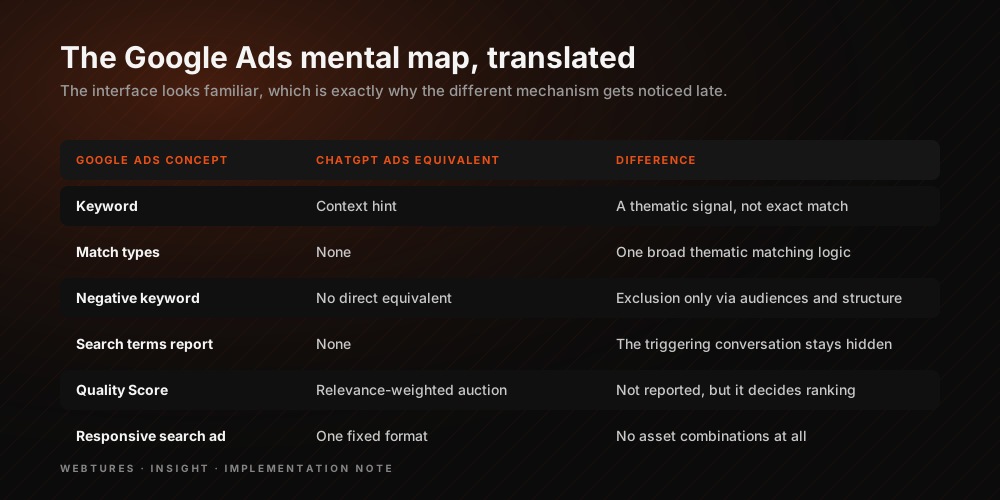
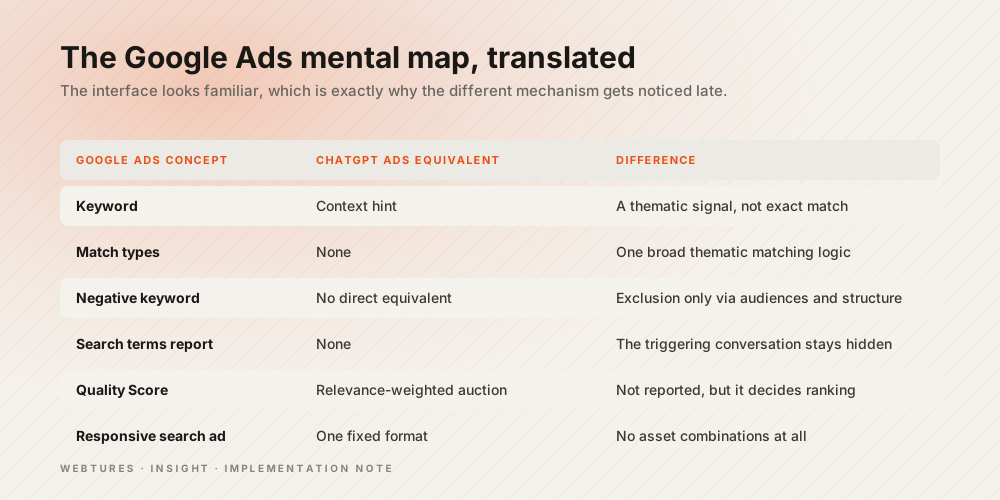
Quick comparison table
| Google Ads concept | ChatGPT Ads equivalent | Difference |
|---|---|---|
| Keyword | Context hint | Not exact match. A thematic signal. Does not guarantee delivery. |
| Match types (exact, phrase, broad) | None | A single broad thematic matching logic. |
| Negative keyword | No direct equivalent | Exclusion works indirectly through audience exclusions, ad group separation, and narrower context. |
| Search terms report | None | You cannot see the triggering conversation. |
| Quality Score | Relevance-weighted auction | Not reported as a score, but it decides ranking. |
| Ad Rank | Second-price auction, relevance-weighted | A well-written low bid can beat a poorly written high bid. |
| Responsive search ad | One fixed format: brand, favicon, headline, text, image, URL | No asset combinations. |
| View-through conversions | None | Click-based measurement only. |
| Third-party verification | None | No independent measurement partner. |
| Brand lift, incrementality tools | None | You have to design your own tests. |
| Customer Match | Custom audiences | Minimum of 25,000 matched users. |
| Ad placement | Below the answer, with a Sponsored label | Cannot appear inside the answer. |
No keywords, only context hints
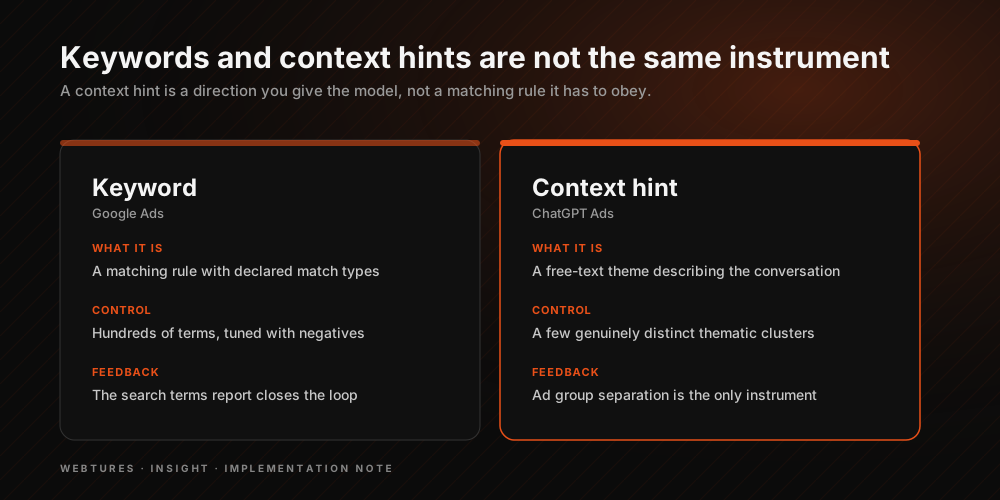
In ChatGPT Ads, targeting works through context hints defined at the ad group level. These are free-text phrases describing the conversation themes where your product or service might be relevant.
In practice, this means: when you enter organic duvet covers, you are not guaranteeing your ad will appear in conversations containing that phrase. The system reads it not as a matching rule but as a direction. How the model categorizes the conversation does not have to line up with the exact phrase you wrote.
Practical consequence: You cannot list hundreds of keywords and play with match types the way you did in Google. Instead, you need a small number of clear, genuinely distinct thematic clusters.
What to do: Build each ad group around a single intent. If you put "how to choose bedding", "best bedding brand", and "bedding discount" themes into one ad group, you will never learn which one got delivery, because there is no search terms report. Ad group separation is the only instrument that replaces the reporting you lost. That is the most practical sentence in this article.
The missing search terms report changes everything
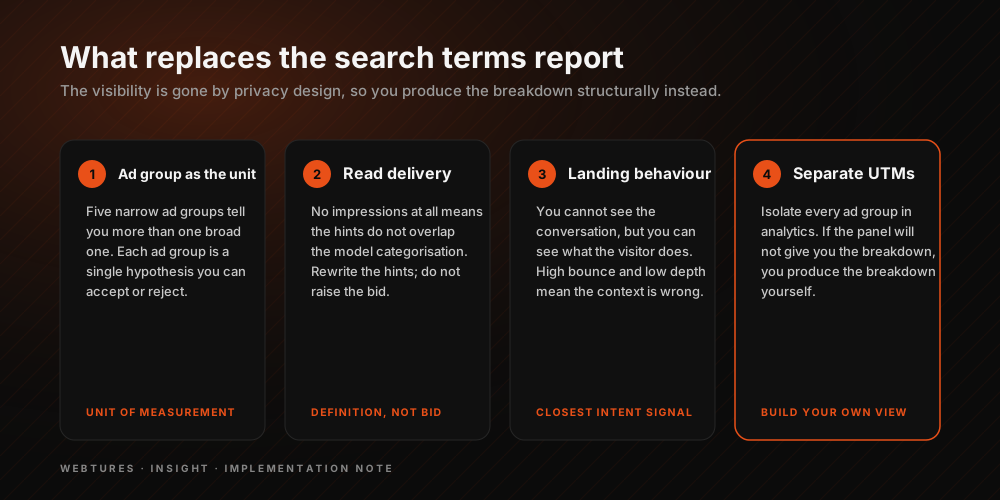
The way you optimized a campaign in Google Ads was, at its core: see which queries triggered it, negate the ones that did not work, break out the ones that did, and raise the bid.
Every step of that loop depended on visibility. In ChatGPT Ads, that visibility does not exist.
The reason is not a technical gap but a deliberate privacy design. OpenAI does not let advertisers access user chats, chat history, or memories; advertisers only receive aggregated, de-identified performance data. Which means this report is not coming any time soon either.
What to put in its place:
- Use the ad group as your unit of measurement. The query breakdown you cannot see, you produce by fragmenting the structure. Five narrow ad groups tell you far more than one broad ad group. Each ad group is a single hypothesis.
- Read delivery through impression data. If an ad group gets no impressions at all, your context hints do not overlap with the model's categorization. That is a definition problem, not a bid problem. Rewrite the hints, do not raise the bid.
- Read landing page behavior as a signal. You cannot see the triggering conversation, but you can see what the person who clicked does on your site. High bounce rate and low depth tell you the context is wrong. This is the closest intent indicator you have.
- Isolate each ad group in analytics with separate UTMs. If the panel will not give you the breakdown, you produce the breakdown yourself.
No negative keywords
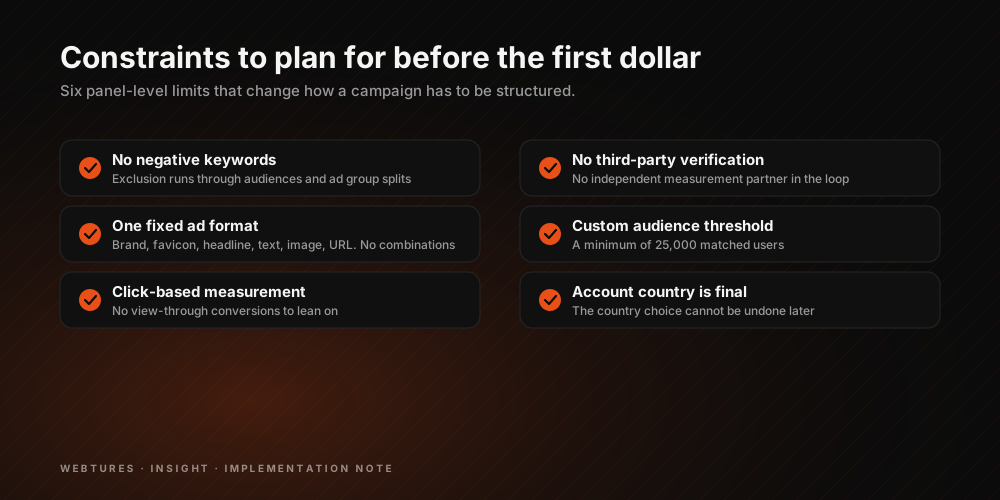
In Google, the fastest way to cut unwanted traffic was the negative list. ChatGPT Ads has no direct equivalent.
The tools you have left:
- Narrowing context hints. Reducing breadth is the primary way to reduce unwanted matches.
- Splitting the ad group. An unwanted theme can be moved into its own ad group and paused.
- Exclusion via custom audiences. You can exclude existing customers from an acquisition campaign, provided the audience clears the 25,000 matched-user threshold.
- Landing page matching. A click from the wrong context will not convert anyway; the right page at least limits the cost.
These tools do not give you the precision of a negative list. That is a cost of the channel you have to accept.
Quality Score is not reported, but it very much exists
The ChatGPT Ads auction runs on a relevance-weighted second-price model. Bid is not the sole determinant: a well-written ad with strong contextual overlap and a low bid can beat a weak ad with a high bid.
The difference from Google is that no score is shown to you. There is no number from 1 to 10, no expected CTR, ad relevance, or landing page experience breakdowns.
Practical consequence: You can only read your relevance indirectly. If you are getting more impressions at the same bid, your relevance has improved. If you raise the bid and impressions do not grow, the problem is not the bid.
What to do: Stop treating a bid increase as the first reflex. If impressions are low, check these in order: the clarity of your context hints, the overlap between headline and context, consistency between the ad and the landing page, feed health. The bid comes last on that list.
One format, zero asset combinations
In Google's responsive search ads, you wrote fifteen headlines and four descriptions and let the system generate combinations. ChatGPT Ads has no such mechanism.
The format is fixed: brand name, favicon, headline, text, image, destination URL. The only format supported on the API side is chat_card. Usually a single ad is shown per conversation.
Let us be honest about unpublished specifications: OpenAI has not published character limits or image size requirements as plain text in its official documentation. The help article says "recommended character limits" and points to the live counter inside the tool. Figures circulating in third-party sources contradict each other. The only officially published dimension is a minimum of 128x128 pixels for the favicon.
Because of this uncertainty: trust the panel's live counter, do not trust character limits from third-party blog posts.
Creative approach: Since you cannot generate combinations, every ad has to be a single, deliberately written statement. The structure that works in the field is Brand: Concrete Benefit, for example Acme: 40% faster setup. Not a pile of adjectives, but one verifiable claim. The user sees this card below an answer, at the moment of decision; a vague promise does not work there.
The measurement layer is incomplete, and you have to compensate
In-platform reporting is limited to: impressions, clicks, spend, CTR, average CPC, average CPM, and conversions if configured. CSV export is available.
What is missing: view-through attribution, brand lift, incrementality measurement, independent third-party verification.
The last item on that list is critical for enterprise advertisers. In many companies, no procurement process approves media investment without independent verification.
What you need to build:
- Conversions API (server-to-server) together with the pixel. Pixel alone undercounts because of cookie loss.
- A disciplined UTM taxonomy. Down to the ad group level. The panel will not give you the breakdown; your web analytics setup will.
- A click attribution window of at least 28 days. On this channel the decision cycle starts in the research phase; a short window punishes the channel unfairly.
- A geographic holdout test. The only way to measure incremental impact. Pick two similar regions, run ads in one, hold out the other, measure the difference.
- Blended cost tracking. Evaluating the channel in isolation produces misleading results.
Spend made before these are in place is spend that produces no learning.
The audience threshold: 25,000
Custom audiences exist; you can upload your customer list as raw or SHA-256 hashed emails or phone numbers. However, OpenAI blocks audiences below 25,000 matched users. The aim is to prevent overly narrow targeting and user identification.
Match rates are never 100% on any platform. The practical target is therefore 100,000 or more raw records. B2B companies working with lists below that cannot use this feature.
Uploaded raw files are deleted within 24 hours. Audiences can be used for inclusion, exclusion, or bid adjustment.
The account country cannot be undone
This may be the most expensive item in the article.
The country you select when opening an ad account is permanent and cannot be changed later. An account opened under the wrong legal entity cannot be corrected; you have to open a new account and lose the historical data.
Advertiser access currently covers seven countries: the US, Canada, Australia, New Zealand, the UK, Japan, and South Korea. Turkey and the EU are out of scope.
Settle these before setup: Which legal entity will open the account? Which country will the billing profile belong to? Is the payment method compatible with that country? Is your product category permitted under that market's policies?
Also: ads do not serve until the account name and logo are completed. The model is postpay; ads are billed after they run. A temporary $100 verification hold may be applied when adding a card.
In retail, you optimize the feed, not the campaign
For retail advertisers, most impressions come from the product feed. This reverses the optimization priority: feed hygiene comes before campaign settings.
The feed is based on OpenAI's Commerce product feed specification and requires an is_ads_eligible flag on every product. Uploads go through SFTP; the general API does not support feed upload.
Most rejection reasons are recurring and preventable: missing product identifiers, low-resolution images, price mismatches between feed and site, delayed stock synchronization, missing eligibility flags, and product titles that are overlong or stuffed for SEO.
Optimization effort spent on a rejected product earns nothing. Adjusting bids while your feed approval rate is low is like arranging the shop window of a closed store. This discipline underpins our e-commerce visibility work as well.
A checklist for the first 30 days
Before setup
- The legal entity opening the account has been decided (irreversible).
- The product category has been verified as permitted under OpenAI's ad policies.
- Conversions API and pixel are live, with a test conversion verified.
- The UTM taxonomy is defined down to the ad group level.
- Landing pages are ready: the relevant product or collection page, not the homepage.
- If retail: the feed is uploaded, the approval rate measured and pushed above 90%.
First launch
- One campaign, at most three narrow ad groups. Each ad group is a single hypothesis.
- Start with CPC, in the recommended $3 to $5 band.
- At least three creative variants per ad group.
- A daily budget is set, not a campaign total.
First 30 days
- Ad groups with zero impressions identified, hints rewritten (bids not raised).
- Landing page behavior compared by ad group.
- Creative rotated, winners separated out.
- A geographic holdout test designed.
Day 30 decision point
- Blended acquisition cost calculated and compared with your existing search channel.
- The scaling threshold applied exactly as it was written in advance.
Frequently asked questions
Does ChatGPT Ads have keyword targeting?
No. Instead of keywords, it uses context hints. These are free-text phrases defined at the ad group level that describe conversation themes. They are not exact match and do not guarantee delivery.
Can I see which query my ad appeared for?
No. ChatGPT Ads has no equivalent of the search terms report. This is a consequence of the privacy design; advertisers cannot access user chats. The need for breakdowns is met by narrowing the ad group structure and using a UTM taxonomy.
Can I add negative keywords?
There is no direct negative list feature. Unwanted matches are reduced by narrowing context hints, splitting ad groups, and using exclusions in custom audiences.
Is there a Quality Score?
There is no reported score, but the auction is relevance-weighted. A well-written low-bid ad can beat a weak high-bid ad. Relevance can only be read indirectly, through impression changes at the same bid.
Can I measure view-through conversions?
No. The platform offers click-based measurement only. There is no view-through attribution, brand lift, or incrementality tooling, and no independent third-party verification.
What is the minimum list size for a custom audience?
OpenAI blocks audiences below 25,000 matched users. Since match rates are never 100%, the practical target is 100,000 or more raw records.
Can I change the ad account's country later?
No. The account country selection is permanent. If a change becomes necessary, you have to open a new account and lose the historical performance data.
What are the official size limits for ad text and images?
OpenAI has not published character limits or image dimensions as plain text in its official documentation; the help article points to the live counter inside the tool. The only officially published dimension is a minimum of 128x128 pixels for the favicon.
Conclusion
Treating ChatGPT Ads like a new tab of Google Ads is the channel's most expensive mistake. The interface is familiar; the mechanism is not.
To compress the difference into one sentence: in Google you could see what was happening and intervene; here you cannot see what is happening, so you have to build a structure that makes it visible. Narrow ad groups, disciplined UTMs, server-side measurement, and geographic holdout tests are all instruments that stand in for the reporting you lost.
There is one more layer advertising cannot buy: ChatGPT recommending your brand. That is entirely organic AI visibility, in other words Generative Engine Optimization work, and it does not switch on or off with an ad budget.
The channel is young. Since February 2026 it has added a self-serve panel, CPC, oCPC, daily budgets, custom audiences, and new markets. Some points in this article will likely be outdated within six months, especially on the measurement side. Note the publication date and verify the current state of the panel before critical decisions.
This note is based on OpenAI's official documentation as of July 2026 and Webtures' hands-on work on the channel. No performance figure cited here is client data.