Google AIO and GEO Strategies: A New Era in Search Results
Explore how Google AI Overviews affect click-through rates, how AIO differs from SGE, and the GEO strategies that earn visibility in SI-driven search.



The rapid advance of SI-powered search technology is reshaping SEO strategy across the digital landscape. Google AI Overview (AIO) and Generative Engine Optimization (GEO) stand out as the two forces leading this change. AIO delivers fast, direct answers to user queries, while GEO strategies make content more intelligible and effective for these systems. Yet the new technology brings challenges for content creators alongside its opportunities. Factors such as AIO's impact on click-through rates, its relationship with organic search results, and which content types gain the most visibility all point to a new era in digital marketing.
In this article we take a broad look at the subject, from Google AIO's effect on click-through rates to the relationship between AIO and organic search results. We offer a perspective on the future of Google AI Overview and GEO strategies, and evaluate the best approaches for succeeding in content production.
How does Google AIO affect click-through rates?


One of Google AIO's most notable effects is the decline observed in organic click-through rates. According to published analyses, a drop of roughly 10 percent in click-through rates is expected because the AIO system answers user queries faster. This is driven by searches that require only simple information, such as "what is a meta description?", where users can reach the answer without clicking any page. AIO panels trigger this decline by serving the answer directly. Used well, however, these panels can become an advantage, drawing attention to your content and increasing its visibility.
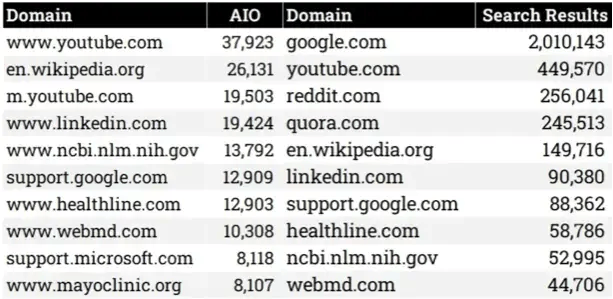
Alongside this effect, an interesting finding is that platforms such as Reddit and Quora carry less weight in this space, while social media platforms are highly visible.
The prominence of visual and professional content on YouTube and LinkedIn in particular is redirecting clicks toward different channels. This shows how important it is for GEO strategies to integrate social media content with AIO surfaces.
What is the relationship between Google AIO and regular search results?


Analyses confirm that there is no strong relationship between Google AIO (AI Overview) and regular search results. A study covering 44GB of data and more than 12 million domains found that only 12.1 percent of URLs in the top 20 search results appear in AIO citations. This data shows that a high organic ranking does not always improve your chances of appearing in the AIO panel. Ranking in the top 10 is not a prerequisite for AIO inclusion, but it does improve your odds; citations have been observed from as deep as the top 20 results.
In light of these findings, reaching high rankings through classic SEO is no longer a sufficient factor on its own for appearing in AIO. This is pushing content creators toward GEO (Generative Engine Optimization) strategies built for AIO. The context-driven, meaning-focused nature of AIO in particular demands content that is clearer and more in-depth.
Which domains are most visible in Google AI Overview?
According to the shared data, the 10 domains that gained the most AIO visibility are: byjus.com, geeksforgeeks.org, timesofindia.indiatimes.com, amazon.com, ahrefs.com, github.com, medium.com, pcmag.com, techtarget.com, and coursera.org. These sites span a wide range of categories, from technology and education to content platforms. The pattern suggests that domains offering in-depth information and content aligned with user intent gain the most ground in AIO.
On the other hand, the 10 domains that lost the most AIO visibility are: support.squarespace.com, knowledge.hubspot.com, quickbooks.intuit.com, allrecipes.com, bhg.com, bankrate.com, cnbc.com, nerdwallet.com, thespruce.com, and tiktok.com. These sites are generally known for narrower content focused on specific topics. Support pages and knowledge-base content in particular appear to be judged insufficient by AIO and pushed into the background. This confirms that AIO prioritizes broader, context-rich content.
Does organic position determine AIO visibility?
The analyses show that Google AIO does not have a strong relationship with organic search results. According to the data, 12.1 percent of sites ranking in the organic top 20 are cited in AIO panels. This demonstrates that a high organic ranking alone is not enough to appear in AIO. In addition, roughly 60 percent of AIO citations do not even come from the top 20 results. This shows that how well content matches user intent, and its capacity to deliver the right answer, matters more for AIO inclusion than organic rank.
Traditional SEO strategies, in other words, are not sufficient for AIO visibility. Google AIO prioritizes not the content that performs well in organic results, but the content that answers user questions most accurately and most quickly.
In this context, GEO (Generative Engine Optimization) strategies become critical for content creators who want to appear in AIO. These strategies require content to focus not only on keywords but also on user intent and context.
What role do forums and Q&A sites play in Google AIO?


As noted earlier, forums and Q&A sites once held a significant place in search engine results, but they do not appear to carry the same weight in the Google AIO panel.
Analyses covering 12 million domains show that sites such as Reddit and Quora have less AIO visibility than expected. One of the main reasons is that these sites tend to create wide-ranging discussion spaces rather than giving users a direct, fast answer. AIO, by contrast, favors content that can deliver quick, precise answers to specific user questions.
Frequent changes in the AI Overview panel and the value of visibility


One of the most striking characteristics of the Google AI Overview (AIO) panel is that it changes constantly. These changes demand significant flexibility and adaptability, especially in content strategy. AIO is dynamic by nature, continually reshaping itself around user intent. Google's habit of testing a carousel format in AIO panels one moment and switching to a sidebar layout the next illustrates AIO's continuously evolving character.
Another challenge these frequent changes create is the obligation to keep content current. Shifts in AIO are tied not only to user behavior but also to Google testing new formats. This means content creators need to adopt a broader strategy that accounts for the opportunities and constraints AIO presents, rather than focusing on keywords alone. Because changes are frequent, the value of visibility fluctuates quickly as well, which makes SEO strategies more flexible and faster to update.
Within the AIO system, it is essential to track which content formats are gaining ground and to produce content in those formats. Lists, comparisons, and guide-style explanations answering "what is" or "how to" questions, for example, tend to earn more visibility in AIO. Even this content, however, may need to be re-optimized over time to keep pace with AIO's dynamic structure.
How do AIOs differ inside and outside AI Overviews?
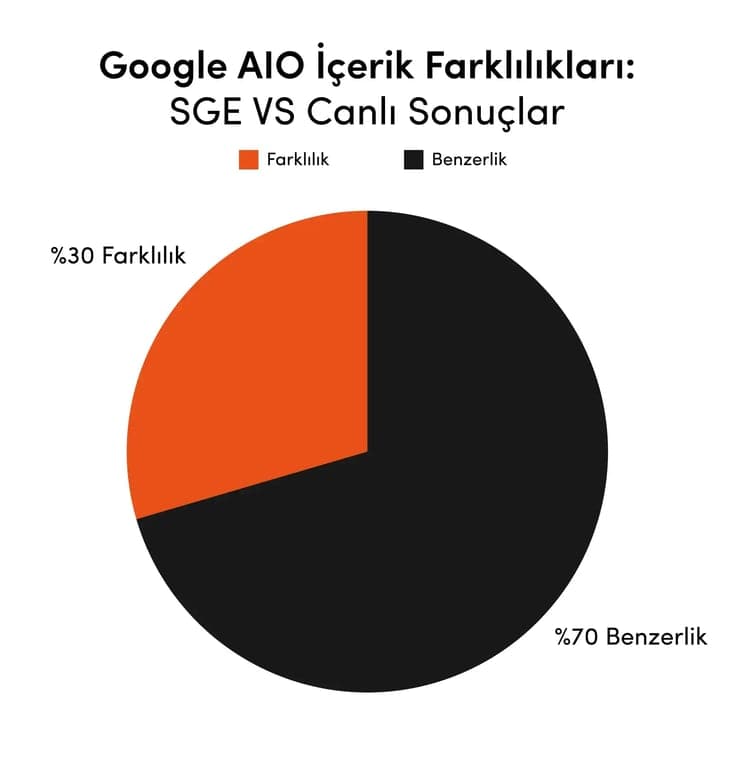
Google's SI-powered search experiences contain some fundamental differences between the AI Overviews system (formerly SGE) and individual AI Overview (AIO) results. AIOs inside AI Overviews, for example, work to understand user intent more deeply, while AIOs outside AI Overviews can offer more surface-level information. AIOs within AI Overviews tend to handle more complex queries and deliver personalized answers grounded in the user's context, giving users more meaningful and detailed information.
AIOs outside AI Overviews, by contrast, generally produce answers closer to classic search results, focused on providing faster access to information. An AIO answer inside AI Overviews offers the user a broader perspective, while AIOs outside AI Overviews generate results geared toward quick information access. This difference shows that AI Overviews is more effective at understanding user intent and shaping results around it.
Optimization strategies for earning a place in AIO
To appear in the Google AI Overview (AIO) panel, content must go beyond traditional SEO. For AIO, content needs to be intent-driven and grounded in context. In AIO optimization, content does not have to answer one specific question word for word; what matters more is delivering genuinely useful information that fits the context of the query.
Creating effective social media content
Social media platforms can be a powerful tool for increasing content visibility in AIO. Research data shows that platforms such as YouTube and LinkedIn stand out in AIO citations. On these platforms, where video and visual content dominate, effective content production creates a major opportunity for AIO inclusion. Video content in particular fits the AIO structure, where visuals and fast information carry weight.
For social media content to succeed in AIO, it needs to be user-focused and informative. Guide videos, product reviews, and short, concise explainers on social platforms can deliver a significant advantage for AIO.
Ranking in organic results
Ranking high in organic results is a meaningful advantage for Google AIO, but it is not enough on its own. A top 10 position is not a prerequisite for appearing in the AIO panel, though strong organic rankings can improve your chances.
Content that is well positioned in organic results tends to be selected by AIO more often. That does not change the fact that the content still needs to be structured specifically for AIO in line with GEO strategies.
Publishing content that matches search intent
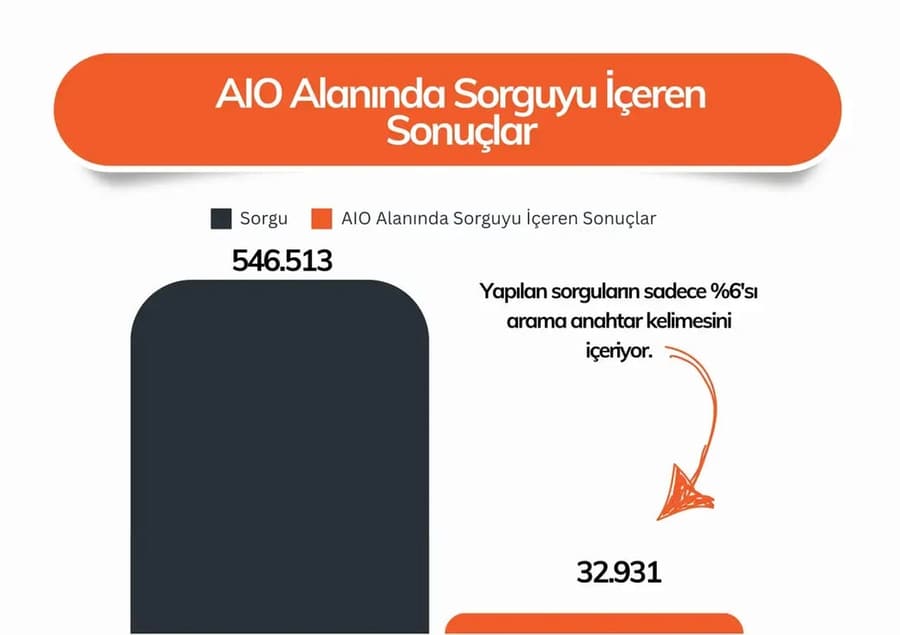
In the Google AIO (AI Overview) system, content does not need to match search queries exactly. Only 6 percent of AIO results contain the search query verbatim. This shows that AIO optimization is oriented toward understanding the intent behind the query and producing content that serves it, rather than focusing on word-level matching. For a query such as "how to choose the best computer monitor?", the content should offer comprehensive guidance on which monitor suits the user's needs, rather than listing technical specifications alone.
In this context, answers should contain guide-style explanations that serve the purpose behind the user's query instead of surface-level technical data. For a "best monitor" search, offering an evaluation based on criteria such as resolution, screen size, and use case can increase AIO visibility. Content creators should focus on producing information that serves the goal behind the query, which in turn can earn more visibility in the AIO panel.
Adopting GEO practices in your content
Generative Engine Optimization (GEO) has emerged as a new SEO strategy that lets content creators optimize their work for SI-powered systems. Unlike traditional SEO, GEO makes content easily processable not just by search engines but by SI algorithms as well.
GEO work helps SI understand content better while ensuring that content is presented in a way that fits user needs. For a query such as "what is smart home technology?", the answer should offer comprehensive guidance on how these technologies integrate into daily life rather than merely listing device specifications. SI systems can analyze GEO-optimized content more effectively and deliver faster, more accurate answers to users, which can increase visibility both in the AIO panel and in general search results.
The future of Google AI Overview and GEO
It is clear that earning visibility in Google AI Overview still holds unexplored territory, and that calls for greater flexibility and more user-focused approaches in content production.
As SI-powered systems advance, content needs to be optimized not only around keywords but around context and meaning. This helps users reach the information they seek faster and more effectively, while obliging content creators to develop strategies better suited to SI systems. GEO strategies enable SI to analyze content in greater depth, and in doing so they open a new era in the world of SEO.
Source: https://www.growth-memo.com/p/ai-on-innovation & Sinan Gergöy