Social media management is the whole process a brand runs to understand its audience, produce content on the right platforms, build relationships with its community and measure how that work contributes to business results. Strategy, content calendar, design, publishing, customer communication and reputation management are complementary parts of that process.
AI can speed up many stages of this structure. It can extract content topics from customer questions, turn one expert interview into several formats, classify comments and make patterns in performance data visible. But what the brand stands for, which claims it can prove and which promises it can make to customers remain the organisation's responsibility.
That is why a strong social media programme opens with this question: which person's decision are we trying to help, and with what knowledge and experience? Platforms, content, AI tools and budget all take shape around the answer.
In this guide we treat social media alongside search visibility, content strategy, brand reputation and commercial goals. Someone discovering a brand in a video, researching it in a search engine, asking an AI assistant about it and later requesting a meeting can all be touches on the same decision journey. Between those touches there has to be consistent information and a clear next step.
The guide covers the basic concepts, platform selection, content production, a sample calendar, performance measurement and AI agents as a workable framework. It is written for business owners, marketing teams and people who want to specialise in social media. The numeric worked examples and sample projects are illustrative; they are not presented as Webtures client results.
Five decisions to start with: Who do you want to reach? Which need will you meet? Which channels suit that need? How will you verify the information you produce? Which business result will you judge success by?
What is social media, and how does it differ from social networks?
Social media covers the digital environments that let users create, share and discover content, and interact around it. The idea of a social network focuses instead on the connections between the people, organisations and communities inside those environments.
Publishing an expert video is a social media activity. The relationships that develop around that video among peers, customers and followers are part of the social network. In practice the two overlap heavily; the same platform serves both content distribution and relationship building.
For brands it helps to hold four concepts together:
| Concept | Scope | Example for a brand |
|---|---|---|
| Social media | The environment for content, discovery and interaction | Publishing a video explaining how a product is used |
| Social network | Relationships between people and organisations | Staying in continuous contact with industry professionals |
| Social media marketing | Activity aimed at commercial goals | Generating qualified enquiries or product requests |
| Social media management | Strategy and daily operations together | Running planning, production, replies, measurement and improvement |
One distinguishing feature of social media is that the audience can join the conversation directly. People ask questions, share experiences, dispute a claim or redistribute the brand's content with their own commentary. That gives brands a chance to learn, and it also means sharing control over the communication.
Social media advertising can make it easier to reach defined audiences and to measure many interactions. Even so, lower cost, higher sales or unlimited reach are not guaranteed outcomes for every brand. Competition, the offer, creative quality, customer experience and the measurement method all change the result.
Why does social media matter for brands?
Social media can help potential customers notice a need, research their options and assess a brand's credibility. After the sale it keeps working for support, sharing experiences and learning new uses.
DataReportal's Digital 2026: Turkey report states that in October 2025 there were 62.3 million active social media user identities in Türkiye. That is not a count of unique people. Some of the report's platform figures are below; they should not be read as live user counts for September 2026. DataReportal, Digital 2026: Turkey
| Platform | Size reported at the end of 2025 | What the measure means |
|---|---|---|
| 62.3 million | Potential reach reported by the ad tools | |
| YouTube | 57.9 million | Advertising reach |
| TikTok | 44.9 million | Advertising audience aged 18 and over |
| 34.7 million | Advertising reach | |
| 21 million | An indicator based on registered members |
Advertising reach is not the same thing as monthly active users. LinkedIn's member measure cannot be compared directly with the other rows either. Because the same people appear across platforms, these figures cannot be added up to calculate unique social media users in Türkiye. DataReportal, Digital 2026: Turkey
For a brand the right question is less whether it is present on the biggest platform than what need its own customers are spending time there for. Reach potential is one input to channel selection; product, customer and content fit have to be assessed separately.
A social media programme can be built around five functions:
- Discovery: people who do not yet know the brand encountering it through a relevant problem or need.
- Consideration: expertise, product usage, comparison and customer experience content making the decision easier.
- Demand creation: people moving to a next step such as a product review, a meeting, a quote or a trial.
- Relationship building: questions getting answered and customers getting more value out of what they already use.
- Learning: recurring objections, expectations and problems feeding back into product, service and communication decisions.
All five should not be expected from the same post. An explainer video can build trust while a comparison table makes the decision easier. Performance should be judged against the job the content was given.
The evaluation approach we recommend in this guide is to bring those five functions into one shared report. The content team shows which questions were answered, the performance team the relevant traffic, the sales team the quality of demand, and the customer team the friction in the experience. That way the discussion moves from "let's post more" to which stage needs improving and why.
How should social media algorithms be understood?
Content distribution on social platforms is shaped by recommendation systems as well as follow relationships. Meta explains that Feed, Stories, Reels and other surfaces on Facebook and Instagram have different ranking systems, and that those systems use a range of signals to predict a user's interest. That means you should not expect a single posting formula to produce the same result on every surface. Meta: how content is ranked
YouTube likewise states that its recommendations draw on feedback including watch behaviour, likes, dislikes, subscriptions and satisfaction surveys. So while watch time is a valuable indicator, it does not on its own explain the whole distribution logic. YouTube: how recommendations work
In the area a brand does control, this approach works:
- Make the subject and the expected benefit clear in the first sentence or the first shot.
- Deliver in the content what the headline promised.
- Cut unnecessary repetition and make examples and evidence visible.
- Retell the same idea in a way that suits how the platform is consumed.
- Assess whether the people the content actually reached overlap with the target audience.
A post getting high views does not by itself show the brand reached the right people. Equally, low reach does not mean the content produced no commercial value. Conversations that start with a small but relevant group of decision-makers can be worth more than a large, irrelevant audience.
How is a social media strategy built?
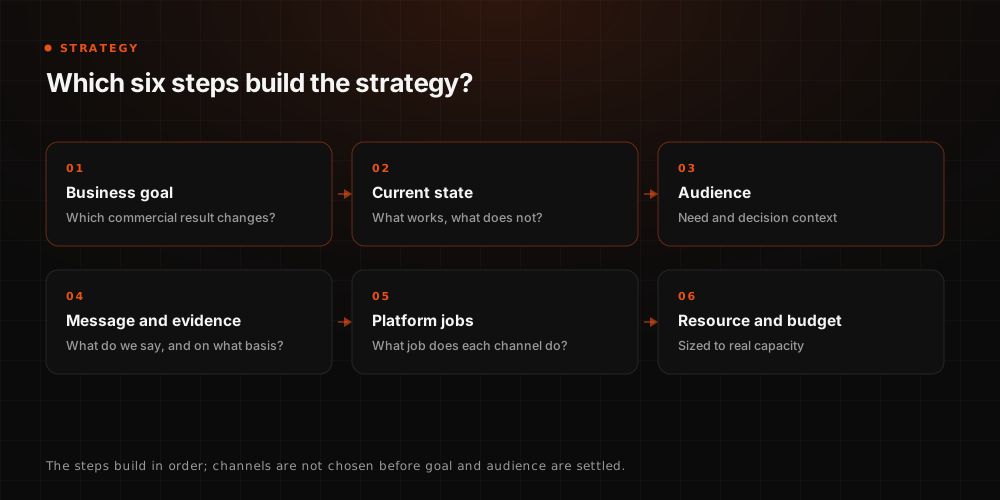
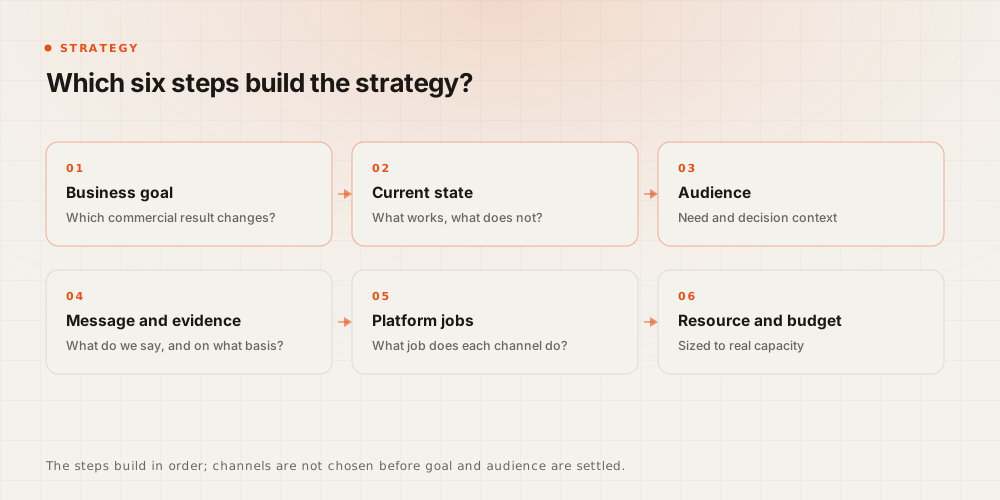
A social media strategy is the set of decisions about audience, business goal, brand message, platform selection, resource use and measurement method. The content calendar is what puts that strategy into practice.
1. Define the business goal
"Looking more active" or "growing followers" are not clear enough goals on their own. You have to establish which result the business is trying to improve: qualified sales conversations, product trials, appointments, repeat purchase, community participation or support efficiency.
Example goal: a B2B software brand taking monthly demo requests that come from social media and are accepted by the sales team from 20 to 30 within 90 days. That is a 50% increase; the figures are illustrative and are not an industry benchmark. The definition of an "accepted request" should be set in advance, against criteria such as company profile and genuine need.
Every headline goal needs a balancing measure alongside it. If request volume rises while request quality falls, the programme cannot be called successful. If content production speeds up while the number of errors needing correction grows, the efficiency claim has to be re-examined.
2. Review the current state
For a first assessment, look at the last 90 days of content, comments, enquiries and sales feedback together. Use a longer window if the account is young or the sales cycle demands it.
Tag each piece of content with topic, audience, format, publication date, time spent and outcome. Look not only at the highest-reach posts but at the ones that brought the most qualified questions, got saved, or were remembered in a sales conversation. Look for repeating patterns rather than one successful post.
3. Define the audience by need and decision context
Age, city and job title give a basic frame. But good content decisions need an understanding of the job the person is trying to do, the problem they are avoiding and the evidence they need. The full method is in the audience segmentation guide.
| Audience | Problem they are solving | Question that makes deciding hard | Useful content |
|---|---|---|---|
| Company founder | Managing growth more predictably | How will the return on this investment be measured? | Analysis linking cost to outcome |
| Marketing manager | Improving the team's production and measurement capacity | How does it fit our existing processes? | Workflow, comparison and an implementation example |
| Technical decision-maker | Safe, sustainable integration | Which systems will the data go to? | An explanation of data flow and permission boundaries |
| End user | Getting daily value from the product | How does it work in my situation? | A real usage demonstration and FAQs |
AI can be used to group consented, properly prepared customer interviews or support records into topic clusters. The segments the model proposes should not be accepted as customer reality; they have to be tested against interviews, sales records and behavioural data.
4. Set the brand message and its evidence
Write in a few sentences what the brand wants to be authoritative on. Then put the basis next to each claim: original research, a product demonstration, expert experience, a method explanation, or a customer result you have permission to use.
For example, "we increase efficiency with AI" is broad. "We design human-approved response flows that classify support requests by topic and urgency" makes the actual work visible. If a time or cost saving is claimed, the measurement period, the baseline and the scope have to be stated as well.
5. Give each platform a job
Set a primary role for every platform. One channel can carry expertise while another shows product usage; a messaging channel can support the conversation after an enquiry. The same brand does not need to be on every platform at the same frequency with the same content.
6. Size resources and budget against real capacity
The cost of a social media programme is team time, external production, software, media investment, creator partnerships and measurement. The absence of ad spend on organic posts does not mean production is free.
When calculating capacity, count research, shooting, editing, review and community management together. Giving all of a 20-hour weekly team capacity to content production, for instance, can leave comments and analysis unowned. Keep real time records in the first month and set the next month's publishing volume from them.
Which social media platforms should you use?
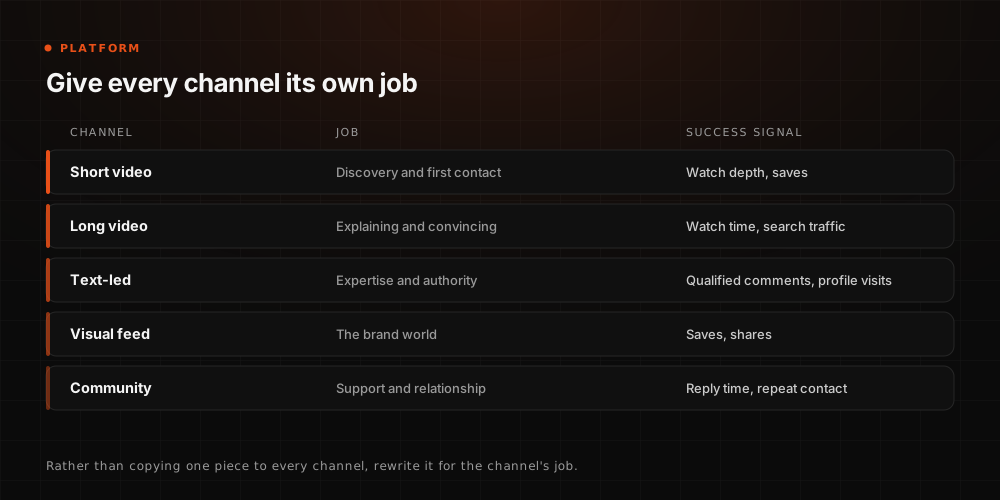
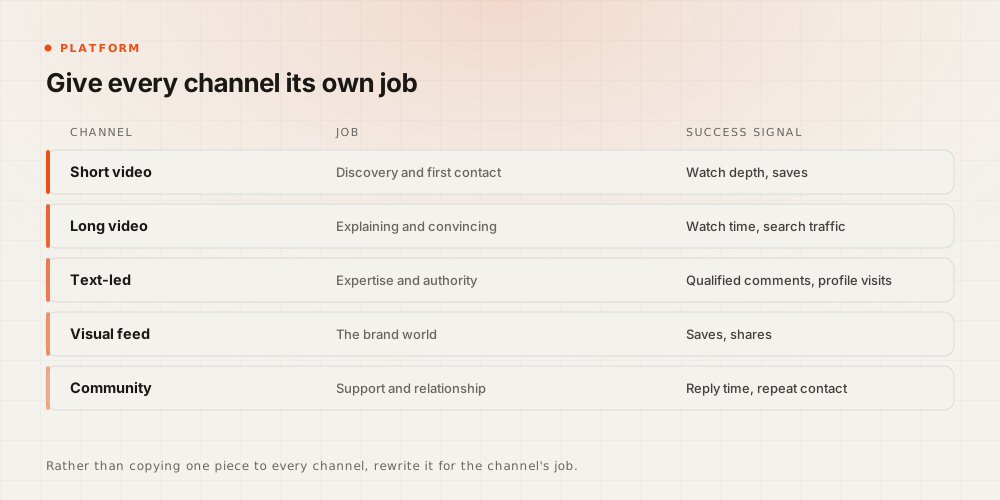
Platform selection is more than ranking the most popular apps. Audience behaviour, content production capacity and the expected action have to be assessed together. The table below is a starting hypothesis; it should be validated against the brand's own data.
| Platform or environment | Role worth considering at the start | Content approach | Result you can measure |
|---|---|---|---|
| B2B expertise, corporate trust, business relationships | Experience analysis, document posts, expert video | Conversations from relevant job titles, qualified enquiries | |
| Visual storytelling, product discovery, brand affinity | Usage demonstration, Reels, carousels, Stories | Saves, meaningful messages, product or appointment requests | |
| YouTube | Detailed learning and evaluation | Training, comparison, demo, Q&A | Audience retention, relevant visits, trial requests |
| TikTok | Discovery through short video and creative format testing | Natural delivery, usage scenarios, Q&A | Relevant viewers, profile visits, requests |
| Community and local communication in suitable segments | Group participation, events, explanatory content | Community participation, local enquiries | |
| Visual research and planning | Idea boards, use cases, visual guides | Saves and relevant page visits | |
| X and Threads | Current debate and expert commentary | Short analysis, assessment of a development | Qualified discussion and relevant profile visits |
| Reddit and industry forums | Understanding problems and contributing openly as an expert | Replies that follow community rules and disclose the relationship | Question quality, needs learned, relevant visits |
| WhatsApp and similar messaging | Conversation, support and customer relationship | One-to-one communication fitting the request context | Requests resolved, appointments, customer satisfaction |
The reach and privacy logic of messaging environments differs from public social feeds. Someone asking the brand a question should not be turned into an assumption that they consented to every subsequent marketing message.
LinkedIn's official page guidance supports completing company information, formats such as documents and video, publishing scheduling and the use of page analytics. These can be the basic tools of a B2B programme; general performance claims a platform publishes do not promise automatic results on a brand's own account. LinkedIn Pages guidance
Choosing two priority channels at the start is a manageable experiment for most teams. A consultancy brand might test LinkedIn and YouTube; a business selling a visual product might test Instagram plus a second discovery channel that suits it. At the end of a four to six week pilot, content quality, the quality of incoming demand and production cost should be assessed together. Long sales cycles need more time before revenue impact can be read.
How should new platforms and private communities be assessed?
A new social network growing quickly does not require the brand to build a large operation there immediately. First examine whether target customers are genuinely active, how the conversations relate to the brand's expertise, and whether the team has capacity to contribute. Separate membership counts from regular participation.
At the start of a pilot, write down the purpose, the duration, the effort allocated and the condition for continuing. For instance, six weeks aimed at learning the relevant industry questions and assessing the feedback expert answers receive. That duration is a research suggestion; it does not provide sufficient sales measurement for every business.
In closed communities, understand the rules and members' expectations first. Rather than accounts that hide the brand relationship, artificial praise or constantly dropping links, contribute under a clear identity and only to the extent the question requires. Moving a community's data into external tools requires a separate permission and data assessment.
What is social search, and how does it work with SEO?
Social search is people looking on social platforms for an answer, a product experience, a comparison or a local recommendation. The context differs between content encountered by chance in a feed and content sought out to answer a specific need. A brand should produce content suited to both. We cover the generative-answer side of search on the GEO service page.
Sprout Social's Q2 2025 research was conducted between 23 April and 5 May 2025 with 2,280 social media users in the US, UK and Australia. In that sample, 41% of Gen Z respondents said they turn to social platforms first when looking for information. This figure is not a rate for Türkiye; it points to a behaviour brands can research within their own audience. Sprout Social Q2 2025 research
Turn search need into a content plan
Customer interviews, sales questions, on-site searches and the question patterns seen on platforms can be pooled into one topic bank. A phrase appearing in a search suggestion does not by itself prove its search volume. The question bank should be prioritised with real customer feedback.
| Need | Example question | Social content | Complementary content on the site |
|---|---|---|---|
| Understanding a problem | Why doesn't social engagement turn into enquiries? | Short video explaining measurement errors | Detailed measurement guide |
| Comparing options | Which review steps does AI content production need? | Carousel showing the review stages | Process explanation and a working template |
| Seeing it applied | How is the product used in a small workspace? | Usage demonstration with real dimensions | Product dimensions and setup information |
| Assessing trust | How is this service actually run? | Process walkthrough with an expert | Scope, deliverables and verifiable examples |
The title, the opening description and the narration inside the video should focus on the same question. Rather than attaching a topic to popular tags alone, explain the relevant terms in natural language. Captions, readable on-screen text and accurate profile information make the content easier to understand. Do not plan for fields or search features the format does not support as though every platform had them.
What should social media and SEO teams share?
The queries the SEO team sees can give the social content team new angles. Objections raised on social can help improve the site's service pages and guides. If "what does this service include?" keeps coming up, both an explainer video and a clearer service page may be needed.
That shared work does not mean reporting a post's likes as a direct Google ranking gain. Social content can create different touches: relevant visits, brand research or awareness among third parties. Which one actually happened has to be measured. Successful distribution on a platform and a web page's search performance are separate results.
From the Webtures perspective, the thing that connects social search, SEO and AI visibility is the question the user is looking to answer. The same knowledge base is kept; the telling changes with the channel and the decision stage.
How is social media content produced?
Producing content is broader than putting text on an image. Good content answers a specific question, shows the brand's point of view and, where needed, backs that view with evidence.
Define your content areas
A sustainable programme rests on a few topic areas that can be worked repeatedly. The structure below adapts to different industries:
| Content area | Core function | Example |
|---|---|---|
| Understanding the problem | Making the need visible | Why does demand not appear despite producing a lot of content? |
| How to | Providing applicable knowledge | How is a social media report matched to business goals? |
| Evidence and experience | Building trust | A project assessment with the measurement method disclosed |
| Comparison | Making the choice easier | When is in-house production preferable to outsourcing? |
| People and approach | Showing how the brand works | Experts checking the claims inside a piece of content |
| Offer and next step | Turning interest into action | Reviewing the relevant guide or requesting a meeting |
The proportions between these areas change with the goal and the customer journey. There is no education, entertainment and sales percentage that holds for every brand. Treat the first calendar as a hypothesis and update it as results arrive.
Choose the format from the job to be done
A format's popularity should not be the reason for choosing it on its own. Content should be designed around what the reader needs to understand and how.
| Format | Suitable use | What to watch in production |
|---|---|---|
| Short video | One question, a usage demonstration, a short explanation | Explain the subject early; match the footage to the claim |
| Carousel or document | Stages, comparison, checklist | Give each page one job; end with an applicable step |
| Long video | Detailed training, demo, expert interview | Topic flow and examples; chapters where needed |
| Live stream | Interactive Q&A and product introduction | An authorised speaker, moderation, and follow-up on unanswered questions |
| Ephemeral post | Daily developments and contact with the existing community | The feature existing on that platform; a permanent home for critical information |
| Case or experience story | Explaining the method and the result together | Baseline, period, scope, permission and measurement limits |
Rather than fixing second-by-second thresholds for video openings or durations that supposedly work on every account, examine your own audience-retention data. Length should carry the explanation the topic needs; both padding and context-destroying cuts should be avoided.
Write a short brief for every piece
Before production starts, these fields should be settled:
- The audience and the core question to be answered.
- The single main message of the content.
- The data, expert view or real example to be used.
- The platform, the format and the expected action.
- Who will check the claims.
- The publication date and the criterion for assessing it.
Example: a carousel for marketing managers answering "how do we protect the brand voice while increasing content production speed?" The main message is that approved information and tone examples have to be defined first. The evidence is a real editorial review process; the call to action is for the reader to assess the checkpoints in their own process.
Build the backbone of the narrative
Many pieces can use this flow: situation or question, explanation, example or evidence, applicable step. Video and text can keep the same flow; the length and the visual structure change.
In a video titled "three ways to improve quality in AI content", for instance, you can start by showing a concrete error. Then explain why it happens, how it is caught and what the reader can change in their own process. That builds a clear link between the headline and the content.
Make accessibility part of production
Review captions on video, use sufficient contrast in visuals, and avoid text that cannot be read on a small screen. Label axes, dates and units on charts. Where the platform supports it, write meaningful image descriptions.
One expert video can become a long guide, a short video, a checklist and a Q&A piece. Each derivative has to stand on its own, and the context, date and limits of any quoted view have to be preserved. Copying the same sentences across platforms does not meet different content needs.
How is social media content produced with AI?
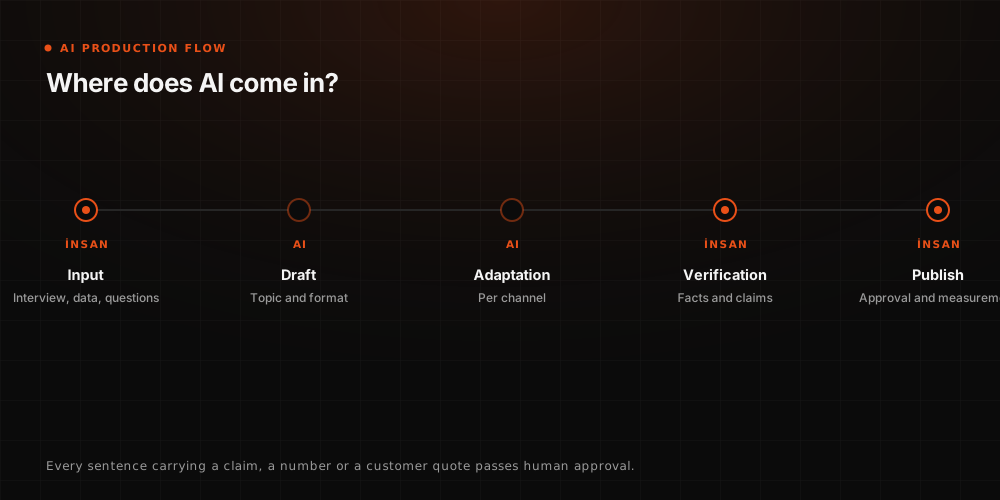
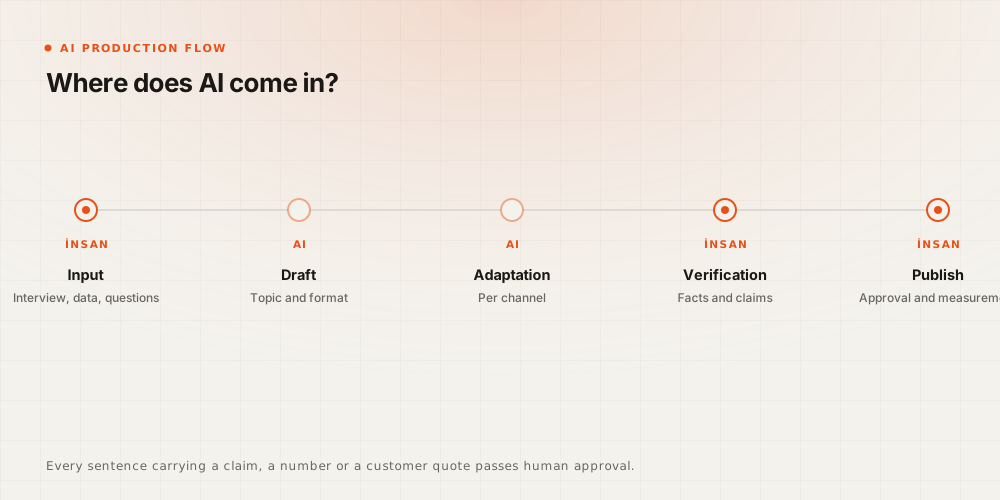
The most valuable inputs for generative AI are the brand's own verified knowledge and experience. Production that starts with a generic prompt can end in generic text. A good starting pack contains the audience, the brand approach, approved claims, product information, sample content and phrases to avoid.
NIST identifies generative AI presenting wrong or fabricated information confidently as a distinct risk. Fluent text is therefore not proof of accuracy. Appearing to cite a source does not on its own prove the source exists or supports the claim. NIST generative AI profile
An AI-assisted production flow
The flow below is a working model we recommend for marketing teams:
| Stage | The AI's job | Human responsibility |
|---|---|---|
| Insight preparation | Grouping prepared questions into topics and needs | Assessing sample representativeness and data use |
| Topic development | Proposing different angles and content outlines | Choosing the brand priority and the original contribution |
| Draft production | Drafting text or a script from approved sources | Checking claims, meaning and tone |
| Format adaptation | Adapting the same source to different channels and lengths | Making sure context and message survive |
| Quality control | Flagging missing sources, inconsistencies and risky phrasing | Opening the source, verifying data and deciding on publication |
| Assessment | Summarising performance data and proposing tests | Questioning causal claims and making the decision |
Every important fact in the brand's knowledge base needs a source, a date and an owner. When price, campaign, product scope or service terms change, that base should be updated first. That reduces the chance of old information being reproduced across new content.
Building an AI system that reaches your sources does not mean retraining a model each time. Supplying approved documents as context to a draft when needed can be enough. That approach does not guarantee accuracy; it provides a starting point you can check.
How is the brand voice protected when using AI?
Brand voice cannot be left to a prompt made of a few adjectives. "Write professionally and warmly" can be read many ways. Prepare a short editorial reference the team and the AI tool can both use.
| Area | What the reference must contain | Example application |
|---|---|---|
| Reader | Knowledge level, role and decision need | Explaining to a marketing manager through process and measurement |
| Word choice | Terms and first-use explanations | Explaining UTM at first mention as a campaign tracking parameter |
| Evidence standard | Which claim is backed by which document | Giving the period and calculation method next to a result rate |
| Delivery | Sentence length, address, use of examples | Explaining the technical idea first, then a short applied example |
| Language to avoid | Vague superiority and guarantee phrasing | Not using unevidenced "best", "guaranteed sales", "error-free automation" |
| Reference content | Approved and critiqued examples | Noting why a paragraph was changed |
In this guide we work from a delivery that is clear, instructive, open about its sources and connected to a business result. Technical detail is used when it helps the reader's decision. Instead of repeating the same opening and the same call in every piece, the flow follows the real question of the content.
When adapting content from another language, review country, currency, product availability, dates and regulation as well. Translation alone does not validate local context. Tone review and fact review should run as separate jobs.
Four prompt examples you can use
1. Building a topic map from customer questions
Review the de-identified customer questions below.
Classify each question by need, decision stage and recurring theme.
For every theme, show the record numbers that support it.
Do not invent customer attributes or statistics the data does not support.
Finally propose 8 content topics; write the question each one answers.
Also state which groups are missing or under-represented in the sample.
2. Producing a source-backed content draft
Audience: [definition]
Platform and format: [details]
Question to answer: [question]
Brand approach: [short description]
Approved sources: [documents and links]

Write a content draft supported by these sources.
Separate facts, interpretations and recommendations.
Do not invent numbers, customer results or quotes that are not in the sources.
Rather than putting unsupported claims in the draft, list them in a check list.
Use one main message and one next step appropriate for the reader.
3. Turning one expert piece into several formats
Use the approved expert interview below as the base.
Prepare a LinkedIn post, a carousel outline and a short video script.
Focus each format on a different reader question.
Do not add new claims to the expert's view; preserve the scope of the examples.
When quoting directly, indicate the relevant part of the interview.
Make sure each piece stands on its own.
4. Performance review and experiment design
Using the table provided, review the content by objective, topic, format and result.
State missing metrics and non-comparable records first.
Do not present correlation as causation.
Propose at most 3 tests. For each, write the hypothesis, the element to change,
the primary measure, the balancing measure and the decision rule.
Where the data is insufficient, state plainly which decision we cannot make.
How is AI efficiency measured?
Measuring only how many seconds a draft takes is misleading. Research, prompt preparation, verification, editing and re-production times all have to be counted.
In a sample pilot, twelve pieces of similar difficulty can be split: six through the existing process, six with AI support. Topics and formats are balanced; total team time, the number of significant errors, tone fit and audience assessment are recorded. Such a small pilot does not give a definitive scientific result; it helps you see the bottlenecks in the workflow.
Net time saved = total time in the existing process − total time in the AI-assisted process. If the quality measures are not holding, a shorter clock alone should not count as success.
How is a social media content calendar built?
A content calendar shows what will be published, for whom, for what purpose, where, when and under whose responsibility. When it also carries the post-publication review date, it links operations to learning.
A working calendar should carry: content ID, date and time zone, platform, audience, topic, format, main message, source, owner, approver, status, link, measure and review date. If AI was used, its role in production and, where required, the disclosure obligation can be recorded too.
The suggested status flow is idea, in production, in review, approved, scheduled, published, reviewed. Someone has to be able to stop planned content when a campaign date, stock or the news agenda changes.
A four-week social media content calendar example
This example is an AI and digital strategy content series that could be planned for Webtures; it does not show the results of a campaign that ran. Four posts a week is a starting plan, not a universal ideal. Times should be chosen from the account's own history and the audience's time zone.
| Week / day | Channel and format | Topic | Purpose / next step | Primary measure |
|---|---|---|---|---|
| 1 / Monday | LinkedIn, expert view | Why do teams producing a lot of content keep hitting the same problems? | Define the problem; invite people to share experience | Meaningful comments from the target audience |
| 1 / Wednesday | Instagram, carousel | 5 things to check before publishing an AI draft | Provide usable knowledge | Saves and relevant questions |
| 1 / Thursday | YouTube, explainer | How is a brand knowledge base prepared? | Show the application; move to the relevant guide | Audience retention and relevant visits |
| 1 / Friday | LinkedIn, document post | An example content brief | Make a process easier to apply | Qualified questions and interest in the document |
| 2 / Monday | LinkedIn, analysis | Why should request volume and request quality be tracked together? | Improve the measurement approach | Engagement from relevant decision-makers |
| 2 / Wednesday | Instagram, short video | How is a real product claim verified? | Make the review process visible | Views and on-topic messages |
| 2 / Thursday | YouTube, application | Turning one expert interview into 3 content formats | Teach the method | Relevant views and feedback |
| 2 / Friday | LinkedIn, comparison | Should content production be run in-house or outsourced? | Make the decision easier | Qualified meeting requests |
| 3 / Monday | LinkedIn, case review | What a documented process improvement taught us | Present evidence | Relevant visits and enquiries |
| 3 / Wednesday | Instagram, carousel | 4 mistakes made when calculating engagement rate | Measurement literacy | Saves and shares |
| 3 / Thursday | YouTube, expert Q&A | How can social content connect to AI answers? | Explain the limits and the opportunities | Question quality and views |
| 3 / Friday | LinkedIn, discussion | Which replies are appropriate to automate? | Learn the needs | Comments containing original examples |
| 4 / Monday | LinkedIn, method | The first decisions in a 90-day social media plan | Establish implementation priority | Relevant meeting requests |
| 4 / Wednesday | Instagram, short video | The difference between a negative comment and a violating one | Explain community management | Qualified feedback |
| 4 / Thursday | YouTube, review | What can be concluded from one content experiment? | Show the learning method | Audience retention |
| 4 / Friday | LinkedIn, open invitation | What is the biggest bottleneck in your team's content process? | Identify relevant needs | Suitable enquiries and meetings |
If there is no real, permission-cleared data for a case piece, explain the method instead. Invented results must not be presented as genuine customer success. Daily comment monitoring and support operations should be planned independently of the post count in the table.
How do you find the best posting time and frequency?
To start, pick a few time slots from the account's own analytics. Test similar topics and formats at different times in a repeating pattern. Do not draw firm conclusions from one post; weigh the effect of the news agenda, audience size and content quality together.
If average content quality, qualified engagement and team capacity hold as frequency rises, expanding can be considered. If replies are getting late and pieces repeat one another, cutting volume and improving quality is the better move.
How do organic content, advertising and creator partnerships work together?
Organic content can be used to explain the brand's approach and build a regular relationship. Paid distribution supports reach against a defined goal and audience. Creator partnerships create a different kind of touch through one person's storytelling and their relationship with a community.
Not every piece with high organic engagement needs to be amplified with ads. First check how that engagement relates to the target audience and what the content's next step is. An education-led piece can build awareness; a direct-response ad may need a different offer and landing page.
Alongside follower count, assess these when choosing a partnership:
- How well the community overlaps with the brand's target audience.
- The quality of the comments and whether the questions are genuine.
- Whether the creator understands the product and can describe it accurately.
- Disclosure of the commercial relationship and clarity of usage rights.
- Measurement links, content approval and responsibility for corrections.
Resharing a piece on the brand's own account, using it in advertising, or producing new AI versions of it are different forms of use. Permission and contract scope have to be assessed separately for each.
The difference between UGC, paid creator content and synthetic delivery
UGC is an abbreviation for user-generated content. In practice the name is also applied to paid creator videos made in a customer-experience style. So as well as how a piece looks, who produced it and under what relationship has to be made clear.
| Content type | Its basis | The brand's decision |
|---|---|---|
| A real user's experience | The person's own use and opinion | Permission to reuse, context, and conveying the experience accurately |
| Paid creator work | A commercial agreement and creative production | Disclosing the commercial relationship, accurate product description, usage scope |
| AI character or synthetic delivery | Generated image, voice or persona | Not creating the impression of genuine customer experience; disclosure and rights checks |
Someone having posted content on their own account should not be turned into an assumption that the brand can use it in advertising without limit. In the partnership definition, publication channels, usage period, paid distribution, editing, use of voice and face, and any need to derive versions through AI should all be assessed explicitly. The rights scope for a concrete use should be verified through the relevant permissions and contracts.
To select a creator, review several candidates' sample content against the same brief. Can they explain the relevant product questions clearly? Do they only watch their community, or do they also ask questions about the topic? Are there repetitive comments unrelated to the product? These are inputs to the assessment; a single sign is not proof of fake engagement.
A longer partnership can help a creator learn the product and the community's questions better. But extending the duration does not automatically produce success. Message accuracy, production discipline, relevant traffic and demand quality from the first pieces should be reviewed together.
How should platforms' creative AI tools be used?
TikTok's Symphony Creative Studio documentation, updated in June 2026, describes capabilities such as video production, voiceover, translation, dubbing and editing. The same document states explicitly that the tool has no direct connection to the TikTok algorithm. Producing content with a platform's own AI tool should therefore not be presented as a guarantee of distribution advantage or higher sales. TikTok Symphony documentation
When assessing a creative production tool, check visual accuracy, correct product representation, pronunciation in the target language and usage rights. When assessing ad optimisation, examine the objective, the conversion data and the budget limits. The ability to produce content and the ability to reach the right person economically are different functions; their results should be measured separately.
How is social media performance measured?
A good report has a structure that starts with the content published and ends at a business decision. It should answer "what happened?", "why might it have happened?" and "what will we change now?" The AI and agentic analytics page sets out a detailed framework for building the measurement architecture.
Choosing metrics that fit the goal
| Goal | Primary indicator | Measure to read alongside it |
|---|---|---|
| Reaching the relevant audience | Reach with an audience breakdown where available | Frequency and the quality of engagement |
| Seeing the value of the content | Saves, shares, meaningful questions | The content's purpose and the audience reached |
| Improving video quality | Audience retention and average view duration | Video length, source and format |
| Driving interest to the site | Relevant sessions and target page visits | On-page behaviour and measurement gaps |
| Creating demand | Accepted enquiries, appointments or trials | Progression to sale and unit cost |
| Improving the customer relationship | Requests resolved and time to first meaningful reply | Recurring problems and satisfaction |
| Improving production | Total team time per piece | Significant errors and rework rate |
Reach is generally a measure of de-duplicated accounts and impressions a count of times content was displayed; check each platform's own definition. Adding reach across platforms does not produce a de-duplicated count of people, because the same person can appear on several channels.
Core formulas
Engagement rate on reach (%) = total selected interactions / reach × 100.
For 10,000 reach and 400 combined likes, comments, saves and shares, the rate is 4%. That is a transaction rate; because one person can interact more than once, it does not mean exactly 4% of people engaged. The report has to state plainly which interactions were counted.
Session-based enquiry rate (%) = relevant sessions with an enquiry / total relevant sessions × 100.
Cost per qualified enquiry = the period's defined social media cost / number of qualified enquiries.
ROAS = revenue attributed to advertising / advertising spend.
ROAS is revenue-focused; it does not directly account for product cost, returns, team or production expenses. A ratio calculated with total social media cost should not be reported under the same name as a ROAS that uses ad spend only.
UTM, web analytics and the CRM link
UTM parameters make it easier to associate traffic arriving through a link with a source, campaign and piece of content. Google Analytics documentation explains consistent source, medium and campaign naming, and the use of utm_content to separate different pieces. Google Analytics UTM documentation
An example link structure:
https://example.com/guide
?utm_source=linkedin
&utm_medium=social
&utm_campaign=ai_content_programme
&utm_content=week1_document
The example is split across lines for readability; in production it is one URL. Personal data such as names, phone numbers or email addresses must never be written into UTM fields.
Enquiry records should be linked to the later stages of the sale in the CRM. A "how did you hear about us?" answer can add context; because it relies on recall, it is not conclusive attribution on its own. Direct messages, unlinked posts and cross-device journeys all create measurement gaps.
Separate attribution from genuine incremental effect
A sale being attributed to social media does not prove the sale would not have happened without it. Last click, first touch and ad platform conversion reports can measure different contribution windows. The same sale can also be reported on more than one platform.
Where there is enough scale, experiments with control groups help you understand genuine incremental effect. Smaller accounts can use before-and-after comparisons, but because campaigns, seasonality and price changes can affect the result, causal claims should stay limited.
From metric to decision: a worked review
Suppose that in a hypothetical month, 1,000 sessions arrived from social media links and 50 of them produced an enquiry. The session-based enquiry rate is 5%. If the sales team accepts 20 of those 50, the acceptance rate is 40%. If the period's defined social media cost is 40,000 TRY, the cost per qualified enquiry is 2,000 TRY.
If total enquiries rise the following month while accepted enquiries stay flat, the message may be attracting a broader but less relevant audience. That is a hypothesis. Changes to the form, the offer or the acceptance standard should be examined too. The decision is to investigate which content created which quality of demand, rather than to raise the budget on the visible increase alone.
This example is not a revenue or profitability calculation. Progression to sale, deal value and costs have to be known separately. If the definition of an accepted enquiry changes between months, the comparison has to be rebuilt.
The four answers a management report needs
- Result: how close did we get to the goal, and which definition and period were used?
- Explanation: which content, offer or distribution change could have affected the result?
- Uncertainty: which data is missing, and which inference is not yet supported?
- Decision: what changes next period, who owns it, and when is it reviewed?
The reporting approach we recommend shows content volume as the context for those decisions. That way the leadership team sees not just how many posts went out, but what the work taught and which business decision it supports.
How are reputation and community managed on social media?
Reputation management on social media covers monitoring conversations about the brand, routing questions to the right people and following problems through to resolution. Community management strengthens the daily relationship-building and participation side of that structure. For work covering the search and review surfaces outside your own channels, see online reputation management.
Monitoring can cover the brand name, product names, common misspellings, campaign names and relevant industry topics. Results should be classified by topic, source, urgency and verification status. A user's allegation and a verified incident should not be reported with the same certainty.
How should negative comments be answered?
| Situation | Appropriate approach | Owner |
|---|---|---|
| An ordinary question about product or service | Explaining with verified information | Community or support team |
| A genuine customer complaint | Acknowledging the problem, taking details on a secure channel, following the resolution | Support and the relevant operation |
| Missing or incorrect information | Explaining with a source; requesting a correction where needed | Subject expert and communications |
| Abuse, spam or disclosure of personal data | Applying published moderation rules consistently | Moderation owner |
| A serious safety, health or legal allegation | Stopping automated replies and escalating to the authorised team | Crisis owner and relevant experts |
The existence of a negative view is not on its own a reason to delete it. Criticism and content that violates community rules have to be separated. When content is removed, the reason should be documented in line with the organisation's record-keeping and privacy policy.
The point of a reply is to understand what the customer experienced and to offer a concrete next step. The team should only state timelines or remedies it can actually deliver. "We are looking into it" only means something when the owner of that review and the follow-up step are defined.
How should response time on complaint platforms be handled?
According to the Ministry of Trade's statement of 27 July 2026, on platforms whose primary activity is publishing consumer complaints, the right-of-reply period granted to the seller or provider before publication was reduced from 72 hours to 48 hours; the change took effect on 1 August 2026. This is not a general 48-hour reply rule for all social media comments. Ministry of Trade, 27 July 2026
A brand should define separate targets for first meaningful reply, resolution and updates in its own operation. Giving a first reply does not mean the problem is solved. The record should move through a process with a clear owner across customer communication, the relevant operation and outcome tracking.
Social listening with AI
AI can group comments into topics, summarise recurring problems and flag unusual changes. Because of irony, slang and context-dependent phrasing, sentiment classification needs regular sample checking.
Alongside a sentiment score, show the underlying comments, the data period and the channels covered. Private groups or messages that cannot be accessed stay outside the report. Results drawn from public data should not be presented as the view of all customers.
Crisis alerts should not be tied to volume alone. A single safety allegation can be more urgent than hundreds of ordinary negative comments. The normal level of conversation, the seriousness of the topic, the number of independent sources and the speed of spread should be examined together.
The order to follow during a crisis
First the information is verified and the owner of the incident is identified. Where necessary, scheduled promotion and automated replies are stopped. Then what is known, what is not yet verified and the time of the next update are shared openly.
Communications and operations have to work together. For a recurring delivery or product problem, improving the reply text is not enough. There has to be a process that addresses the source of the problem and tracks the outcome.
How do social media, AI visibility and AI reputation management connect?
AI visibility describes which questions a brand appears on, and in what context, inside AI-assisted answer and discovery environments. Expert explanations and public content on social media can become part of the wider information ecosystem in the systems that can reach them. But it cannot be assumed that all social content reaches all models, or that every post increases visibility. Visibility Intelligence is used to measure how the brand is represented in generative answers.
There are three distinct processes in this area:
| Process | What it means | Its limit for the brand |
|---|---|---|
| Model training | Information being used in model development | When a recent post reaches a model cannot be controlled directly |
| Retrieval at answer time | A system reaching external sources during a query | Source accessibility and selection depend on the system and the query |
| The brand's own AI assistant | An application working from the organisation's approved sources | The organisation can manage its sources and update process more directly |
The workable approach for social media is to make sure important information also exists, current and clearly written, on the brand's own site. A text summary of an expert video, the method explanation and its sources can be published on the relevant page. Consistency has to hold between the brand name, product names, descriptions and official profile links.
Google states explicitly that AI Overviews and AI Mode need no extra special optimisation, no separate AI text file and no special structured data type. Basic technical accessibility and the principles of helpful, reliable content apply. That statement covers Google's own products; it does not describe the behaviour of every AI system. Google Search Central: AI features
How should the role of social sources in AI answers be read?
In the public summary Tinuiti published for its Q3 2026 AI Citation Trends Report, queries across different product and service categories were tracked through Profound in six AI environments. The summary shows that the citation share of social sources differs by system and by category. What was examined here is the public summary; the full report's sampling detail was not available for this guide. Tinuiti Q3 2026 public report summary
The practical conclusion is not to build a single list of "the social platform AI likes most" for every industry. Reddit leading in one study and YouTube in another need not be a contradiction if the queries, periods, languages and measurement definitions differ. The cited domain, the brand being named, and the brand being positively recommended are also separate events.
The priority for a brand is producing accurate, accessible evidence on the questions that matter to its target customer. An expert video, a detailed method page, current product information and openly identified community contribution meet different needs. Fake user reviews or repetitive artificial posts are not a substitute for verifiable expertise.
How is AI visibility tracked?
Build a fixed question set representing the needs that matter to the brand. Record the answers to those same questions at intervals, with language, country, system, date and, where available, model information. Brand presence in the answer, source linking and factual accuracy should each be examined separately.
Example measure: if running each of 30 questions three times produces 90 valid answers and the brand appears in 27 of them, the mention rate in that sample is 30%. That rate is not market share or the proportion of results all users encounter. Question selection, context and system changes all affect the result.
When incorrect information is found, first investigate the basis of the claim. Correct any inaccurate official pages, request corrections from third-party publications, and use the platform's feedback channels where appropriate. No route can guarantee immediate correction across all systems.
Separate at least three indicators in AI visibility tracking: brand mention rate, citation rate to the brand's own sources, and the accuracy of information about the brand. The first assesses the brand name, the second the source that was linked, the third the verifiable claims. The denominator of each has to be written explicitly.
An answer might name the brand while citing a competitor's comparison page as the source. Another might cite the brand's guide without recommending the service. Those two cases must not disappear into a single success score. An increase on a small question panel should not be equated with real user reach or a rise in sales.
From social commerce to agent-assisted commerce
The core idea in agent-assisted commerce is software researching products on the user's behalf, or carrying out permitted transaction steps. The useful preparation on the social media side is keeping product demonstrations consistent with current product information, price, stock, delivery and return terms.
A video can show how a product is used; the conditions needed for a purchase decision have to be on an accessible product page. This is an approach to preparing for different future discovery and shopping interfaces. It is not a claim that agent-based shopping features exist on every social platform today.
Where can AI agents be used in social media management?
A production assistant only prepares drafts, while an agent can carry out multiple steps with defined tools. It might classify new comments, draft a reply and add it to a review queue. The scope of its authority has to be defined from the start.
| Task | Suggested authority | Checkpoint |
|---|---|---|
| Gathering content ideas and sources | Read and draft | Source suitability |
| Preparing a calendar proposal | Draft calendar | Editorial review |
| Scheduling approved content | Limited publishing rights on specific accounts | Verifying the final version and the target account |
| Drafting a reply to an ordinary question | A draft from the approved knowledge base | Handover to a person on out-of-scope questions |
| Changing price, campaign or budget | Separate transaction authority and limits | Decision by an authorised person |
| Crisis statements or remedy commitments | Drafting only | Authorised human approval |
The design should use official, permitted integrations, limited account access, transaction logs and the ability to stop. Instructions written inside a comment or an external source must not change the system's authority. Who intervenes in the event of a wrong post or a repeated action should be decided in advance.
Two measures can be tracked together to evaluate automation: the share of transactions completed correctly without human intervention, and the significant error rate. A rising transaction count does not on its own show the system has become more reliable.
Which social media management tools can be used?
Choose tools by business need rather than feature count. For a small team, the platforms' own analytics and publishing screens plus a shared calendar can be enough. As the number of accounts and approvals grows, the need for central management appears.
| Need | Type of tool | What to check when choosing |
|---|---|---|
| Calendar and responsibility | A shared planning sheet or work management tool | Status tracking, owner, version history |
| Publishing and channel adaptation | A social media publishing tool | Supported formats, account permissions, approval flow |
| AI writing support | A production assistant that can work from sources | Brand knowledge, verification, data usage terms |
| Image and video | Design and editing software | Usage rights, captions, format adaptation |
| Social listening | A public conversation monitoring solution | Real data coverage, performance in your language, historical access |
| Measurement | Platform analytics, web analytics and CRM | Data definitions and the link to sales stages |
Buffer's AI Assistant, for example, offers idea generation, rewriting and adapting content to different channels. Features like these support the writing process; they do not mean the facts in the text have been verified. Buffer AI Assistant
Pilot with your own content before buying. Check how much editing ten sample drafts need, whether the approval flow fits your team, and whether the formats you need can actually be published. Alongside price and packages, assess integration limits and the ability to export your data.
How are account security and operational continuity maintained?
A social media account is a business asset. Leaving access tied to one employee's personal account or device can disrupt the work during staff changes or an account problem. Permission management is the operational discipline that lets the content strategy actually run.
For each account, keep a record of the corporate owner, authorised users, the recovery method and connected applications. Use the strong authentication methods the platform supports, and remove access when someone's role ends. Access for external service providers and content creators should be limited to the task they need it for.
Approved content files, published copy, sources and performance exports can be kept in a shared space the organisation controls. Check that the approved version of a draft matches the published version. A record of which account, which content and on whose behalf an action was taken matters especially with automation.
Decide who checks on an access or service interruption, how scheduled posts are stopped, and where the necessary customer information is updated. The brand's own site and properly consented communication channels provide alternatives for reaching current information. That preparation reduces dependence on the assumption that any one platform will always be reachable.
What does a social media specialist do, and how do you become one?
A social media specialist translates brand goals into content and community activity, runs the daily operation and improves the programme by learning from results. The scope varies with the size of the organisation. In larger structures, strategy, design, video, advertising, analytics and customer communication can sit with different people.
The core responsibilities are understanding the audience, planning for each platform, coordinating production, checking publication quality, following the community and reporting results. Growing AI use also makes source evaluation, data privacy, automation permissions and draft review important skills.
Competencies to develop
- Strategy: connecting business goals to content decisions.
- Editorial skill: writing clearly, asking good questions and assessing sources.
- Visual storytelling: understanding design, video and accessibility principles.
- Analytics: knowing metric definitions, the limits of comparison and the logic of experiments.
- Community management: listening, handling difficult conversations and routing issues to the right person.
- AI application: preparing good context, checking output and setting task boundaries.
A route to learning by doing
Start by choosing an industry and a sample brand. Try to understand the needs through audience conversations; then set the purpose and content areas for two platforms. Prepare a four-week calendar and a small content series.
If you have publishing rights, track the results; if not, present the work clearly as a sample project. In a portfolio, show not only the visuals but the reasoning behind the decisions, the sources, the review process and what you learned. Do not add customer results that did not happen as success stories.
The number of tools someone uses does not explain their value. A strong portfolio shows why a particular problem was taken on and which decision changed in the face of the result.
Dividing work between the specialist, the team and an external provider
In a small team, one person can hold several roles; even so, decision responsibilities should be written down. The subject expert checks the facts, the editor shapes the narrative, the design or video owner handles visual production, the publishing owner schedules the final version. For a customer complaint, communications and operations work together; for measurement, marketing and sales do.
When buying external help, do not compare monthly post counts alone. The scope of research, expert interviews, production, approval, community monitoring and reporting should each be stated. Ownership of accounts, access to files, handover at the end of the engagement and the sharing of measurement data should also be settled at the start.
When assessing a specialist's salary or a service budget, weigh experience, responsibility, video production, ad management, analysis, language and working model together. A single salary range with no stated source or scope is not enough to compare these different jobs properly.
Transparency, privacy and advertising rules for AI content
Using AI in production does not remove responsibility for the accuracy of advertising or for a person's data. The type of content, the country of publication, the sector and the platform all have to be assessed together.
Advertising transparency in Türkiye
According to the Ministry of Trade, influencers must clearly state the advertising nature of commercial posts made for a benefit. In line with the changes that took effect on 1 August 2026, a visible "Reklam" or "Tanıtım" disclosure can be added to the publishing standard. Ministry of Trade, 27 July 2026
The same statement says that when AI characters indistinguishable from humans are used in advertising, this must be disclosed clearly. Advertising that gives the impression that an AI-generated digital copy of a real person personally experienced or endorsed the product is prohibited. An AI label therefore does not make every advertising application acceptable. Ministry of Trade, 27 July 2026
Platform AI disclosures
YouTube requires disclosure for realistic-looking content that is meaningfully created or altered with AI. It counts production support such as scripting help, idea development or captions among the uses that do not require disclosure. The determining factor is the nature of the content. YouTube AI disclosure rules
Meta describes an approach of adding an AI information label to images, audio and video based on defined technical indicators or the creator's declaration. A platform label, an advertising disclosure and the rights to use a person or a work are separate matters. Meta's AI labelling approach
How should AI transparency be assessed for the European Union?
The European Commission has stated that transparency rules for certain AI systems apply from 2 August 2026. Article 50 of the AI Act separates the duties of the system provider from those of the organisation deploying it, and distinguishes between content types. For activity connected to the EU, geographic scope, the organisation's role and the relevant exemptions have to be examined for the concrete use. European Commission transparency statement
| Use | The core distinction in Article 50 |
|---|---|
| An AI system interacting directly with a person | The provider ensures a design that informs the person they are interacting with AI; there is an exemption where this is obvious. |
| A system generating synthetic text, audio, image or video | The provider has a machine-readable marking duty; exemptions exist for certain uses such as standard editing. |
| An organisation deploying a deepfake image, audio or video | There is an obligation to disclose that the content was artificially generated or altered. |
| AI text informing the public on matters of public interest | Disclosure is required; an exemption exists tied to human review or editorial control and publishing responsibility. |
The editorial exemption in the last row is not a general waiver for every kind of synthetic image or audio. Whether content is compliant cannot be settled by asking only "was AI used?" AI Act, Article 50
Protection of personal data
Türkiye's data protection authority's generative AI guidance addresses purpose limitation, data minimisation, a lawful basis for processing, transparency and transfers abroad together. Data being public should not be used as the basis for assuming it can be used in an AI system for any purpose. The purpose and the legal basis have to be assessed separately. KVKK generative AI guidance
In operations, rather than pushing all customer messages into an AI tool, prepare the data the job needs and strip out unnecessary personal information. Examine the vendor's data retention, training-use and transfer terms. Deleting names alone does not show a dataset has been definitively anonymised. KVKK generative AI guidance
Social media strategy examples for different businesses
The three scenarios below show how the same strategic frame adapts to different business models. All are hypothetical; they are not completed client projects or success claims.
A B2B service or software business
Need: potential customers struggle to understand the scope of the service and how it would fit their existing work. The goal is to create conversations with suitable companies.
Content explaining the decision-maker's objections can be planned for LinkedIn, and detailed demos and process walkthroughs for YouTube. The service page on the site should use the same terms and explain the scope and the next step. One expert interview can yield a short video, a document post and a detailed guide.
AI drafts from interview notes and groups the questions. The expert checks technical claims and the promises that can be made to a customer. The sales team assesses enquiries on company profile, need and timing. Success is tracked through relevant conversations, cost per accepted enquiry and progression to sale. Content with low views that brings questions from suitable companies can be kept.
An e-commerce business
Need: customers buy without understanding the product's real dimensions, its use or the difference between options. The goal is to create demand for the right product while reducing wrong expectations.
Real product demonstrations, comparisons and customer questions can be worked on visual discovery channels. Creator partnerships can show the same product in different usage contexts. Dimensions, materials, price and campaign terms mentioned in content must match the product page.
AI can generate scenario alternatives and Q&A drafts from the product knowledge base. Check that it does not add features to a visual that the product does not have, and that synthetic delivery is not presented as real experience. Measurement should weigh return reasons, product questions and proper cost definitions alongside ad revenue. If more orders come with more wrong expectations, the communication needs reviewing.
A local service business
Need: nearby customers want to learn where the service is offered, by whom and under what conditions. The goal is suitable appointments and trustworthy customer communication.
Content can be planned around location, working pattern, service scope, preparation information and frequently asked questions. Profile, site and booking flow have to carry the same current information. Usage terms are checked for images featuring staff or customers.
AI drafts replies from approved service information; eligibility assessment, complaints and special cases are routed to the relevant person. Alongside appointment volume, track attendance, how well the request fits the service, and the questions resolved. In regulated sectors, content and advertising limits are handled separately.
A 90-day implementation plan
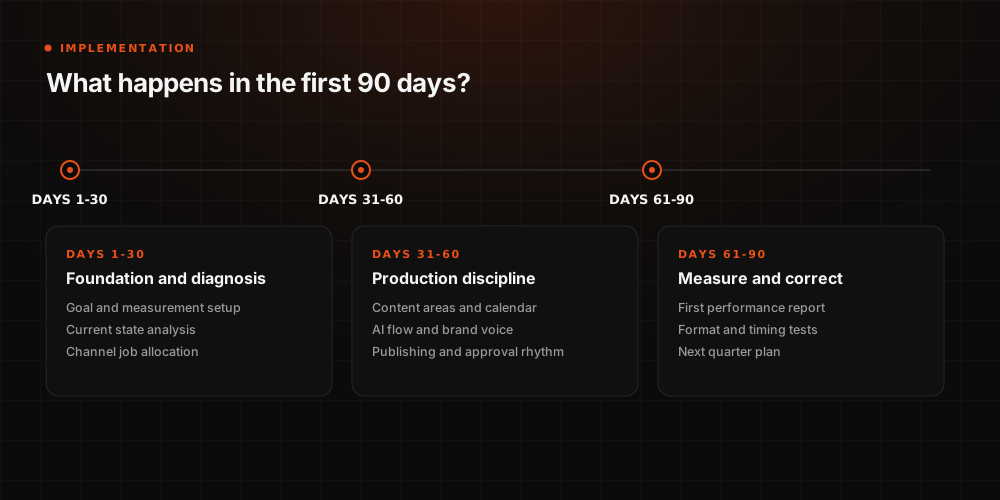
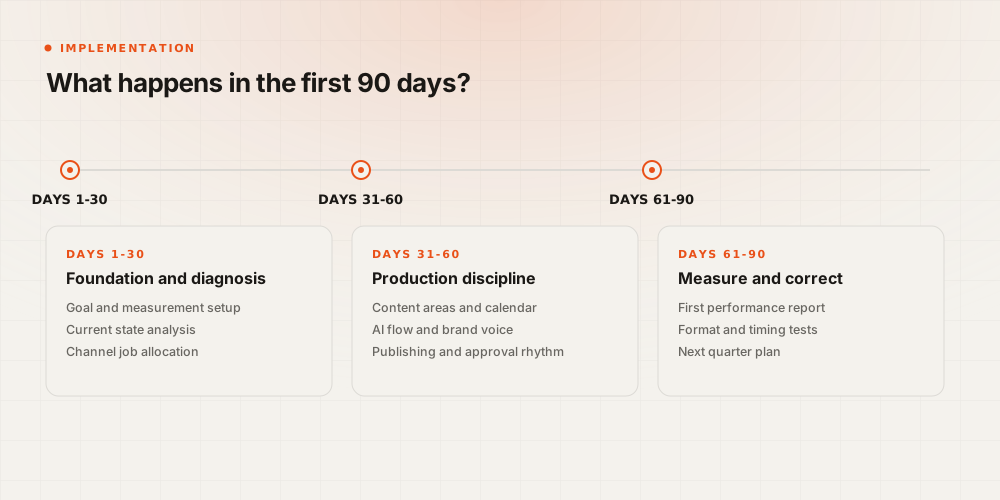
The plan below is a recommendation for a team that wants to establish regular production and measurement. Durations should be adapted to the organisation's resources, content volume and sales cycle.
| Period | Priority | Concrete output | Condition for moving on |
|---|---|---|---|
| Days 1-15 | Current state, audience and data review | Content inventory, customer questions, baseline measures | Business goal and measures agreed |
| Days 16-30 | Strategy and production discipline | Channel roles, content areas, knowledge base, calendar | Owner and approval flow working |
| Days 31-45 | First publishing and AI pilot | A balanced content series, time and quality records | Significant errors and bottlenecks visible |
| Days 46-60 | Content and distribution tests | At most a few open hypotheses and comparisons | Enough consistent data to decide |
| Days 61-75 | Connection to business results | CRM tracking of enquiries, cost and quality report | Enquiry quality assessed |
| Days 76-90 | Scaling and correction | Next quarter plan, current workflow | What worked can be justified |
Three questions make a sufficient backbone for the weekly meeting: which need did we understand better this week? Which content supported the behaviour we expected? If we change one thing next week, what should it be?
Frequently asked questions
Should every business be on every social media platform?
No. Prioritise the channels where the target audience is, that production capacity can support, and whose contribution to business results can be measured. A new channel should be assessed with a clear purpose and a limited pilot.
Is social media management just posting content?
It is running strategy, content, community, customer communication, reputation and measurement together. Posting is the visible part; the decisions and follow-up behind it determine the result.
Will AI replace the social media specialist?
Some writing, adaptation and classification tasks can be automated. Brand decisions, verification, customer relationships and accountability remain. How the role changes depends on the organisation's structure and the scope of automation.
Does every AI-written piece need to be labelled?
There is no single universal rule. Production support, realistic synthetic image or audio, and commercial advertising are each assessed differently. The platform's disclosure rules and the advertising obligations in the relevant country have to be checked together. Ministry of Trade, 27 July 2026, YouTube AI disclosure rules
How many days should a content calendar cover?
A four-week plan is a useful start for most teams. It should be updated in a weekly review against the news agenda, customer questions and campaign conditions. Separate capacity can be planned for regular content and for real-time communication.
Which matters more, follower count or engagement?
Both have to be read in context. If the business goal is qualified conversations, conversation quality comes first; if it is customer support, resolution and satisfaction do. Followers and engagement are indicators that help explain those results.
Do social media posts guarantee appearing in AI answers?
No. Source accessibility, the query, the system and the answer-generation method all affect the outcome. Building consistent, sourced content is useful; visibility should be tracked with a separate sample and never guaranteed.
When can we tell whether a social media programme is working?
Production quality, workflow and early engagement indicators can be assessed in the first weeks. Results such as sales and customer lifetime value need a longer follow-up matched to the sales cycle. The review date should be set at the start.
Are social search and AI visibility the same thing?
Social search is a user looking for information inside a social platform. AI visibility is the brand or its sources appearing in AI-assisted answers. They can work from a shared question and knowledge base; the distribution and measurement methods differ.
Can every customer comment be used as UGC in advertising?
The purpose of reuse, permission, the rights of the people in the content and any commercial relationship have to be assessed. A public post should not be treated as unlimited permission for all advertising and AI-derived uses.
How much budget should go to social media management?
There is no single correct figure. Research, team time, design, video, community management, tools, advertising and partnerships should be costed separately. A starting budget can be set to cover a meaningful pilot and the assessment of its results.
Where should a small team start with AI?
Adapting one approved expert piece into different formats, or grouping de-identified questions, are manageable starting points. In the first pilot, track total team time, the need for correction and significant errors together.
How should older content relate to a new guide?
The new guide has to cover the questions the older pages answered. The decision to consolidate technically should be made by examining current traffic, links and search intent. Content that serves a separate need can be kept and linked from the relevant sections of the main guide.
Make social media part of your growth strategy with Webtures
A strong social media programme rests on a working discipline that understands the customer's questions, supports its answers with evidence and learns from results. The content calendar makes that discipline visible; the team, measurement and customer experience keep it running.
The approach we recommend in this guide is to weigh social media decisions together with SEO, AI visibility, brand reputation and commercial goals. First the customer need and the current state become clear. Then channel roles, information sources, the production flow and success measures are set. AI supports research and production inside that order; brand responsibility stays explicit.
To review your brand's social media strategy, AI-assisted content processes and measurement approach together, get in touch with Webtures.