What Is Fine-Tuning? How to Fine-Tune AI Models
Fine-tuning is a method that retrains an AI model for a new task or dataset without losing what the model has already learned. The technique saves time and resources for projects that need high accuracy from limited data.

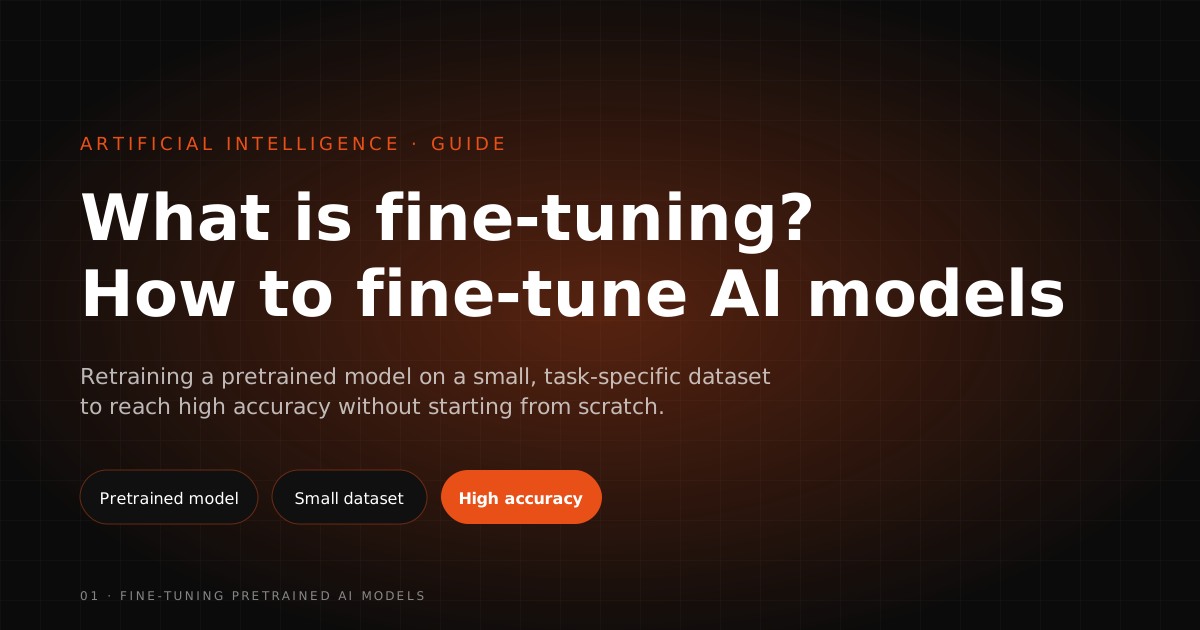
Fine-tuning is a method that retrains an AI model for a new task or dataset without losing what the model has already learned. The technique saves time and resources for projects that need high accuracy from limited data.
What is fine-tuning?
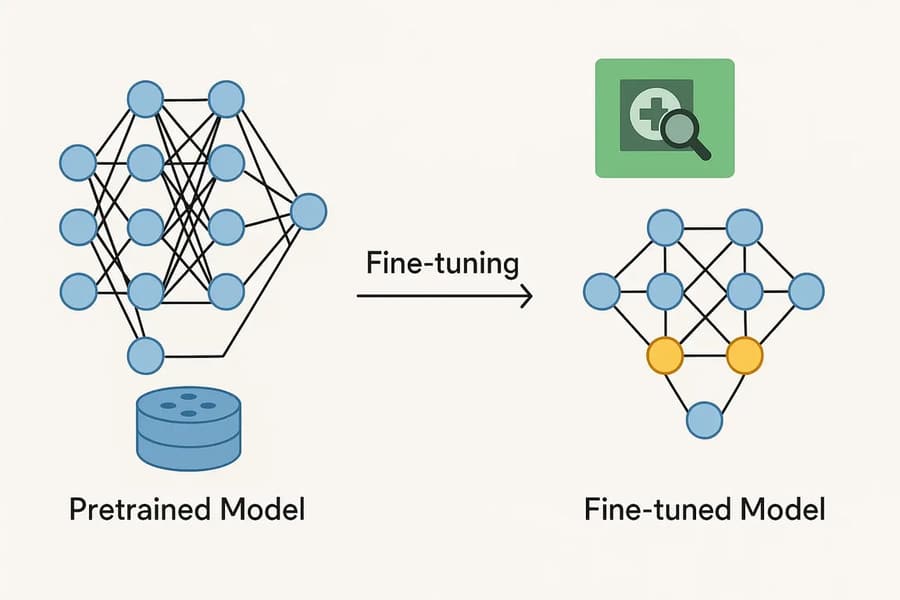
Fine-tuning is a widely used technique in artificial intelligence, and in deep learning in particular. It takes a model that has already been trained on large datasets and retrains it on a new, smaller dataset to specialize it for a specific task. The model is not trained from scratch; new knowledge is layered on top of what it has already learned. That saves time and makes it possible to reach high accuracy with far less data. An image recognition model trained on general visuals, for example, can be retrained on medical images alone and put to work in healthcare. Because the approach uses resources efficiently, it is especially effective for projects with limited data.
In most modern AI applications, fine-tuning strategies play a vital role. The method is used everywhere from large language models to visual analysis systems, because building a model from scratch demands enormous computing power and massive datasets. With this refinement step that follows transfer learning, a model that has learned general features can be optimized for a new task with relative ease. Costs drop for industry applications while accuracy improves. Fine-tuning also offers an advantage for ethical data use, since effective results can be achieved with less data.
Why does fine-tuning matter in AI training?
AI projects typically require large volumes of labeled data and powerful hardware, and those resources are not always within reach. This is where fine-tuning comes in, delivering high-accuracy results from limited resources. Imagine a healthcare provider that holds only 5,000 medical images. That may not be enough to train a model from scratch, but fine-tuning a pretrained model on those images can produce strong results. It gives projects flexibility and speed. The general knowledge the model has already acquired also boosts its performance on the new task, leading to more accurate predictions.
Another major advantage is a dramatically shorter training time. Because the model has already learned the fundamental features, only the layers closest to the output are updated with the new data, which means far less compute is consumed during training. The method can also protect data privacy: since retraining can run on local data alone, sensitive information never has to be transferred to central servers. For all these reasons, fine-tuning stands out as a strategic choice in AI training today.
What is the difference between fine-tuning and transfer learning?
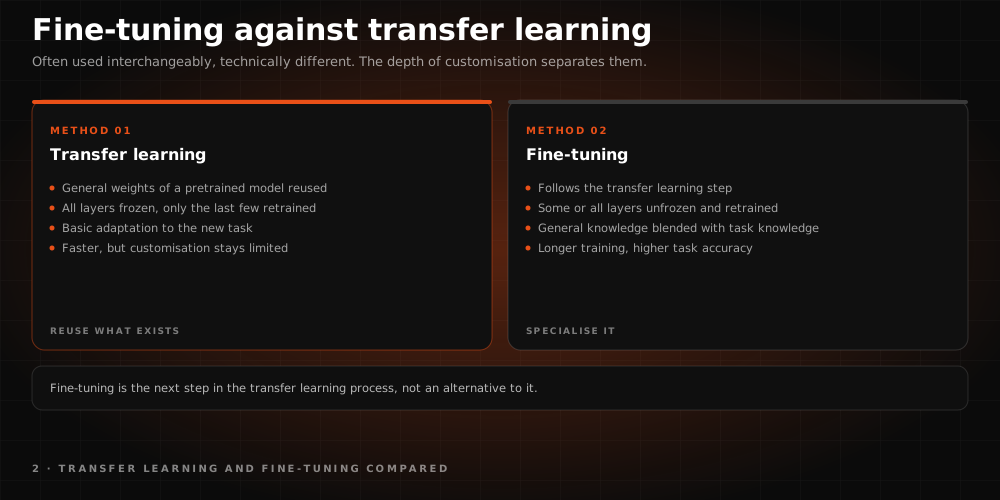
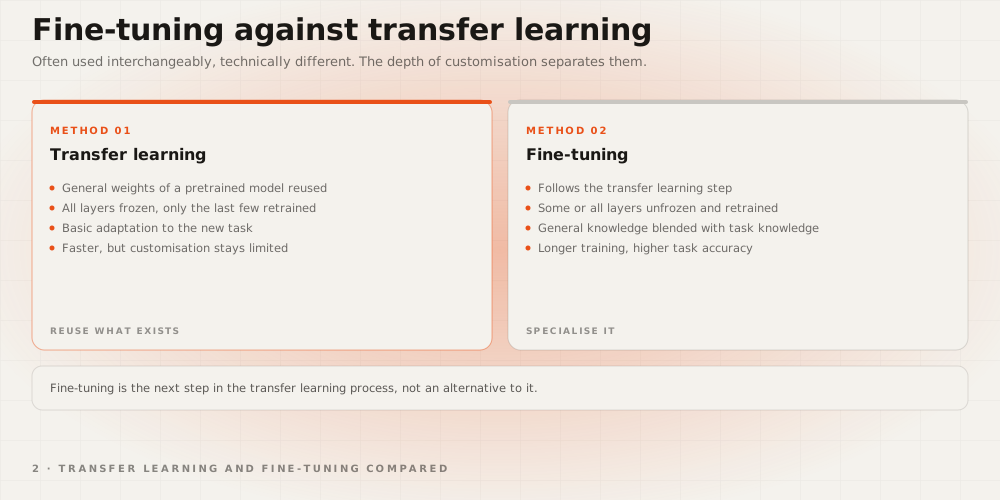
Fine-tuning and transfer learning are often used interchangeably, but there are technical differences between them. Transfer learning means reusing the general-level weights of a pretrained model on a new task. In this approach, all of the model's layers are frozen and only the last few are retrained. The model's general capabilities are leveraged while a basic adaptation is made for the new task. A language model, for example, can be repurposed for a different language or subject through transfer learning. The customization this delivers, however, is usually limited.
Fine-tuning offers a deeper level of customization. After the transfer learning step, some or all of the model's layers are retrained to reach higher task-specific accuracy. Fine-tuning can be seen as the next step in the transfer learning process. The goal is for the model to blend its general knowledge with task-specific knowledge. Training takes longer, but the potential lift in task performance is greater. On sensitive tasks in particular, this detailed calibration can make a decisive difference. Understanding the distinction between the two methods is critical to choosing the right strategy.

How is fine-tuning done?
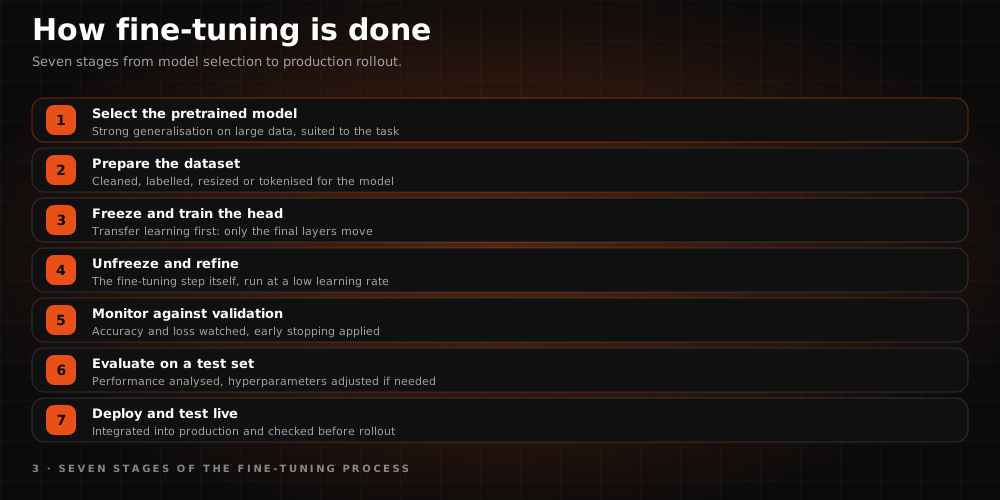
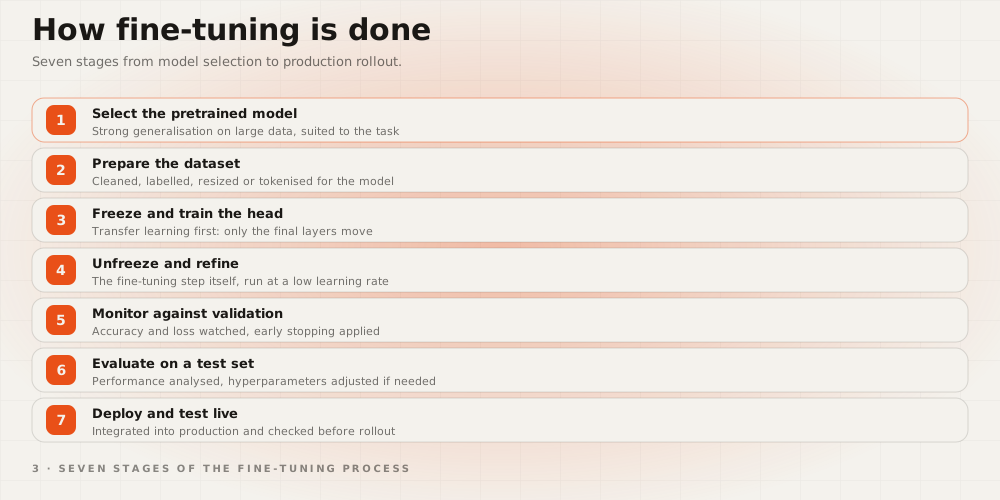
Fine-tuning is the process of retraining a pretrained AI model for a specific task. The model retains its general knowledge while being optimized for the new task. The process requires both technical expertise and careful data preparation.
- First, a pretrained model suited to the task is selected. It is usually a model trained on large datasets with strong generalization ability. For a language processing task, a BERT- or GPT-based model might be used.
- The task-specific dataset is prepared. Data is cleaned, labeled where necessary, and converted to a format the model can consume. Visual data is resized at this stage; text data goes through tokenization.
- Transfer learning is applied by freezing some of the model's layers so that only the final layers are trained. This preserves the model's general knowledge.
- The layers are then unfrozen and the entire model is refined. This step is the fine-tuning process itself and runs at a lower learning rate.
- Throughout training, the model's accuracy and loss are monitored regularly against a validation set. Techniques such as early stopping can be applied to prevent overfitting.
- Once training is complete, the model is evaluated on a test set and its performance is analyzed. Hyperparameters are adjusted again if needed.
- Finally, the fine-tuned model is integrated into production systems and tested in live environments before rollout. The result is a functional AI model ready for end users.
When is fine-tuning the right choice?
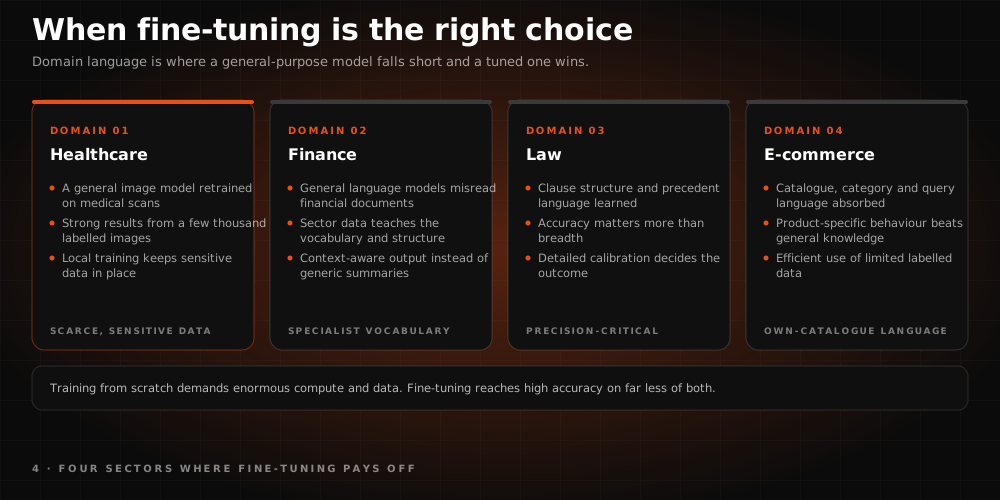
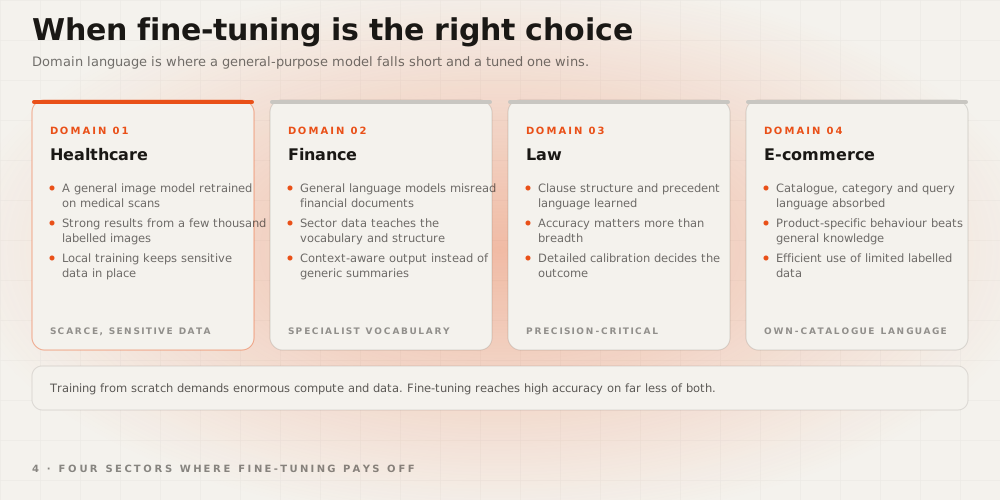
Fine-tuning is an effective AI technique for building customized solutions, particularly in scenarios where data is scarce. When training a model from scratch would be costly and slow, retraining a pretrained model offers substantial advantages. The method is a major asset for AI solutions targeting specific fields such as healthcare, finance, law, and e-commerce. A general-purpose language model may struggle to interpret financial documents, for example. But apply fine-tuning with finance-specific data and the model produces far more accurate, context-aware results. Accuracy rises while the model learns to recognize the language of the sector.
The risk of overfitting and how to prevent it
One of the most critical challenges in the fine-tuning process is overfitting. When a model adapts too closely to its training data, it can perform poorly on new data. In effect, the model memorizes patterns specific to the training set and loses its ability to generalize. Overfitting appears more often when working with small datasets, because the model cannot derive broadly applicable learning from limited examples. The result is lower accuracy on the test set and reduced practical value.
Several methods can reduce this risk. First, early stopping automatically halts training when performance on the validation set begins to decline, preventing the model from memorizing. Regularization methods such as dropout temporarily deactivate some of the model's neurons, which keeps it from becoming overly dependent on the data. Hyperparameters, especially the learning rate, must be optimized carefully. A low learning rate produces more controlled updates and preserves the model's overall structure. Together, these safeguards prevent overfitting during fine-tuning and contribute to more robust, reliable models.