Agentic AI and Agentic Commerce Glossary
Master 81 essential agentic AI and agentic commerce terms, from protocols and GEO to cross-border e-export and regulation, in one practical glossary.

Digital marketing stands at the edge of a new paradigm shift. The rules of the search-engine era are giving way to a new ecosystem in which AI agents research, compare, and buy. In this transformation, brands need to be visible and accessible not only to people but also to the agents acting on their behalf.
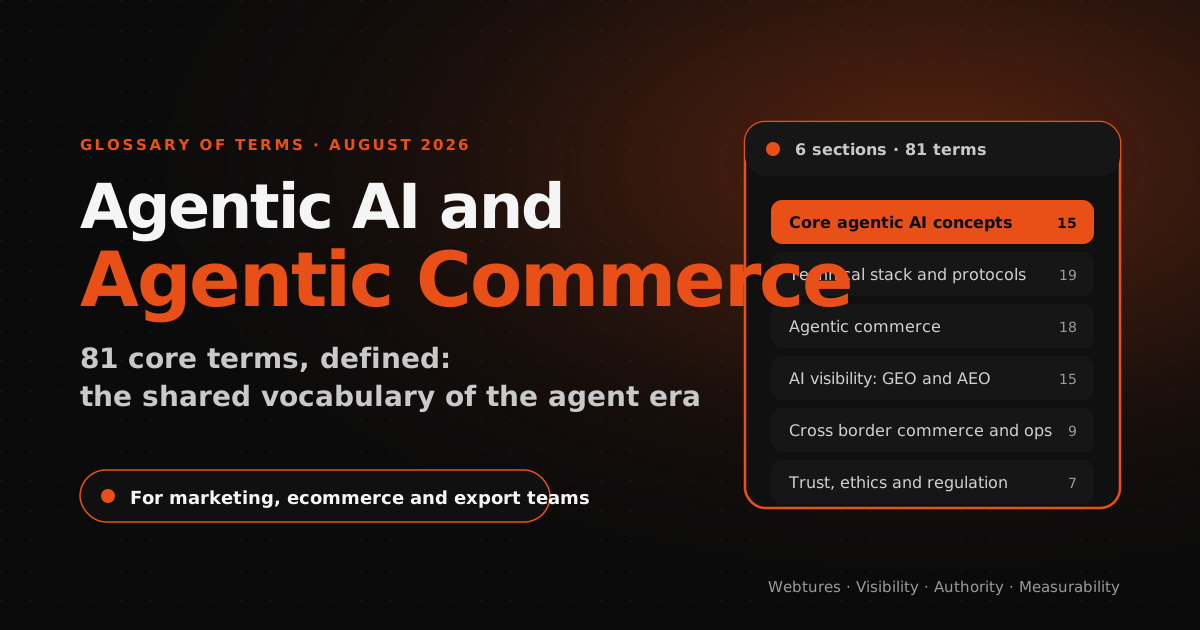
This glossary brings together the core concepts of the agentic AI and agentic commerce ecosystem with clear, practical definitions. Our aim is to give marketing teams, e-commerce and e-export managers, and decision makers a shared language for this new era.
The terms are grouped into six main sections: core agentic AI concepts, technical infrastructure and protocols, agentic commerce, AI visibility (GEO/AEO), e-export and operational transformation, and trust, ethics, and regulation. Each term is presented with a practice-oriented definition.
1. Core agentic AI concepts
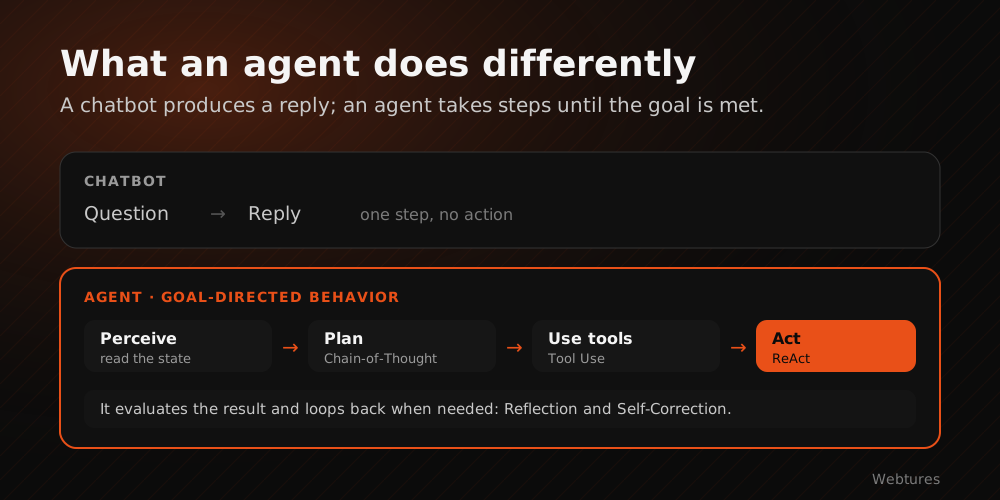
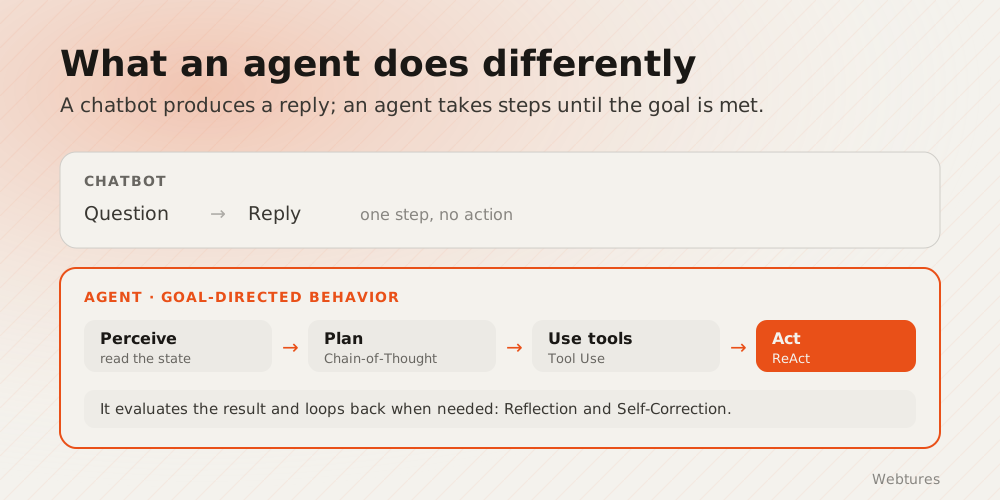
The fundamental concepts you need to understand what AI agents are, how they think, and how they act.
AI Agent
An AI system that perceives its environment, makes decisions, and takes action using tools to reach a specific goal. What sets it apart from classic chatbots is that instead of merely generating responses, it can plan and execute multi-step tasks on its own.
Agentic AI
The approach that describes AI's shift from a passive assistant to goal-directed, autonomous systems capable of taking action. It is the main paradigm shaping the transformation of every sector, from digital marketing to e-commerce, in the post-2025 era.
Autonomous Agent
An AI agent that can complete tasks end to end with no or minimal human intervention. The autonomy level is a critical design choice that determines which decisions the agent may take on its own.
Multi-Agent System
An architecture in which multiple AI agents collaborate or divide tasks to solve complex problems. In an e-commerce operation, for example, pricing, inventory, and customer service agents working together.
Agent Orchestration
The coordination layer that manages task distribution, sequencing, and communication among multiple agents. Typically an "orchestrator agent" delegates subtasks to specialist agents and merges the results.
Agentic Workflow
An automation model in which a business process is executed by AI agents through planning, tool use, verification, and correction steps. Unlike classic rule-based automation, the agent can adapt to unforeseen situations.
Human-in-the-Loop (HITL)
A design model in which the agent pauses at critical decisions (payment approval, contracts, refunds) and waits for human sign-off. It is the core mechanism for managing trust and accountability.
Human-on-the-Loop
An oversight model in which a human monitors the agent's work from the outside and intervenes when needed, rather than approving every decision. It balances scalability with control.
Autonomy Level
A grading that defines the scope of decisions and actions an agent may take without human approval. It spans a spectrum from purely advisory systems to fully autonomous transaction-executing ones.
Goal-Directed Behavior
The agent's ability to break a high-level goal it is given (for example, "find the best supplier") into subtasks and work until it reaches the outcome. It is the core trait that separates agentic AI from classic command-and-response systems.
Planning & Reasoning
The process by which an agent anticipates the steps toward a goal, weighs alternatives, and draws logical inferences. It underpins the success of modern language models on multi-step tasks.
Chain-of-Thought (CoT)
A technique that has the model explicitly produce its intermediate reasoning steps before reaching a conclusion. It markedly improves accuracy on complex problems.
ReAct
A popular agent architecture pattern in which the agent runs a "think → act → observe → think again" loop. The name combines the words Reasoning and Acting.
Reflection / Self-Correction
The agent's ability to evaluate its own output, spot mistakes, and fix them. It is an important agent capability that raises output quality and reduces hallucination risk.
2. Technical infrastructure and protocols
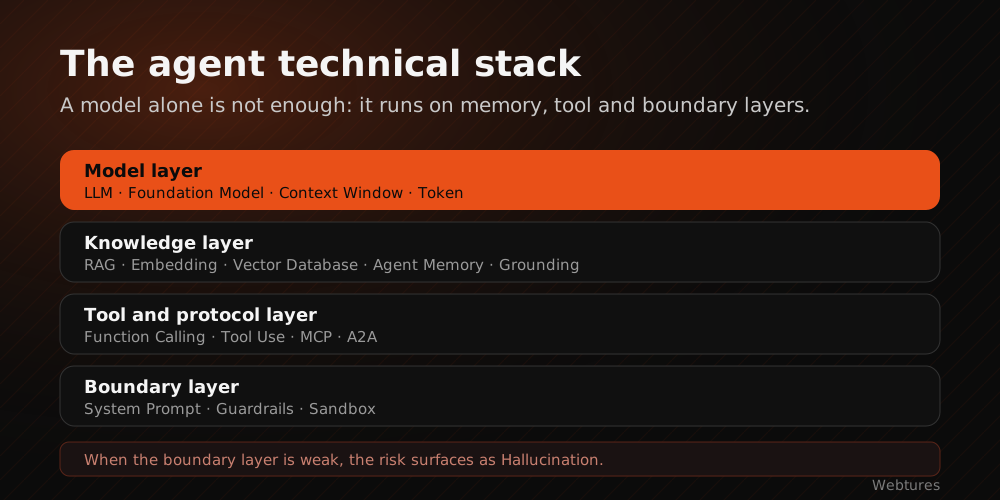
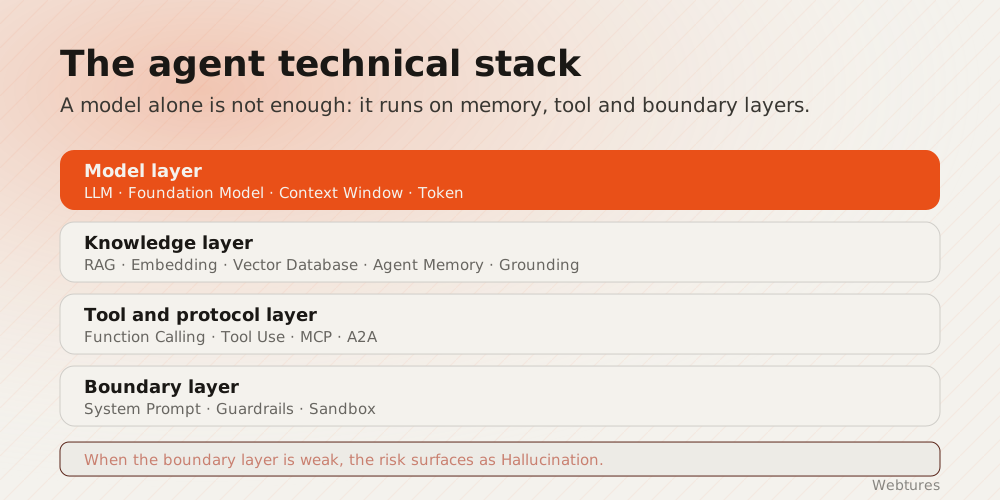
The models, protocols, and technical components that make agents possible.
LLM (Large Language Model)
An AI model trained on massive text data that understands and generates language. Models such as GPT, Claude, and Gemini serve as the "brain" of agentic systems.
Foundation Model
A general-purpose AI model trained on very broad data and adaptable to many different tasks. Agents are built by adding tools and memory on top of foundation models.
Function Calling / Tool Use
The mechanism that lets a language model call external software, APIs, and databases to take action in the real world. It is the critical capability that turns a model from a system that "talks" into an agent that "does."
MCP (Model Context Protocol)
An open protocol developed by Anthropic that lets AI models connect to external data sources and tools in a standard way. It has become the de facto standard for agent-tool integration across the industry. Detail: What is MCP?
A2A (Agent-to-Agent Protocol)
A communication standard that lets agents from different vendors discover each other, communicate, and hand off tasks. It is the interoperability layer of the multi-agent ecosystem.
RAG (Retrieval-Augmented Generation)
A method in which the model pulls current, verified information from external sources into its context before generating an answer. It reduces hallucination and makes working with enterprise knowledge possible. Detail: How RAG works.
Context Window
The total amount of text (tokens) a model can process at once. It determines how much information, instruction, and history an agent can "hold in mind" at the same time.
Fine-Tuning
Retraining a general-purpose model with additional data for a specific domain, brand voice, or task. It is used to raise accuracy and consistency in industry-specific agents.
Embedding
Converting text, products, or content into numerical vectors so they can be compared semantically. It is the mathematical foundation of semantic search and recommendation systems.
Vector Database
A specialized database type that stores embedding vectors and enables similarity search. It forms the infrastructure of RAG architectures and agent memory.
Prompt Engineering
The discipline of systematically designing instructions to get the desired output from AI models. It is a specialty that directly determines the quality of agent behavior.
System Prompt
The foundational instruction set that defines an agent's identity, rules, boundaries, and job description. Think of it as the agent's "employment contract."
Guardrails
Control mechanisms that prevent unwanted, risky, or off-policy agent behavior. For example, rules that stop a shopping agent from exceeding its assigned budget.
Sandbox
An isolated environment where an agent can run code or attempt transactions without harming real systems. It is standard practice for safe agent development.
Agent Memory
The agent's ability to store information within a task (short-term) and across tasks (long-term). It is the precondition for personalized, continuous agent experiences.
Token
The smallest unit language models use when processing text, roughly a word or part of one. Model costs and context limits are calculated in tokens.
Hallucination
The model confidently producing information that does not actually exist. It is the core risk in agentic systems, managed through grounding, RAG, and verification layers. Causes and safeguards: LLM hallucination.
Grounding
Anchoring model outputs in verifiable sources, current data, or an enterprise knowledge base. It is the indispensable principle of trustworthy agent systems.
3. Agentic commerce
The concepts of the new commerce model in which purchasing decisions and transactions are carried out by AI agents.
Agentic Commerce
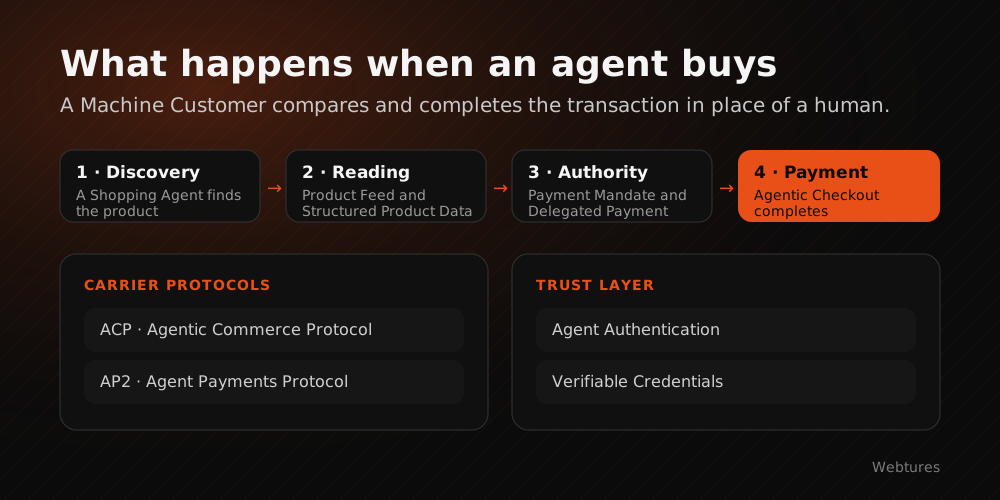
A commerce model in which shopping steps such as product research, comparison, ordering, and payment are handled by AI agents on the user's behalf. It represents e-commerce's evolution from an interface-centric structure to an agent-centric one.
Agent-Mediated Purchase
A purchase completed not by the user directly but by an agent the user has authorized. The new question for brands: is your customer still a human, or their agent?
Shopping Agent
An AI agent that researches and compares products against the user's needs, budget, and preferences and manages the purchase process. The shopping features of ChatGPT, Perplexity, and similar platforms are the pioneers of this category.
Conversational Commerce
Shopping experiences that happen through natural-language conversation instead of searching and clicking. It is the user-facing side of agentic commerce.
Machine Customer
A software-based customer that makes purchasing decisions and completes transactions on its own. According to Gartner's projections, it is one of the most significant new revenue channels of the coming decade.
ACP (Agentic Commerce Protocol)
An open protocol led by OpenAI and Stripe that lets agents perform standardized product discovery and purchasing against merchant systems. It is the infrastructure behind the Instant Checkout experience inside ChatGPT.
AP2 (Agent Payments Protocol)
A protocol led by Google that cryptographically verifies the chain of authorization, identity, and accountability in agent payments. It makes the payment authority a user grants an agent secure and auditable.
Instant Checkout
Completing a purchase through an agent in a single step, without the user ever leaving the chat interface. It is the experience model that radically shortens the purchase funnel.
Agentic Checkout
Designing the merchant-side checkout process so that agents can programmatically build carts and complete transactions. It is the link in agent-readiness work closest to commercial outcomes.
Delegated Payment
The user handing payment authority to an agent within defined limits and conditions. It forms the financial foundation of autonomous shopping.
Payment Mandate
A verifiable digital authorization record defining under which conditions and up to which amount an agent may transact. It determines who bears responsibility in a dispute.
Agent Authentication
Verifying on whose behalf an agent is acting and whether it is genuinely authorized. It lets merchants distinguish legitimate agents from malicious bots.
Verifiable Credentials
Digital documents that cryptographically prove an agent's identity, permissions, and the user it represents. They are the building blocks of the agent economy's trust infrastructure.
Trust Layer
The set of protocols and services that secures identity, authorization, and transactions among agents, users, and merchants. It is the precondition for agentic commerce to scale.
Product Feed
Presenting product information (price, stock, attributes, images) in a structured format that agents and platforms can read. It is the data foundation of agent visibility.
Structured Product Data
Marking up product attributes with standards like schema.org so machines can understand them. It is mandatory for a product to be found, compared, and recommended by agents.
Agent-Readiness
The degree to which a brand's website, product data, content, and payment infrastructure are accessible and transactable for AI agents. It is one of the most critical digital competitiveness metrics of the coming period. Measure your site with the AI Agent Readiness scan; for the setup see Agentic Commerce Readiness.
Machine-Readable Content
Preparing content in a structure that agents and language models can accurately understand and use, not just humans. Heading hierarchy, structured data, and clear information architecture are the foundations of this approach.
4. AI visibility: GEO and AEO
The new generation of optimization concepts that make brands visible in AI-powered search and answer engines.
GEO (Generative Engine Optimization)
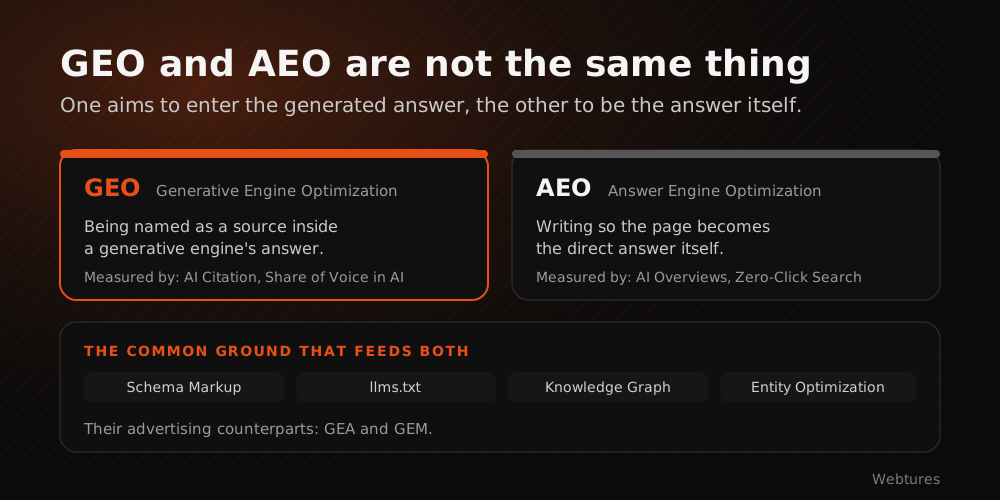
The optimization work that gets a brand included and recommended in the answers of generative AI engines such as ChatGPT, Gemini, and Perplexity. It is SEO's counterpart in the AI era. Webtures runs this as GEO consulting with measurable KPIs; see also the GEO roadmap.
AEO (Answer Engine Optimization)
Optimizing content so it is selected as a source by systems that answer user questions directly (AI Overviews, voice assistants, answer engines). It focuses on producing clear, structured, authoritative answers to questions.
AI Visibility
The holistic measurement of how often, in what context, and how favorably a brand appears in the answers of AI platforms. It is the new-generation brand metric measured by platforms such as Brantial.
AI Citation
An AI engine showing a brand's content as a source while generating an answer. It is the AI-era equivalent of "ranking on page one."
Brand Mention
The brand appearing by name in AI answers even without a link. Because language models largely learn brand perception through mentions, it is a critical visibility signal.
Share of Voice in AI
The proportional measurement of how much space a brand occupies in AI answers on a given topic or industry compared with its competitors. It is the main performance indicator of AI visibility strategies.
Answer Engine
A search system that gives users a directly synthesized answer instead of a list of links. Perplexity and AI Overviews are the prominent examples of this category.
AI Overviews
The AI-generated summary answers Google shows at the top of its search results. It is the development transforming organic traffic and accelerating zero-click behavior.
Zero-Click Search
The user finding the answer on the search results page or in the AI answer and leaving without clicking through to any site. It is the behavioral shift steering brands toward visibility and mention-focused strategies instead of traffic.
llms.txt
An advisory standard, similar to robots.txt, through which websites offer language models a guide to their content. It aims to present the site's most important content to AI systems in an organized way. Google ignores this file; it is kept as a hygiene step for multi-engine GEO.
Schema Markup
Structured data code that tells search engines and AI systems the type and attributes of content (product, FAQ, review, organization). It is the technical foundation of GEO and agent-readiness work.
Knowledge Graph
A knowledge network that stores entities (brands, people, products) and the relationships between them in a structured way. What AI systems "know" about your brand is largely determined by this structure.
Entity Optimization
The work of getting a brand recognized as a clear, consistent, authoritative entity by search engines and language models. It represents the shift from keyword-focused SEO to entity-focused visibility.
GEA (Generative Engine Advertising)
The new generation of ad formats appearing on AI chat and answer platforms. With the opening of ChatGPT advertising, it is becoming digital marketing's newest channel.
GEM (Generative Engine Marketing)
The umbrella marketing discipline that covers both GEO (organic) and GEA (paid) work. It manages a brand's total presence in the generative AI ecosystem.
5. E-export and operational transformation
The roles agents take on in e-commerce and e-export operations and the infrastructure approaches they require.
Agentic E-Export
An e-export model in which market research, localization, pricing, and cross-border sales processes are scaled with AI agents. It is the transformation that lets SMEs enter global markets at low cost.
Autonomous Negotiation
Buyer and seller agents negotiating price, delivery, and terms without human intervention. It is the capability expected to radically change efficiency in B2B trade.
Dynamic Pricing Agent
An agent that analyzes demand, competition, inventory, and currency data in real time and updates prices automatically. It plays a critical role especially in multi-market e-export operations.
Inventory Agent
An agent that monitors stock levels, forecasts demand, and automates reorder decisions. It is one of the fastest value-generating areas of agent automation in the supply chain.
Customer Service Agent
An AI agent that answers customer questions, resolves order issues, and can initiate a return or exchange when needed. Unlike simple chatbots, it has the authority to execute transactions.
Procurement Agent
An agent that researches suppliers, collects quotes, and manages purchasing processes on behalf of a business. It is the B2B counterpart of the machine customer concept.
API-First Commerce
The approach of designing commerce infrastructure for programmatic access (APIs) first, rather than for the interface. It is the technical precondition for agents to work smoothly with a system.
Headless Commerce
Decoupling the e-commerce backend from the front end so the same infrastructure can serve every channel (web, mobile, agents, voice assistants). It is the architectural approach that eases the transition to agentic commerce.
Composable Commerce
Building commerce infrastructure by flexibly combining best-of-breed components (payment, search, cart, content). It provides the agility needed to adapt to the fast-changing agent ecosystem.
6. Trust, ethics, and regulation
The concepts of accountability, transparency, and legal compliance in the agent economy.
AI Alignment
The work of ensuring AI systems behave in line with human values and user interests. Whether a shopping agent truly works in the user's interest or in a platform's interest is the commercial face of this field.
Explainability
Being able to explain, in understandable terms, why an agent made a specific decision or recommended a specific product. It is increasingly becoming mandatory for user trust and regulatory compliance.
Auditability
Recording all of an agent's decisions and transactions so they can be reviewed afterward. It is the basis of dispute resolution, especially for agents executing financial transactions.
Consent Management
Transparently managing, and being able to revoke, the permissions users grant to agents (data access, spending limits, transaction types). It is the agent-era extension of GDPR and similar data protection compliance.
Agent Liability
The question of how responsibility is shared among the user, the agent provider, and the merchant when an agent makes a faulty transaction. It is the most actively debated legal area of agentic commerce.
EU AI Act
The European Union's comprehensive regulation that classifies AI systems by risk level and imposes obligations accordingly. It also carries binding consequences for e-exporters selling into the EU market.
Bot Detection vs. Agent Whitelisting
The balance sites must strike between blocking malicious bots and granting access to legitimate shopping agents. Misconfigured bot protection can lock a brand out of the agent economy.
About Webtures
Webtures is a digital marketing and SEO team with more than 16 years of experience, serving from its Istanbul and London offices and having worked with over 4,000 brands. From search engine optimization to generative engine optimization (GEO/AEO), and from AI visibility to agentic commerce transformation, it manages brands' adaptation to the next-generation digital ecosystem end to end.
To discuss your brand's readiness for the AI era, its agent-readiness status, or its GEO/AEO strategy, get in touch with us: webtures.com