AI Search Trends for 2026 and the Technologies Shaping the Future
Explore the AI search trends of 2026, from multimodal queries and AI Overviews to GEO metrics like citation rate and mention score that define brand visibility.


2026 marks an AI-centered transformation of the search ecosystem. Search engines are no longer structures that simply process queries; they are becoming intelligent systems that anticipate user intent, reshape content, and merge data signals across many platforms. Chat-based search experiences, multimodal queries, real-time personalization, and transparent AI citations are now a natural part of user expectations. For brands, competition is no longer defined by what position you rank in but by how often AI models cite you and how accurately they represent you. The trends of 2026 point to a hybrid search order that makes running SEO and GEO programs in parallel a necessity.
How will AI search technologies evolve in 2026?
2026 will be a turning point where search technologies shift to a fully AI-driven structure. Search engines are moving beyond systems that merely answer user queries; they are becoming multi-layered decision mechanisms that interpret the user's intent, context, historical signals, and real-time behavior together. LLMs will begin combining multiple modalities (text, image, video, audio) in a single query format, producing results that are both more precise and more holistic.
In this period, results pages will shift toward a format of summaries, recommendations, comparisons, and personalized guidance. The traditional ten blue links will fade almost entirely into the background, while AI Overviews, chat-based answers, and source-citing LLM panels move to the center of the user journey. Search is no longer a one-off question-and-answer exchange; it is becoming a flow in which the user stays in continuous interaction with AI until reaching their goal.
For brands, this transformation shows that the era of competing through SEO-focused optimization alone is over. Presenting content so that LLMs can understand it, segment it, reshape it around intent, and cite it easily becomes the core success factor of 2026. In short, the evolution of AI search technologies creates a new competitive arena that redefines both visibility and how brand representation takes shape.
Dynamic results driven by real-time personalization
In 2026, search engines will interpret user signals not only through past behavior but through immediate context. LLM models will process micro-interactions in real time, including typing rhythm, preference direction, recent click behavior, scroll speed, and how the user refines a query. As a result, even within a single query, results will become a dynamic structure that continuously adapts to the user.
For example, when a user first searches for "office chair" and then adds refinements like "with lumbar support, suitable for long sessions," the system will no longer simply filter; it will deliver fully personalized product lists, price ranges, quality assessments, and recommendation summaries. For brands, this shift makes it mandatory not only to produce content but to structure it so it can adapt to evolving user intent.
The rise of multimodal (image, video, and voice) search queries
In 2026, multimodal search becomes the baseline standard of the search experience. Users will be able to search by pointing a camera at a product, selecting a scene from a social media video, or describing something with a voice recording. Gemini, Perplexity, Meta AI, and OpenAI models will read images scene by scene, perform object recognition plus intent analysis in videos, and detect emotional tone and context in voice queries.
This structure creates new obligations for brands in three areas:
(1) Supporting product images with technically LLM-compatible metadata,
(2) Strengthening video content with transcripts and scene descriptions,
(3) Including clear category, use case, and material information in image and video content.
Because multimodal data has also become one of the cornerstones of GEO, managing visual assets systematically will be a decisive competitive factor for brands in 2026.
The expansion of AI Overviews and chat-based search structures
In 2026, structures such as AI Overviews (Google), Chat Mode (ChatGPT), Perplexity Answers, and Bing AI Responses move far beyond informational queries. They concentrate on high-intent areas such as shopping, local services, financial decisions, product comparisons, education, health, and B2B purchasing, narrowing the role of traditional search results.
This expansion creates three important shifts:
• The user journey collapses into a single step of summary, recommendation, and decision guidance.
• Brand visibility is now measured by AI citation and reference rates as much as by rankings.
• Success depends on preparing content at chunk level, keeping information blocks clear, and making them easy for AI models to summarize.
In this new order, the critical question for brands is no longer "what position do I rank in?" but "how accurately do AI models represent me, and how often do they cite me?"
AI citation mechanisms become more transparent
In 2026, search engines and LLM-based platforms begin presenting the sources behind their answers in more visible and verifiable ways. Google's AI Overview updates, Perplexity's sources panel, OpenAI's retriever-based answer flows, and Meta AI's outbound links all carry strong signals of a more transparent content production chain. Users now want to see not just the answer but which source the answer was derived from.
This creates a new competitive arena for brands:
AI citation rate.
In other words: how often a brand, page, or piece of content is referenced in LLM answers.
Citation rate is becoming a KPI as strategic as classic SEO metrics in 2026. Brands therefore need to structure their content not only for keywords but so that AI models can index it among their trusted sources.
The critical role of LLM compatibility in brand visibility
LLM compatibility is becoming one of the fundamental factors deciding the fate of brand visibility in 2026. Search engines no longer limit themselves to crawling content; they work on understanding, rewriting, summarizing, and reshaping it around context. As a result, even technically sound content loses visibility if an LLM cannot process it easily.
LLM compatibility becomes critical across four dimensions:
• Chunk-level structure: Content clearly organized into distinct information blocks.
• Consistent structure: Balanced use of heading hierarchy, tables, lists, and explanatory paragraphs.
• Semantic clarity: Sentences structured so models can summarize them easily.
• Data accuracy: Current, reliable, and verifiable information.
Content that meets these standards appears more often in AI Overviews and ensures the brand is represented accurately in chat-based search results.
The growing impact of brand authority plus mention score
In 2026, brand authority is no longer measured solely by domain authority or backlink strength. The new competitive arena is mention score, meaning how often a brand appears across platforms, in content, and during LLM training.
LLMs tend to cite high-authority brands more often when generating content. This makes it essential for brands to:
• produce authoritative content within their industry,
• define their areas of expertise clearly,
• use digital PR to place the brand name in trusted content pools
.
In traditional SEO, being visible was enough; in 2026, brands whose digital footprint in the LLM universe fails to grow will inevitably disappear from answer engines. Mention score is now a GEO metric and one of the core indicators of a brand's AI visibility.
Regional search differentiation through localized LLM outputs
In 2026, LLMs place greater weight on region-based content generation. The same query can produce different outputs in the Netherlands, different outputs in Turkey, and very different outputs in the US. The reason is that models have begun optimizing their data sources and training sets around regional contexts.
Producing content that fits each region's cultural, linguistic, and legal context becomes a critical factor directly affecting LLM visibility in 2026.
The rise of GEO (Generative Engine Optimization) in the search ecosystem
2026 may signal a period in which the GEO approach gains ever greater importance in the search ecosystem. As LLMs carry more weight in search results, evaluating brand performance through classic SEO metrics alone may fall short in some cases. With a significant share of users turning to AI-based tools more often during research, tracking how visibility takes shape on these platforms becomes genuinely valuable.
In this new era, adding GEO metrics to brand evaluation processes can paint a healthier picture of visibility. For example:
• AI Citation Rate: How often AI models reference the brand,
• Chunk-Level Retrieval Score: How easily an LLM can retrieve the content,
• LLM Compatibility Score: How well AI can understand the page,
• Mention Score: How widely the brand appears across digital sources,
• AI Visibility Score: Overall visibility performance on chat-based platforms.
These metrics offer a meaningful framework for brands that want to monitor AI visibility alongside SEO in 2026. Even if a piece of content ranks on the first page of the SERPs, a brand that is underrepresented in LLM answer generation can remain limited at the touchpoint where users meet it through AI.
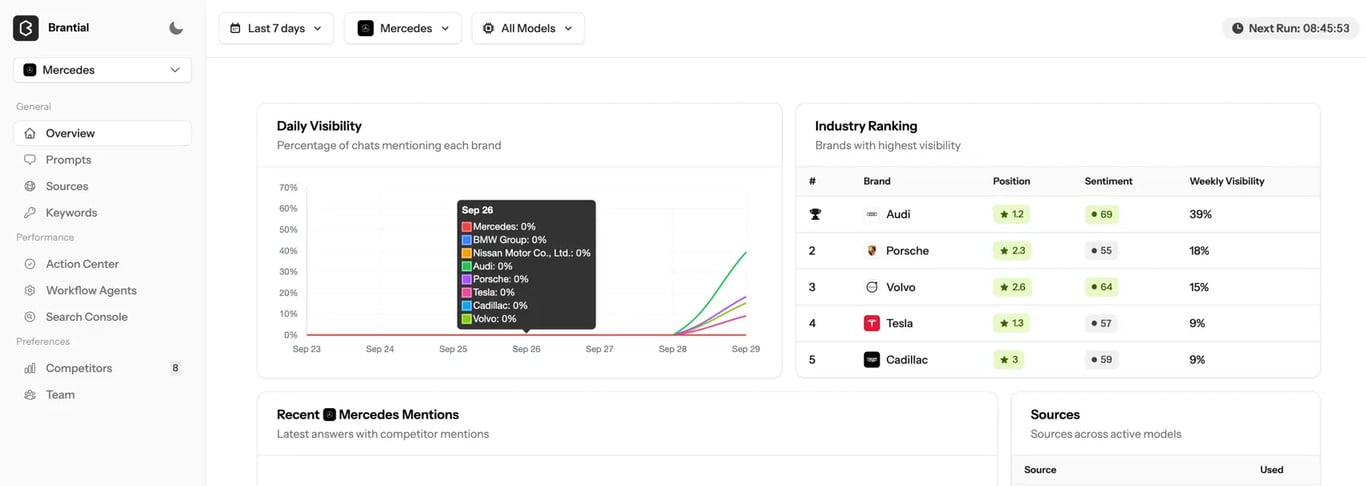
For brands that want to track all of these measurements in a single panel, Brantial can be a highly practical option. Brantial brings together metrics such as AI Citation, Mention Score, Chunk Retrieval, LLM Compatibility, and AI Visibility, giving brands a more holistic way to monitor their visibility across the generative search ecosystem.
In short, the GEO approach in 2026 should be seen not as a replacement for SEO but as its complement and extension. Brands would do well to consider this new metric set to keep pace with both changing user behavior and the way AI models process content.

Let us make your brand visible in AI search.
Share your goals, we'll come back with a custom growth plan within one business day. A strategy lead will reach out personally.
Get in touch