What Is AI Agent Readiness and How Do You Measure It?
How do AI agents see your site? Run the free AI Agent Readiness scan, get your score across access, meaning, action and authority, and build a 90-day plan of fixes.

What AI Agent Readiness is and why it matters
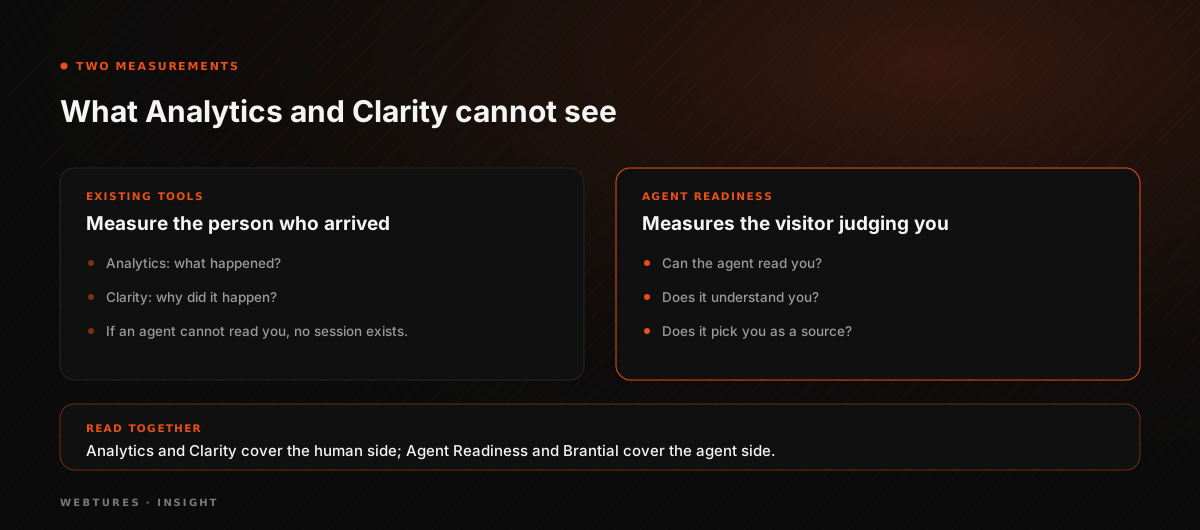
For years a modern website was measured by two things: how many visitors it drew and what those visitors did on the site. Google Analytics answered the first, tools such as Microsoft Clarity the second. Both rested on the same assumption: the visitor is a person, looking at a screen, scrolling, clicking.
That assumption is now incomplete. Traffic from AI agents and agentic browsers grew sharply over the past year, and in B2B a meaningful share of purchase research runs straight through an assistant. This visitor reads your site without ever appearing in a heatmap, does not scroll and leaves no session recording. But it decides whether to recommend you to its user.
Here is the problem: without a tool that measures how that visitor sees you, every optimisation decision in the agent era rests on guesswork. Much like changing a page before behaviour analytics existed, without knowing why the exit rate was high.
AI Agent Readiness fills that gap. The tool reads your site through an agent's eyes: can bots reach the content, is the content machine-understandable, can an agent transact with you, and do AI engines pick you as a source? It returns a single score from 0 to 100, a maturity level and a prioritised list of fixes.
Three properties matter most: it is free, it needs no sign-up and it needs no installation. You do not add code to your site; entering the domain is enough. Results arrive in about 60 seconds.
What the tool checks
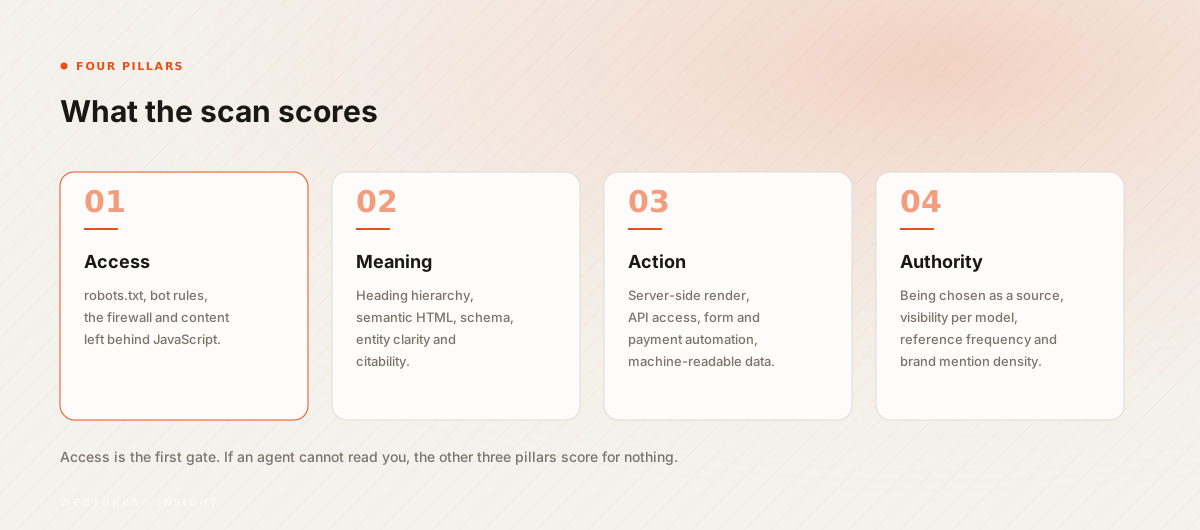
A four-pillar assessment
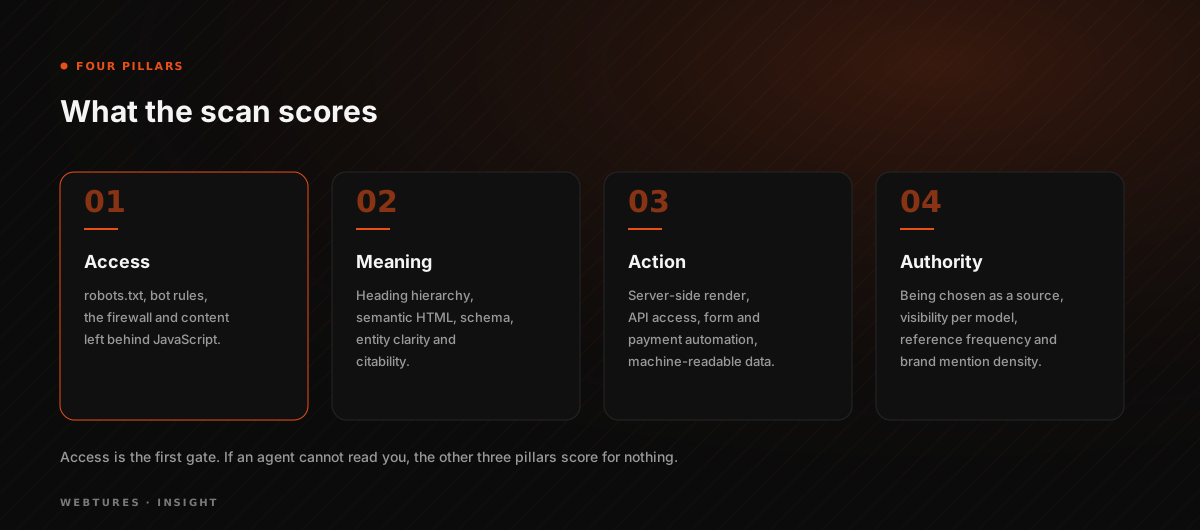
It examines your site in four pillars, following the agent's own read, evaluate, choose-a-source logic.
Access. robots.txt rules, permissions for GPTBot, ClaudeBot, PerplexityBot and OAI-SearchBot, firewall restrictions, content left behind JavaScript. The output is an access map. If an agent cannot read you, nothing else matters.
Meaning. Heading hierarchy, semantic HTML, structured data, entity clarity and citability. The output is a schema and entity score. The agent reads you, but does it understand what you sell?
Action. Server-side rendering, API access, form and payment automation, machine readability of the data layer. The output is an API and SSR report. Can the agent do something on your behalf?
Authority. Potential to be chosen as a source, visibility per model, reference frequency, brand mention density. The output is a citation index.
Twelve dimensions, more than fifty automatic checks
Underneath the four pillars sit the technical dimensions: structured data (Organization, Product, FAQ, Review schemas), AI discoverability (llms.txt, AGENTS.md, sitemap, canonical, meta), content readability, technical foundation (HTTPS, Core Web Vitals, error rate), API readiness (endpoints, OpenAPI documentation, CORS), agent protocol (MCP manifest, function calling readiness), AI visibility and entity authority.
A deterministic deep scan
The deep scan mode is built for e-commerce sites with a product catalogue. Supply a product feed URL alongside the domain and you are scored in six categories: agent access, structured data, the product feed, freshness and consistency, visibility signals, and measurement readiness. The same input always produces the same score, which makes progress comparable over time.
There are two gate rules and both matter. If agent access scores below 10, the total is capped at 40. If the price in the feed disagrees with the price on the site, 15 points come straight off. The logic is simple: a flawless feed on a bot-blocking site is worth nothing, and a site showing inconsistent prices has no credibility.
A 189-item auditable checklist
The 47 items the automatic scan can verify from outside are ticked when the scan finishes. The remaining 142 (stock accuracy, margin, authorisation policy and the like) can only be known from inside the company; you tick those, and your progress is stored in your browser. Every item states three things: what should be true, how it is proven, and how many points it is worth.
How it differs from Analytics and Clarity
Google Analytics tells you what happened, Clarity tells you why it happened. Both sentences still hold, but a third question joined them: why did the visitor who never arrived stay away?
Analytics measures the traffic that reaches your site. Clarity shows what the person who arrived did there. Neither can see an agent reading your site and choosing not to recommend you, because that decision is taken outside your site, inside the model. When an agent cannot read you, no session is even created; it is a gap invisible to a heatmap.
Agent Readiness measures that gap. It focuses not on the visitor who arrives but on the visitor judging you. It measures no traffic and records no behaviour; it scores how readable and selectable your site is to an agent.
An example: Analytics shows your referral traffic from ChatGPT is low compared with a rival. Clarity is silent, because with no arrivals there are no recordings. Agent Readiness shows the cause: OAI-SearchBot blocked in robots.txt, product information rendered only through JavaScript, Organization schema missing. Three findings, three fixes.
A fourth tool belongs in the picture: Brantial. It continuously tracks how often and in what context your brand appears in AI answers, measuring the outcome. Agent Readiness scans the technical causes behind that outcome. One answers "am I visible in AI", the other answers "why am I not".
| Tool | What it measures | The question it answers |
|---|---|---|
| Google Analytics 4 | Incoming traffic and conversion | What happened? |
| Microsoft Clarity | Behaviour of the person who arrived | Why did it happen? |
| Brantial | Visibility inside AI answers | Am I visible? |
| AI Agent Readiness | Agent readability of the site | Why don't agents pick me? |
The most effective method is using all four together. Analytics and Clarity cover the human side; Agent Readiness and Brantial cover the agent side.
Running the scan, step by step
Step 1: open the tool
Go to the AI Agent Readiness page. There is a single field at the top: your domain.
Step 2: enter your domain
Type your full domain and start the analysis. The scan takes about 60 seconds. During it the tool checks your robots.txt, your sitemap, the HTML of the home page and sample pages, schema markup, llms.txt and AGENTS.md, traces of an API and MCP, and your visibility across four AI models.
Step 3: add a product feed for the deep scan
If you run an e-commerce site, supply your product feed URL alongside the domain. Completeness of feed fields, id uniqueness, GTIN coverage, price format, the status codes of product links and price consistency between feed and site are then scored too. Without a feed you are assessed on a service and B2B profile; that is a different scale, not a shortcoming.
Step 4: verify and keep the report
The report opens on screen when the scan ends. Because the scan is deterministic, you can run the same site a month later and compare progress precisely. With no code involved, there is no waiting period for data.
Reading the report
Score and level
The top of the report carries a score from 0 to 100 and the maturity level it maps to.
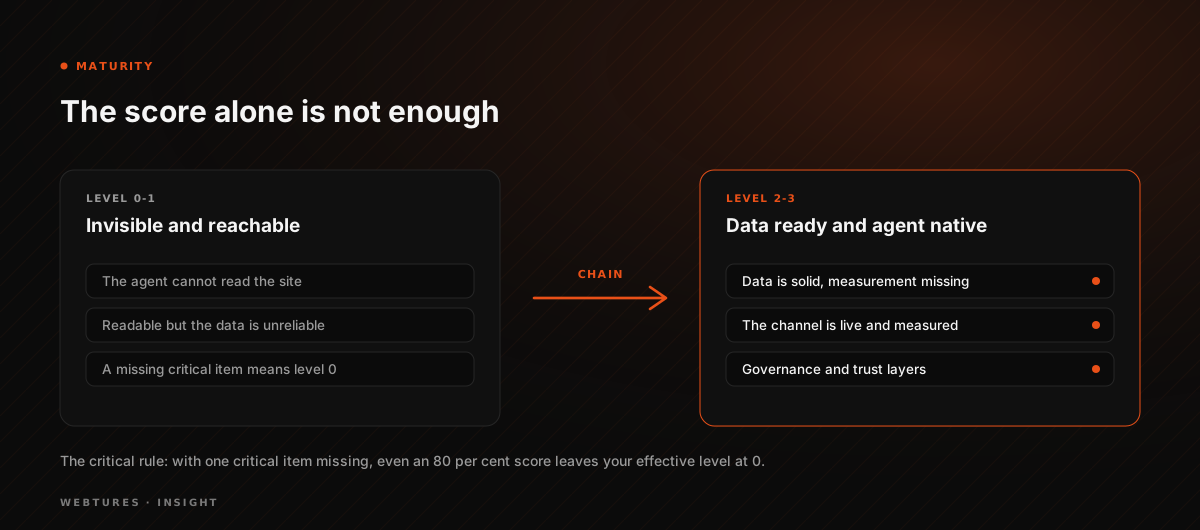
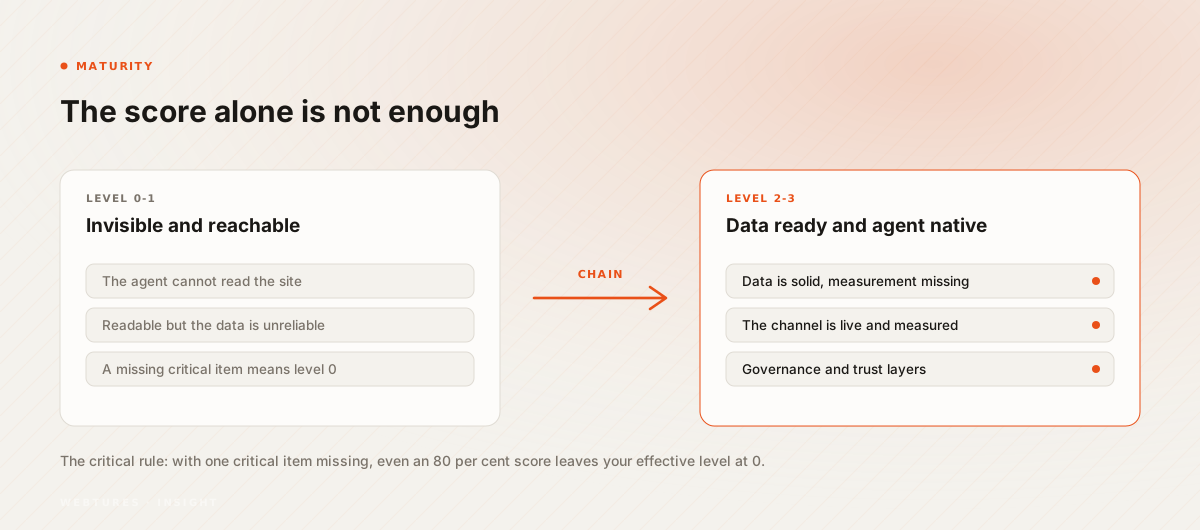
| Score | Level | Meaning |
|---|---|---|
| 0-25 | 0 · Invisible | Agents cannot read the site or understand the product |
| 26-50 | 1 · Reachable | Readable but the data is not reliable |
| 51-75 | 2 · Data Ready | Data is solid, visibility and measurement missing |
| 76-90 | 3 · Agent Native | The channel is live and measured |
| 91+ | 3+ · Reference | Mature, including governance and trust layers |
The level carries a critical rule: a level is not earned until the critical items of that section are complete. If OAI-SearchBot is blocked in robots.txt, your effective level is 0 even at 80 per cent. That rule stops the score from misleading you.
Automatic results and the fix list
The second section holds the result of every item testable from outside: pass, partial, missing. Open a missing item and it states what was found and how to fix it. The third section ranks missing items by their effect on the score and tells you roughly where your score lands if you complete the first five. Every finding comes with a ready fix prompt you can hand straight to your development team or your coding assistant.
Red flags
The report separately marks the conditions to look at before anything else. If one of these appears, drop everything else and solve it.
- The firewall or
robots.txtis blocking legitimate search and agent bots - Price or stock disagrees between the feed and the site
- Product information is rendered only through JavaScript
- The feed carries invented GTINs
- Fake reviews or AggregateRating are present
- Stock accuracy is below 90 per cent
- No logs are kept for agent transactions
Turning the data into a 90-day plan
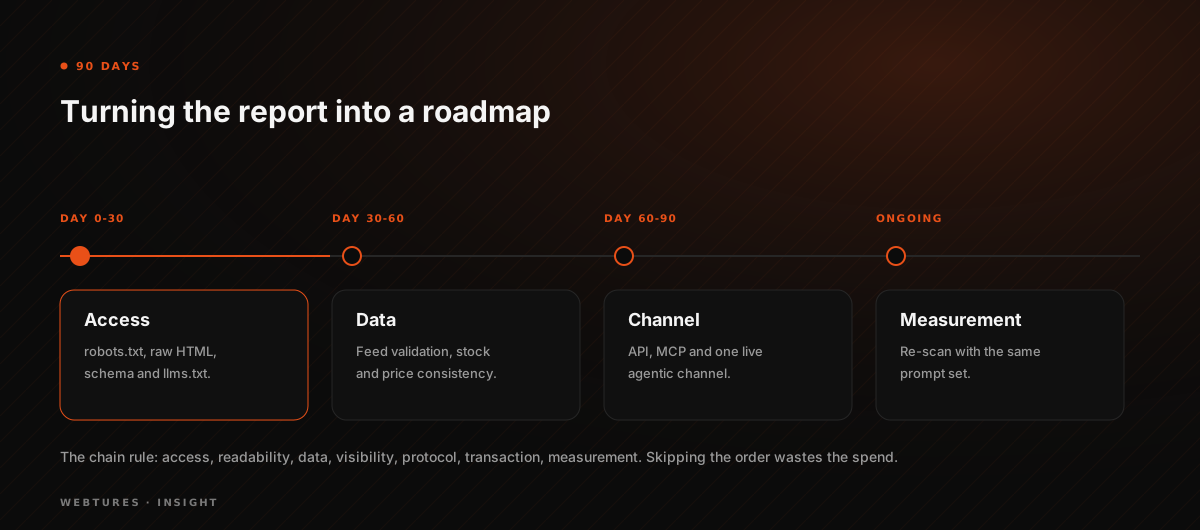
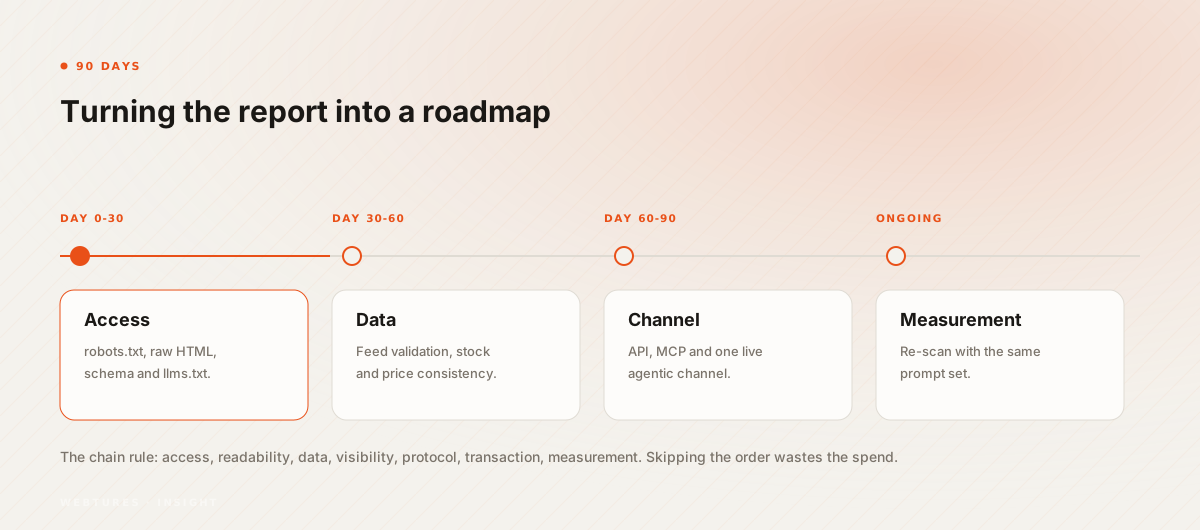
The tool's core principle is the chain rule: access, readability, data, visibility, protocol, transaction, measurement. Investment that skips the order is wasted. A flawless product feed on a bot-blocked site is never found; an MCP server on a site with no schema reaches nobody.
Day 0-30: access and readability. Fix robots.txt and firewall rules, move content out of JavaScript into raw HTML, validate Organization and the core schemas, publish llms.txt. In the same period define a prompt set and take the first measurement of your visibility.
Day 30-60: data and reliability. Validate the product feed, raise stock accuracy, align feed and site pricing, choose the right products for the channel. Output: a data layer agents can trust.
Day 60-90: channel, visibility, governance. API and MCP readiness, live product in at least one agentic channel, a written authority and authorisation policy, logging for agent transactions. Output: an agent channel that is measured and managed.
Honest limits
- It is not a sales guarantee. Agentic commerce is primarily a discovery channel today.
- Market asymmetry is real. The return on protocol and feed investment currently sits mostly in export markets.
- Measurement is incomplete. Part of AI traffic escapes every setup; the numbers are a floor.
We covered the button-scale version of the same discipline in our CTA article, and the team-and-process scale in our piece on choosing an AX partner. Once you have run the scan and seen your score, the next step becomes clear on the Agent Experience side.
Growth & GEO
Let us make your brand visible in AI search.
Share your goals, we'll come back with a custom growth plan within one business day. A strategy lead will reach out personally.
Get in touch