AI Roadmap (2026): A Complete Guide for Individuals, Professionals Over 40 and Organisations
How to prepare an AI roadmap: a 90-day individual plan, a six-step organisational method, a guide for professionals over 40 and the 2026-2030 national framework.

What is an AI roadmap?
An AI roadmap is a staged plan that defines in which order, with which resources and against which metrics an individual or an organisation will put artificial intelligence into practice. A well-built roadmap answers three questions clearly: where are we today, where will we be in 12 months, and how will we measure it.
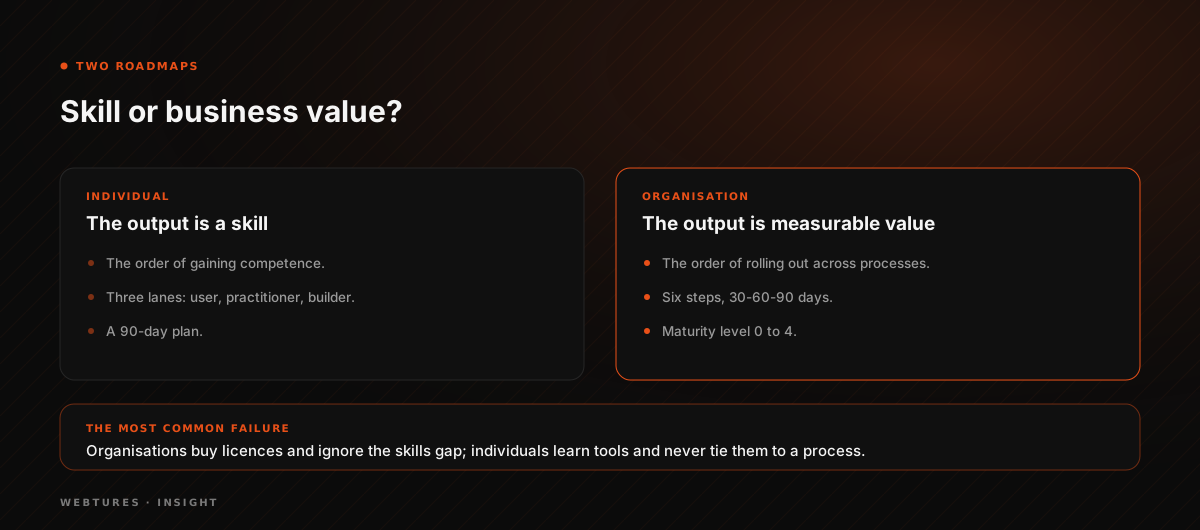
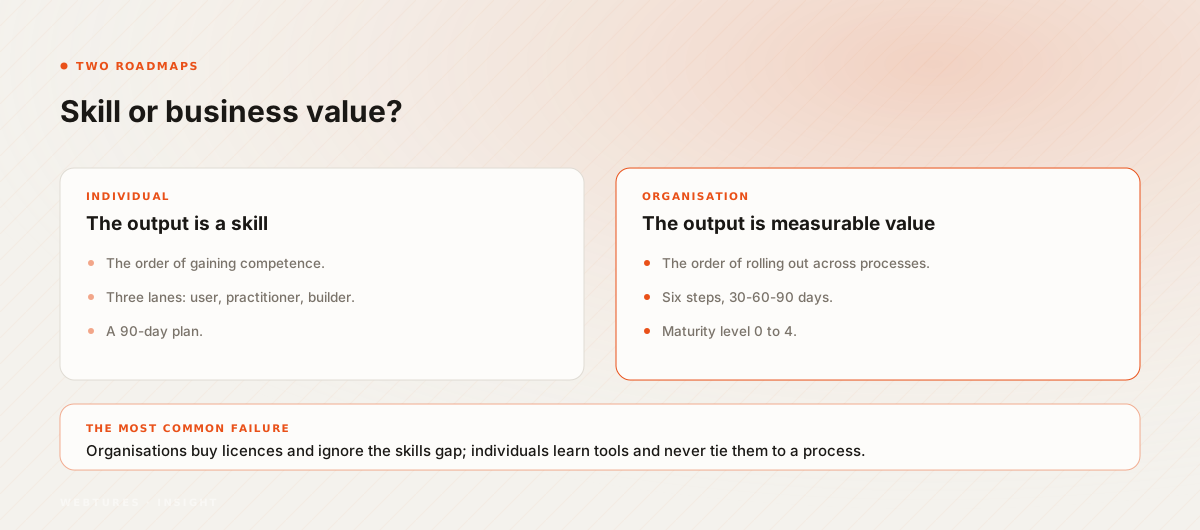
There are two different roadmaps, and the two are constantly confused. An individual AI roadmap defines the order in which a professional gains competence; its output is a skill. An organisational AI roadmap defines the order in which an organisation rolls AI out across its business processes; its output is measurable business value. This guide covers both, because the most common cause of failure we see in the field is exactly that this distinction was never made: organisations buy tool licences and ignore the skills gap, individuals learn tools and never tie them to a business process. Both get stuck in the same place.
The picture in 60 seconds, using Turkey as the case study:
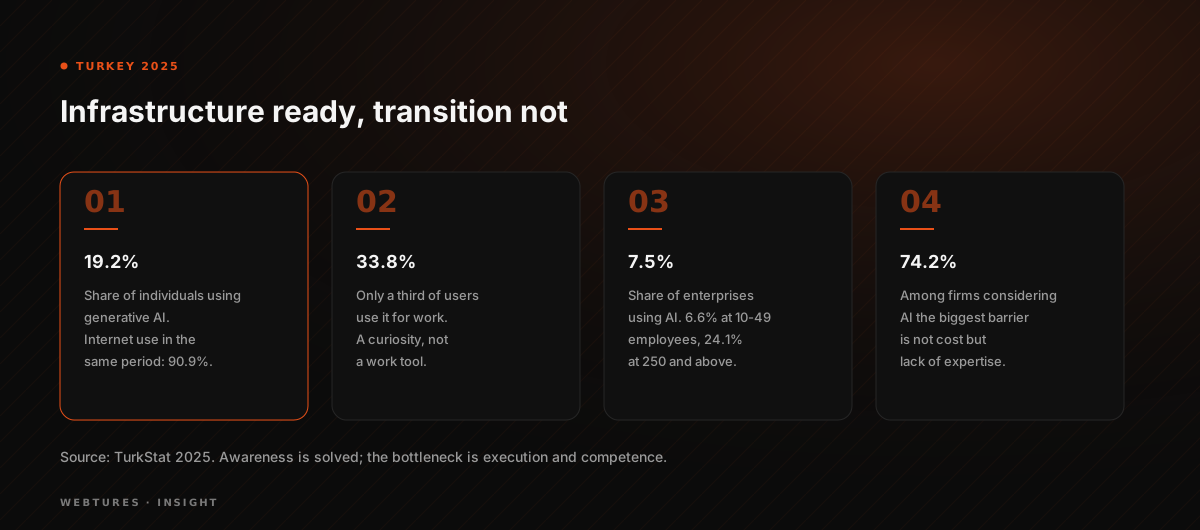
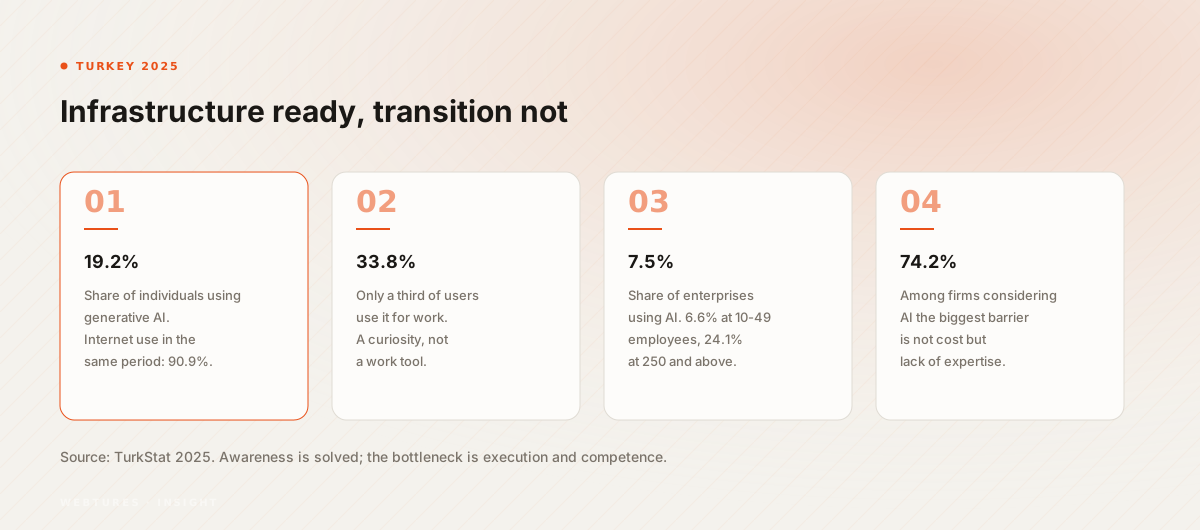
- 19.2% of individuals in Turkey use generative AI (TurkStat, 2025). Internet use among 16 to 74 year olds in the same period is 90.9%. The infrastructure is ready; the transition is not.
- The age split is sharp: usage approaches 40% among 16 to 24 year olds, falls to 15.5% among 35 to 44 year olds and below 1% over 65.
- Only 33.8% of users use it for work. For most people AI is still a curiosity, not a work tool.
- 7.5% of enterprises use AI; 6.6% among firms with 10 to 49 employees, 24.1% at 250 and above.
- The most critical figure: among firms considering AI, the biggest barrier is not cost but lack of expertise (74.2%).
- Turkey's National AI Action Plan (2026-2030) came into force with the Presidential Circular 2026/9 published in the Official Gazette on 18 August 2026; four axes, 16 priority actions.
- Globally, the World Economic Forum's Future of Jobs 2025 report projects that 39% of job skills will change by 2030; sector barometers show that employees with AI skills earn a clear wage premium.
Our reading at Webtures is clear: the awareness problem is largely solved. The next bottleneck is execution and competence. The coming 24 months are the period in which the gap between organisations with a roadmap and those without will open permanently.
Why do projects that start without a roadmap stall?
The five sticking points we see most often in AI projects:
- Scattered initiatives. Marketing buys its own tool, finance its own, HR its own. No shared data layer, no shared policy, no shared measurement. Six months later there are seven subscriptions and zero consolidated output.
- The pilot trap. The proof of concept works, everyone is pleased, and it never reaches production, because the pilot was built on the easiest scenario and the data quality, integration and process problems that appear at scale were never tested.
- Tool focus. "Which AI tool should we buy" is the wrong question. The right one: in which business process do we have a measurable loss, and can AI close it?
- The competence gap. Licences are bought, training is not given. The 74.2% expertise barrier in the TurkStat data is exactly the result. A tool can be bought; competence cannot.
- Missing governance. Projects that start before defining data classification, which data may enter which model and who is responsible for verifying output are halted at the first serious incident.
A roadmap cannot be drawn without knowing the current position. The five-level maturity model we use in field work:
| Level | Name | Definition | Typical indicator |
|---|---|---|---|
| 0 | Unaware | No AI use in the organisation, not discussed | No policy, no tools |
| 1 | Individual experiments | Employees use personal accounts, unnoticed | Shadow use, high data risk |
| 2 | Controlled pilot | A defined pilot runs in one department | 1 to 2 use cases, weak measurement |
| 3 | Process-embedded | Several processes, defined policy, measured | KPIs exist, ownership exists |
| 4 | Scaled and governed | Integrated across the organisation, tied to the data layer, auditable | AI board, risk register, ROI report |
The large majority of organisations sit between Level 1 and Level 2 today. The real risk is shadow use: corporate data flowing into external models without policy or oversight. The roadmap's first job is to close that risk, not to add another tool.
How do you build an individual roadmap?
Most AI learning roadmaps assume a single goal: becoming an AI engineer. That is the right goal for less than 1% of the working population. The realistic model has three lanes.
Lane A: AI power user. No code. The goal is to hand a defined share of routine work in your current profession to AI. Duration 8 to 12 weeks. This should be the goal for 90% of white-collar workers, public employees, SME owners and managers.
Lane B: AI practitioner. Low-code or no-code automation. The goal is to build department-level workflows, connect agent-based tools and work with data. Duration 4 to 6 months.
Lane C: AI builder. Python, models, MLOps. The goal is to build products. Duration 9 to 18 months, and only meaningful for those with a technical background.
The common mistake is a professional who belongs in Lane A following the internet's "start with linear algebra" advice and quitting in three weeks. The 90-day plan for Lane A has three phases:
- Foundation (weeks 1 to 4): the first real work output. Choose one main assistant and stay with it; trying four tools at once slows learning. Learn the three rules of an effective prompt: give context, define the role, specify the output format. Recognise hallucination; noticing when the model invents is a more valuable skill than knowing how to use it. Make the first week's output concrete: a real email, a real report, real meeting notes.
- Expansion (weeks 5 to 8): three areas of daily work. The text layer (correspondence, summarising, translation, report drafts), the data layer (PDF and spreadsheet analysis, table interpretation), the visual and presentation layer. Use a real file from your own work for each; working with sample data seriously reduces the learning effect.
- Systematisation (weeks 9 to 12): repeatable workflows. Build a fixed prompt template for your three most frequent tasks, connect two steps with no-code automation, start with agent-based tools. The real break of 2026 is not chat but agents that take over multi-step tasks. Write your personal AI policy: which data you will never enter into any model, which output you will never use unverified.
For those who want to progress in a structured cohort, the Webtures Academy programmes run these three phases with live support.
Why do professionals over 40 need a different path?
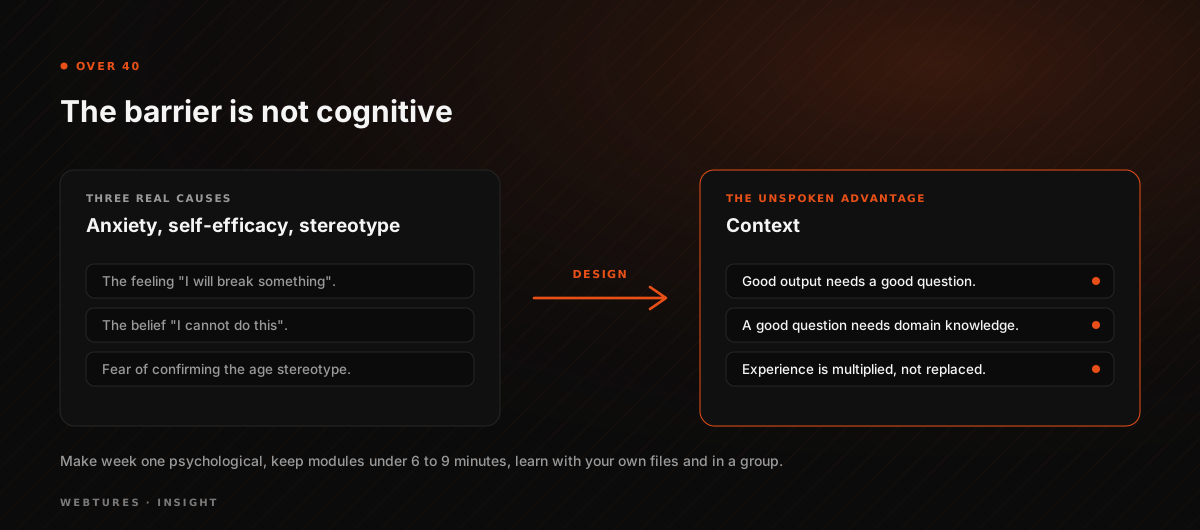
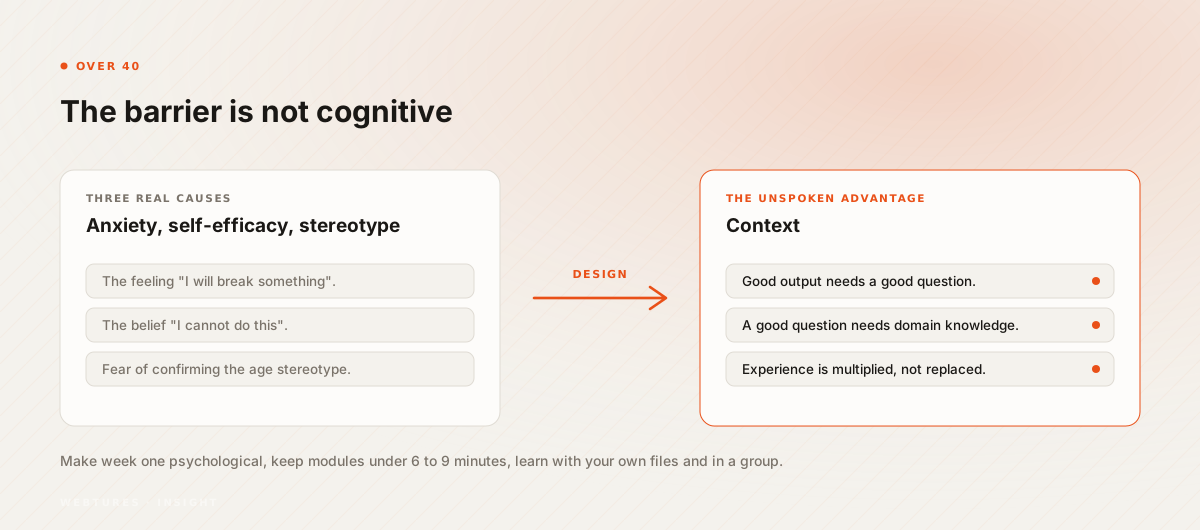
We write this section separately because the data clearly shows a different picture. In TurkStat's 2025 data, generative AI use is 15.5% among 35 to 44 year olds while it approaches 40% among 16 to 24 year olds. The difference is not one of cognitive capacity. There are three real causes we see in the field.
Technology anxiety. The feeling of "I will break something" when meeting a new interface; technology acceptance models define it as a factor that directly lowers perceived ease of use. The self-efficacy gap. The belief "I cannot do this" kicks in before trying and reduces the number of attempts. Stereotype pressure. Fearing confirmation of the "they cannot handle technology" cliché about their age group, people both perform worse and withdraw from the field entirely. The second is the more damaging outcome: avoidance instead of trial.
Against that, the professional over 40 has a serious and almost never discussed advantage: context. Getting good output from AI requires asking good questions; asking good questions requires domain knowledge, sector experience and the ability to define a problem. The question a finance manager with 20 years of experience asks of a financial statement is worth many times more than the question of a 24-year-old who uses the same tool far faster. AI does not replace experience; it multiplies it.
| Rule | Why |
|---|---|
| Make week one psychological, not technical | Learning does not start until anxiety breaks. The only aim of the first session is a guaranteed success |
| Keep videos and modules under 6 to 9 minutes | A study of 6.9 million viewing sessions on edX shows attention dropping sharply after 6 minutes |
| Use real files from your own work | Adult learning is problem-centred. Knowledge that cannot be applied immediately is not retained |
| Learn in a group, not alone | Completion rates on open online courses hover around 7.6%; cohort-based, live-supported programmes reach 60 to 72%. The difference is social structure, not content |
| Create an environment that allows mistakes | Getting wrong output is part of learning. Asking the assistant a wrong question costs nothing |
| Slow pace, frequent repetition | Spaced repetition clearly outperforms one-off intensive training |
How do you prepare an organisational roadmap?
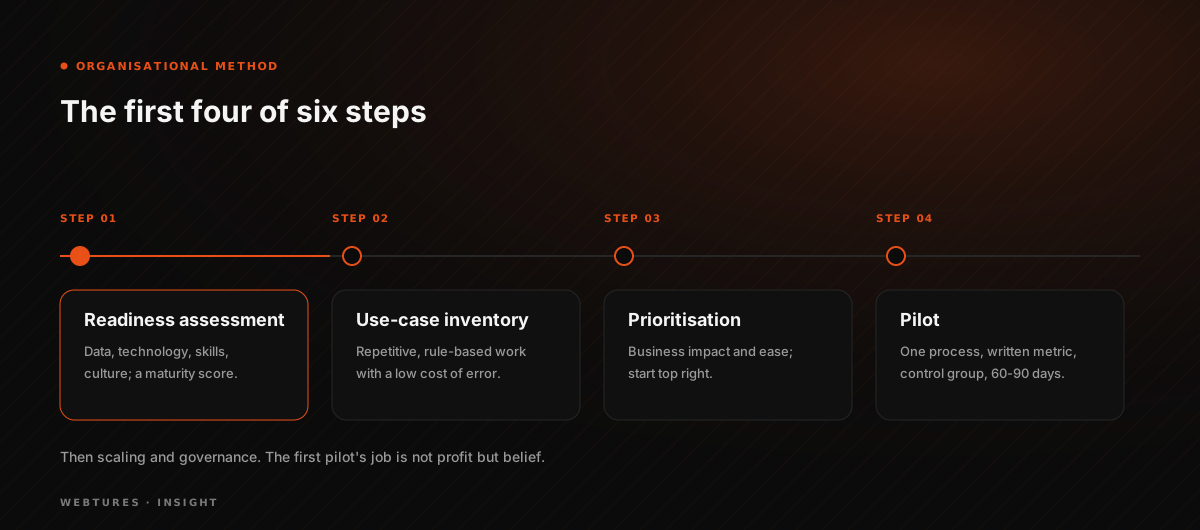
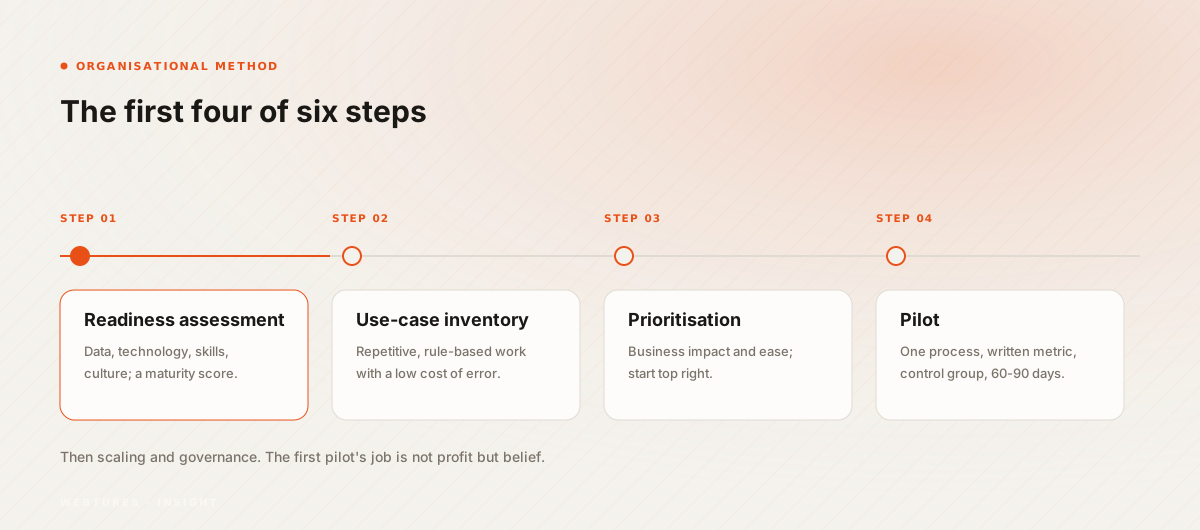
The six-step Webtures method:
- Readiness assessment (2 to 3 weeks). Measure four dimensions: data (quality, accessibility, ownership, governance; most AI projects fail because of data, not the model), technology (cloud, APIs, integration, security), competence (measure the 74.2% expertise barrier inside your own organisation), culture (openness to change, data-driven decisions, tolerance for experimentation). Output: a maturity score from Level 0 to 4 and a gap map.
- Use-case inventory (2 to 4 weeks). Do not go from department to department asking "where would AI help". Ask instead: which work is repetitive, rule-based, time-consuming and low in cost of error? Typical high-return starting points: first-line response and ticket classification in customer service, contract and document summarisation, pre-sales research and proposal preparation, content production and localisation, reporting, candidate screening in recruitment.
- Prioritisation (1 to 2 weeks). Score every scenario on business impact and ease of implementation. High impact and high feasibility: start now, the first pilot is chosen here. High impact, low feasibility: put it on the 12 to 24 month plan. Low impact, high feasibility: use it for momentum. Low impact, low feasibility: do not do it. In organisational transformation the first pilot's job is not to produce profit but to produce belief.
- Pilot (60 to 90 days). One department, one process, a defined start and end. Write the success metric before starting: "it worked well" is not a metric; "average response time fell from 4 hours to 40 minutes" is. Keep a control group; if you cannot compare, you cannot prove the effect. Build the pilot on a representative scenario, not the easiest one.
- Scaling (6 to 12 months). Carry the process the pilot worked in to other departments. Build a shared AI layer: one policy, one access management, one cost tracking. Launch the internal training programme; in organisations that skip this step adoption stays below 20%. One champion per department.
- Governance (continuous). An AI policy (which data enters which model, and which does not), output verification responsibility (every output must have a human owner), a risk register and incident procedure, data protection compliance and data classification. For organisations touching the European market, an EU AI Act assessment: since 2 February 2025, Article 4 obliges providers and deployers of AI systems to ensure sufficient AI literacy among their staff.
| Period | Focus | Concrete output |
|---|---|---|
| First 30 days | Visibility and control | Maturity assessment, shadow-use inventory, draft AI policy, long list of use cases |
| Days 31 to 60 | Prioritisation and preparation | Priority matrix, pilot selection, success metrics, tool selection, pilot team training |
| Days 61 to 90 | Execution and proof | A working pilot, the first measurement report, a business case for the board |
The only thing you need at the end of 90 days is a document that shows, in numbers, that AI works in your organisation. Without it the budget conversation does not move.
Which KPIs should you track?
Measurement is the weakest side of AI investment. Measure on four layers: adoption (active user rate, weekly active use, spread by department), productivity (time per task, process cycle time, transactions per person), quality (error rate, rework rate, customer satisfaction), financial (cost per process, revenue effect, payback period of licence cost).
A critical warning: do not mistake adoption metrics alone for success. High use does not mean high value. If you cannot show which business outcome the use changed, what you have is a cost line.
Aligning the organisational roadmap with a national framework gives a direct advantage to public bodies and to private firms working with them. Turkey's AI Action Plan is built on four axes: Recognise (literacy; training 5 million people in two years through workshops in 81 provinces, 10,000 advanced specialists and 100,000 application professionals), Benefit (compute; raising installed data-centre capacity to at least 1 gigawatt by 2030), Produce (financing, domestic models, robotics) and Govern (AI diplomacy, regulatory sandboxes in at least five priority sectors). Two windows: governance structures and first public-sector applications in 2026-2027, scaling of pilots in 2028-2030. The practical conclusion: build the part of your roadmap up to the end of 2027 around "set up governance, run a pilot, build competence"; the national calendar points the same way.
The seven most common mistakes: buying tools before strategy (a licence is not a roadmap); not budgeting for competence (at least 20% of the tool budget should go to training); ignoring shadow use; starting without defining measurement; choosing the easiest scenario for the pilot; removing human verification (the hallucination risk has not gone to zero); skipping the visibility leg.
The forgotten leg of the roadmap: AI visibility
There is a layer almost always missing from organisational AI roadmaps. You plan how you will use AI inside; how does AI describe you outside? Users now research brands not from search result lists but from the direct answers of generative engines. ChatGPT, Gemini, Perplexity and Google AI Overviews reference certain sources when answering a question and leave others out. The rules of that choice work differently from classic SEO; the field is called Generative Engine Optimization (GEO).
Our forecast at Webtures is clear: between 2026 and 2030 the fight for digital visibility will be fought not over rankings but over being the source of the answer. Your organisational roadmap must run in two directions. Inward: AI in processes, productivity, cost. Outward: your brand's visibility in generative engines, which questions you are referenced for, whether competitors are the answer in your place. You cannot manage the second without measuring it; start with the GEO checklist, build the measurement layer with our GEO tools article, and see how agents work with you on our Agent Experience page.
Frequently asked questions
How long does an AI roadmap take to prepare?
An organisational roadmap typically takes 6 to 10 weeks from readiness assessment to pilot selection. An individual roadmap can be framed as a 90-day execution plan.
Do you need to code to learn AI?
No. For the large majority of the working population the right goal is Lane A, the no-code AI power user. Code is only needed by those who want to build products.
Is it too late to learn AI after 40?
No. Valuable output requires good questions, and good questions require domain knowledge and experience; that depth of context is the greatest advantage of the professional over 40. The barrier is not cognitive; it is mostly technology anxiety and self-efficacy, and a well-designed programme overcomes it.
Which department should an AI project start in?
The one with the most repetitive, rule-based, time-consuming, low-error-cost processes. In practice that is usually customer service, marketing or operations.
Does a small business need an AI roadmap?
Yes, even more so. According to TurkStat, AI use is 6.6% among firms with 10 to 49 employees and 24.1% at 250 and above. That gap is both a risk and an opportunity for SMEs. A small business's roadmap is shorter and more focused, and more necessary.
How is the return on AI investment measured?
On four layers: adoption, productivity, quality and financial effect. The critical point is that baseline values were recorded before the pilot. Without a comparison point, return cannot be proven.
How does data protection law limit AI use?
Data protection law sets the general framework for processing personal data, and that framework covers transfers to AI tools. The practical rule: no content containing personal data enters an external model whose processing conditions have not been clarified. The governance step must put that limit in writing.
How often should an AI roadmap be updated?
We recommend a review every six months. An update is also mandatory when the maturity level changes, when a pilot scales, and when the regulatory framework changes.
An AI roadmap is not a technology choice but a question of order: measure the current state first, find the bottleneck, start with the single highest-impact scenario, measure, then spread. To measure your organisation's maturity level and draw up a roadmap of your own, get in touch with our team.

Let us make your brand visible in AI search.
Share your goals, we'll come back with a custom growth plan within one business day. A strategy lead will reach out personally.
Get in touch