How to Create the Best Content with AI
Learn how to create the best content with AI, from prompts and drafting to editorial control, so your pages stay original, accurate and visible in AI Search.

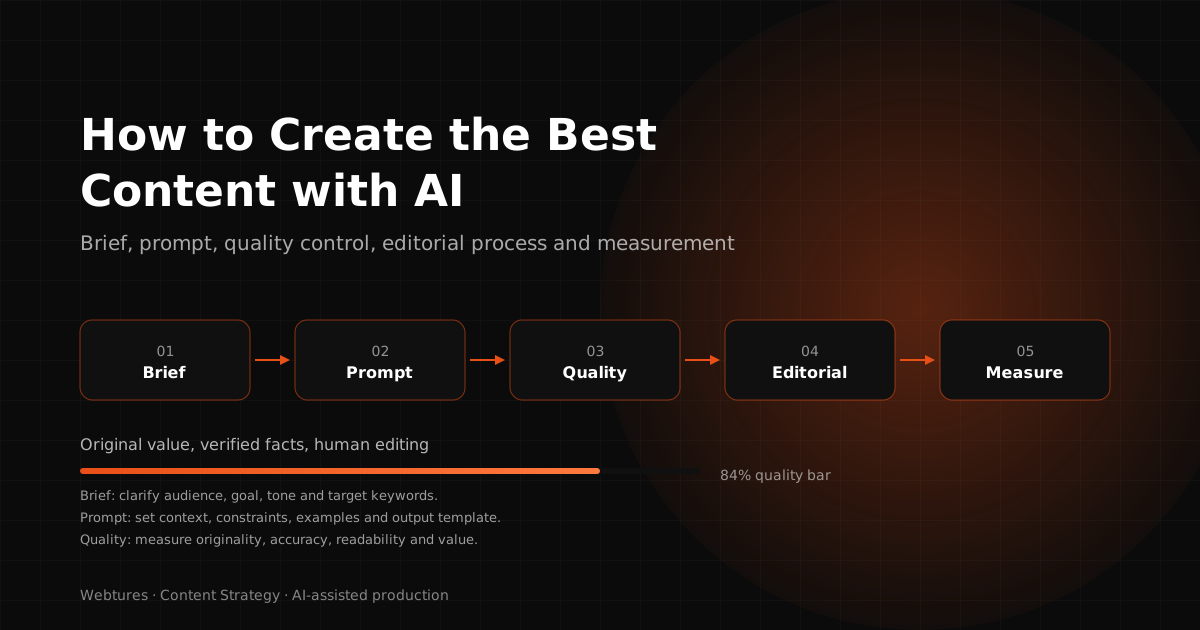
AI can produce a blog draft in minutes. What makes that draft fit to publish is still a human editor. This article covers where AI-assisted content production genuinely helps, where it carries risk, and which checks a model output has to clear before it goes live. The focus is the process, not a tool list.
As a team that has produced content for enterprise brands for 16 years, we see a consistent picture. AI raises production speed. It does not raise quality on its own. The difference in quality is created by the editorial layer placed on top of the draft.
What is AI content production?
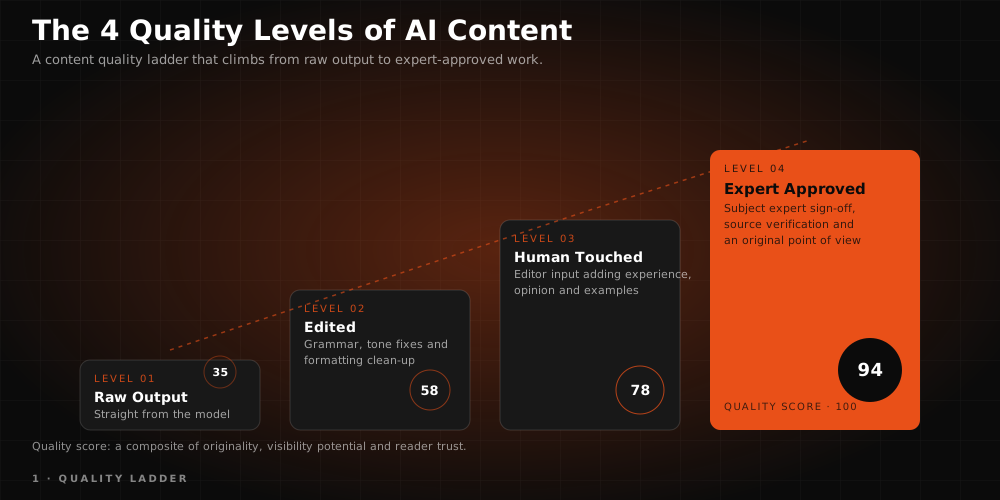
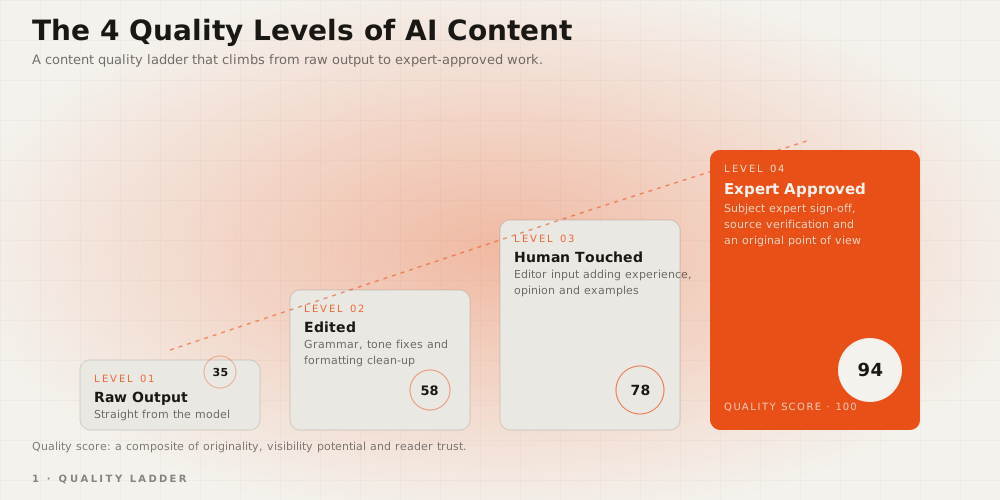
AI content production is the use of large language models to generate a draft, a set of headlines, a summary or a content outline from a given prompt. The model writes the statistically most likely continuation using language patterns learned from its training data. That is why the output reads fluently. It is not why the output is correct.
Three concepts form the technical basis:
- Natural language processing (NLP): Combines linguistics, statistics and machine learning to interpret meaning and generate new text.
- Machine learning: The family of algorithms that lets a system analyse defined data and make predictions about new data.
- Deep learning: Multi-layer neural networks that make more complex language tasks solvable.
Together these determine not what the model knows, but what is likely to be said next. The distinction is critical: a model writes a sentence because it looks linguistically coherent, not because it has a source for it. That is exactly where the case for editorial control begins.
How does a language model actually produce text?
A language model breaks the text it receives into pieces and selects the next piece by probability. Understanding that mechanism explains why output is sometimes flawless and sometimes entirely invented.
Four factors shape the result:
- Training data: The model learns from an enormous body of text collected up to a certain date. Anything after that date is absent unless it is supplied separately.
- Context window: The amount of text the model can hold in view at once. Long briefs, brand guidelines and source documents influence the output only to the extent they fit inside it.
- Grounding: Connect the model to search results, your own document library or product data and accuracy rises noticeably. Without grounding, the model speaks only from memory.
- Randomness setting: This is why the same prompt returns different answers twice. Useful in creative copy, risky in anything carrying data.
The practical consequence: the more verified input you give the model, the less output you have to correct. Quality comes from the quality of the context supplied, not from the length of the prompt.
Where is AI strong and where is it weak in content production?
AI is strong on volume, speed and structure. It is weak on accuracy, first-hand experience and brand voice. Building the process around that split is the first decision that determines the value of the output.
Areas where the model contributes reliably:
- Mapping a topic at the research stage and gathering subheading options.
- Producing a rough draft so the editor starts from text rather than a blank page.
- Expanding the set of questions a target audience might ask.
- Listing topic gaps in an existing content library.
- Retelling the same information for different reader levels.
- Summarising and comparing long source documents.
Areas where the model falls short on its own:
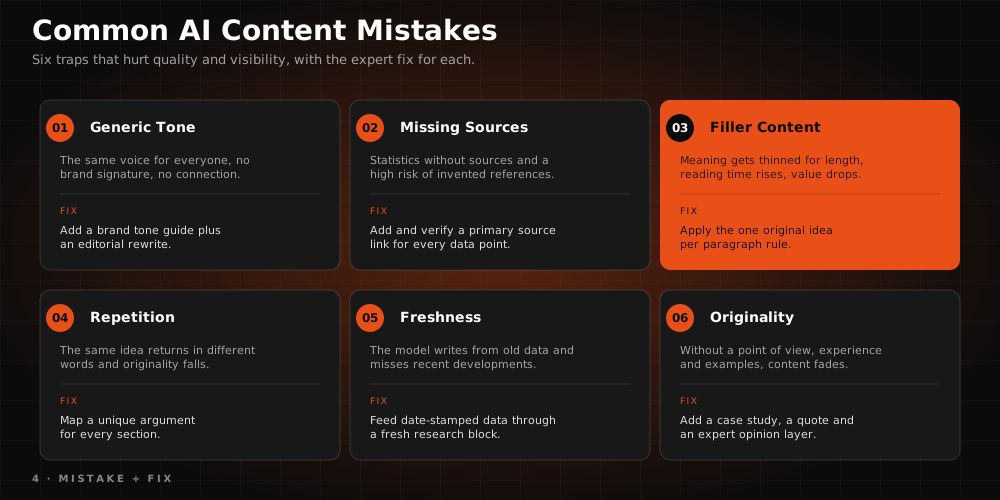
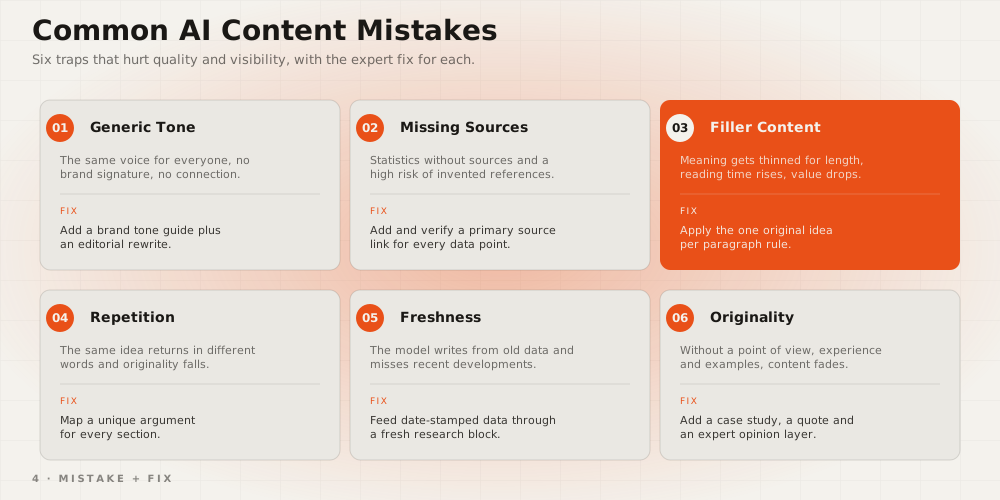
- Accuracy: A model can produce a non-existent statistic or source in entirely convincing language.
- Currency: Training data freezes at a date. Industry data does not.
- Original experience: The model has never run a project, so it has no field to report from.
- Brand voice: Default output is formulaic and neutral. What differentiates a brand is the opposite of that.
- Judgement: Deciding which information actually matters to the reader is an editorial call.
Which content types benefit most from AI?
AI returns the most on content types with repeating structure and clearly defined inputs. On content requiring original judgement and field experience, it belongs to the preparation stage only.
Where the gain is clearest:
- Product descriptions: Given a specification list, the model produces consistent, readable copy. The gain scales with catalogue size.
- Meta titles and descriptions: Generating many variations inside a character limit is tedious for a person and trivial for a model.
- FAQ sections: Feed the model real questions pulled from support tickets and answerable drafts come together quickly.
- Summaries and reframing: Rewriting a long technical document for different audiences.
- First-pass translation and localisation: A clear accelerator, provided a human revises it.
- Content gap analysis: Comparing an existing page inventory against a target query list to surface missing topics.
Case studies, market commentary, expert interviews and strategy pieces are the opposite case. There the model produces an outline at best; the organisation writes the body.
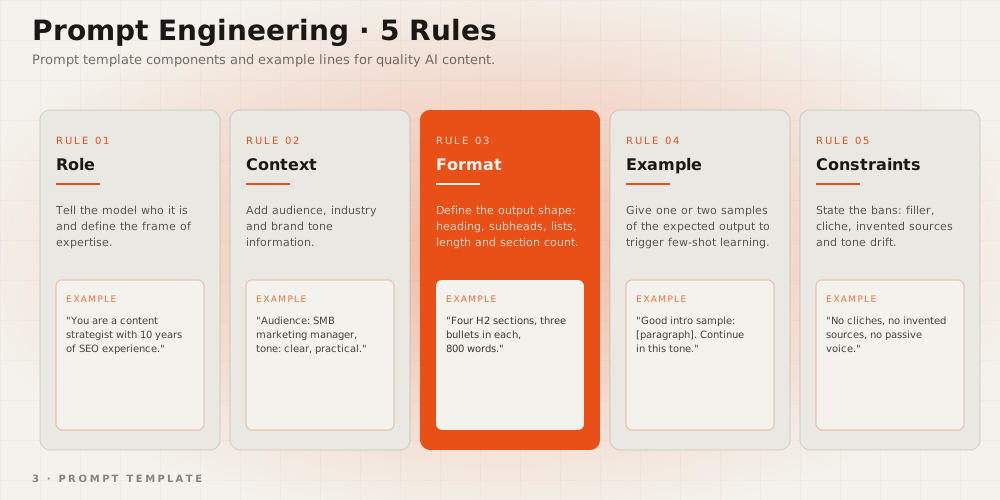
How do you write a good content prompt?
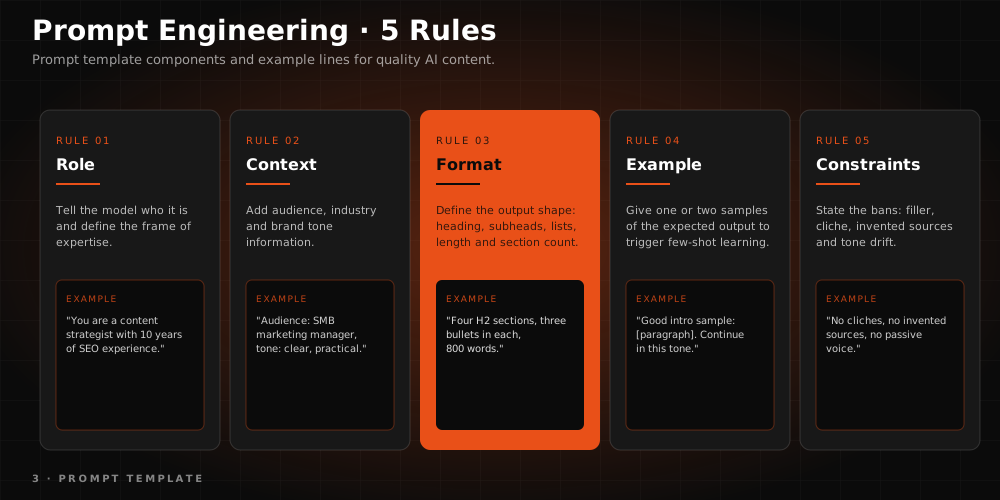
A good prompt describes not just what you want, but the conditions under which you want it. Poor output usually traces back to a thin brief rather than a weak model.
What a prompt should carry:
- Role and audience: Who is writing and for whom. "A senior SEO specialist writing for a marketing director" and "a general reader" produce entirely different texts.
- Purpose: Which decision the piece should make easier for the reader.
- Context: Product information, brand guidelines, existing page copy and verified data. Pasting context into the prompt is the single most effective way to stop the model inventing from memory.
- Structure: Heading hierarchy, number of sections, length per section.
- Constraints: Banned words, phrasing patterns to avoid, rules on figures and sources.
- Verification instruction: An explicit request to flag uncertain information rather than invent it.
Do not try to perfect a prompt in one pass. Save the ones that work, collect them in a shared library and revise them against the output. A prompt is a process asset, not a piece of text.
How do you make AI output ready to publish?
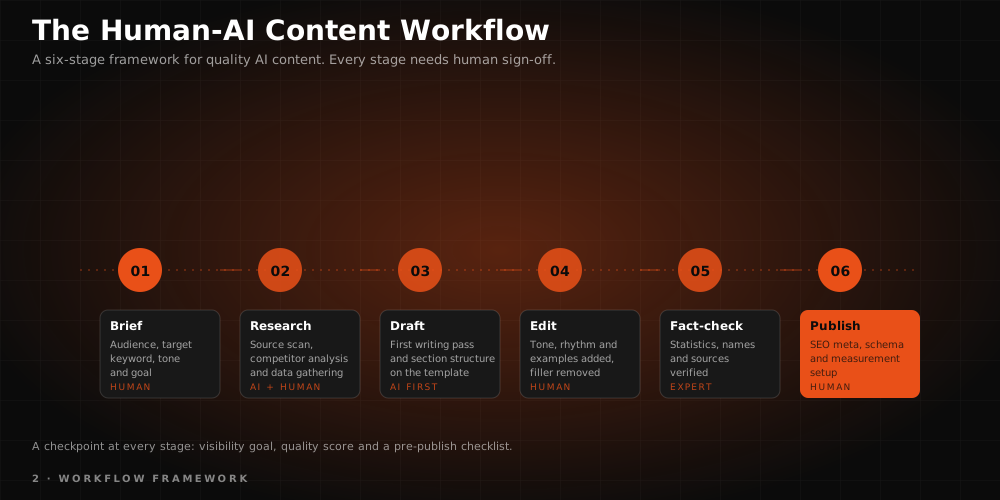
An AI draft does not go live until it clears a seven-stage human review. This is the sequence we run in the Webtures content process:
- Fact verification: Every figure, date, name and claim is checked against a primary source. Anything unverifiable is removed or converted into a qualitative statement. This step eliminates the most common failure in model output: false data presented convincingly.
- Source attribution: Every remaining data point is tied to a named, dated source. A claim without a source does not stay in the text.
- Adding original experience: Project experience, field observations and the practical limits encountered in delivery are added to the draft. This is the layer that separates a piece from its competitors.
- Brand voice correction: Formulaic sentences, empty praise and neutral AI phrasing are stripped out. The text is pulled into the brand's own terminology and sentence rhythm.
- Redundancy cleanup: Paragraphs that restate the same idea in different words are merged. Models tend to generate length; the editor restores information density.
- Internal linking and structure check: Heading hierarchy is fixed, the opening sentence of each section is rewritten to answer without needing surrounding context, and descriptive links to related pages are added.
- Final read before publishing: An editor who did not write the piece reads it end to end. The goal is not catching typos. It is testing whether the reader's question was actually answered.
The checklist slows publishing down somewhat. In exchange it removes the cost of correcting a mistake after it is live. The real risk in AI-assisted writing is not poor writing. It is wrong information delivered in well-written form.
What are the advantages and the risks?
The advantage of AI is speed and scale. The risk is accuracy and sameness. Teams that see only one side trade short-term efficiency for long-term reputation cost.
Concrete advantages:
- Blank-page time disappears. The editor starts by revising rather than writing.
- Research and drafting compress, and the time saved moves to verification and depth.
- The same information converts quickly into other formats: blog, email, deck, social copy.
- Small teams can cover a much wider topic map.
- First-pass cost drops sharply in multilingual production.
Risks worth taking seriously:
- Fabricated information: A model can present a study that does not exist as a source. Every unverified figure is a publishing risk.
- Sameness: Brands using the same models produce text that reads alike. Differentiation comes from the layer the model cannot supply.
- The scale trap: Easier production can turn into an archive nobody reads. Page count is not a success metric.
- Confidentiality: Customer data, contract text and unpublished strategy should not be fed into external tools.
- Accountability gap: If no name stands behind a piece, no one owns the error. Every piece needs an editor.
Does Google support AI content?
Google evaluates how useful content is, not how it was produced. Content prepared with AI assistance is not banned. The criterion is the value delivered to the reader, not the production method.
The framework sits in Google's helpful content guidance. Content is expected to be people-first, to genuinely answer the reader's question, to carry first-hand knowledge or expertise, and to have enough depth to satisfy the reader. It is a framework that questions intent rather than banning automation.
The actual boundary is drawn by the spam policies. Content produced at scale primarily to manipulate search rankings counts as a policy violation regardless of who or what produced it. The problem is not using AI. The problem is using AI to manufacture volume for an algorithm rather than for a reader.
The practical conclusion: using AI grants no automatic advantage and creates no automatic penalty. The difference is made by the editorial accountability standing behind the text. Every published piece, whatever its origin, has to pass quality control. We cover the search side of this in content optimization for AI search.
How do you use AI for GEO-ready content?
In GEO-ready content, AI is a preparation tool rather than a production tool. Whether answer engines select a brand as a source depends on information accuracy, clarity of entity relationships and content built in an answerable structure. None of that is obtained automatically by writing a prompt.
The model is productive for a defined set of jobs: mapping topic coverage, expanding user questions, identifying gaps in existing content and building the structural outline. The final text is then strengthened with expertise, first-hand experience, verified sources and editorial control.
The technical detail that determines citability in answer engines is a separate discipline. Passage-level readability without surrounding context, opening sentences that answer directly, consistent brand information and correctly marked entity relationships form its foundation. We collected the rule set in the five golden rules of GEO content and covered where GEO sits in a marketing plan in GEO as a marketing tool. You can also review how we approach this work on our generative engine optimization and AI-first SEO pages.
How do you measure an AI-assisted content process?
An AI-assisted content process is measured by revision load and post-publication performance, not by the number of pages produced. Without measurement, the efficiency claim stays an assumption.
Indicators worth tracking:
- Revision rate: How much of the draft changed on the way to the published text. Very low means a weak editorial layer; very high means a weak prompt and thin context.
- Claims dropped in verification: How many statements in the output turned out to be unsourced. This is the risk indicator for the process.
- Time to publish: Brief to live. This is where the real gain from AI becomes visible.
- Read depth and conversion: Time on page and goal completion. What is measured is response, not volume.
- Visibility in answer engines: Which queries cite the brand as a source. This sits alongside classic rank tracking, not in place of it.
Compare indicators quarter over quarter. A single piece performs noisily; process quality only becomes visible across a series. Model behaviour differs between systems too, and what Google Gemini is and how to use it is a useful starting point on that.
How should you position AI in content production?
Put AI in front of the content team, not in place of it. Let the model draft, accelerate research and propose structure. Let people make the decisions on accuracy, experience and brand voice.
Brands that draw this line see a measurable difference: production volume rises without content quality falling, because quality control sits in the process as a step independent of volume. Brands that do not draw it end up with a fast-growing content archive nobody reads.
At enterprise scale, the structure that holds up has three parts: a shared prompt library, a mandatory editorial review before publishing, and a written policy defining how far AI goes in each content type. With all three in place, AI stops being a shortcut and becomes part of the production infrastructure.
If you want your AI-assisted content process built on an enterprise editorial standard, review our services or get in touch.