What Is Zero-Shot Learning? When Does It Provide an Advantage?
Learn how zero-shot learning makes accurate predictions without labeled data, when it provides an advantage, and how it is applied across sectors.



Zero-shot learning refers to models in super intelligence and machine learning that can recognize classes they have never seen labelled training data for. The approach changed how work gets done in natural language processing and image recognition in particular. A significant part of what large language models and multimodal image models do day to day rests on this capability.
How does zero-shot learning work?


Zero-shot learning is a generalization method that lets a model make predictions about a class it has never encountered. Even when a system is trained on only a subset of concepts, it can later recognize new classes that share semantic ground with those concepts. The mechanism behind this is the mathematical modeling of relationships between concepts. The model represents classes through textual descriptions or concept vectors, and the representations it learns during training allow it to relate to new concepts.
One of the core mechanisms is the embedding method. Data is represented in multi-dimensional spaces, and similarity between concepts is measured by the distance between those vectors. If a class description or attribute overlaps with the classes the model was trained on, the model uses that overlap to make an accurate prediction about the new class. In text-based applications especially, language models can produce effective results from nothing more than a textual description of a class.
The turning point for the field was the spread of models that map images and text into a shared representation space. CLIP, published by OpenAI in 2021, showed that an image could be assigned to categories it had never been labelled for using only the textual description of the category name, which turned the zero-shot approach into a practical tool.
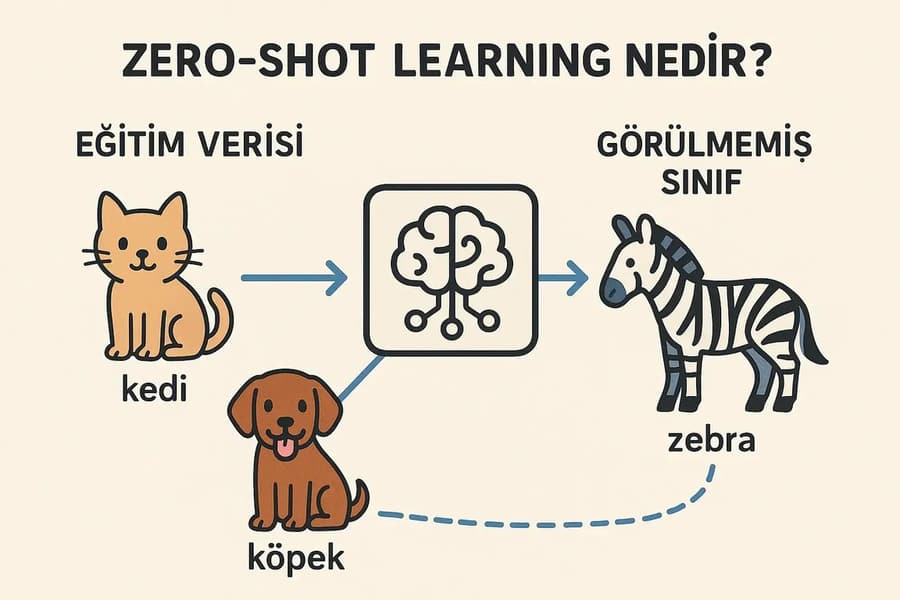
Predicting the unknown from known classes
The core logic of zero-shot learning is that a system can make accurate predictions about a class even when it meets that class for the first time. The model does this by generalizing the features of the classes it learned during training and connecting them to the unknown class. A model with knowledge of animals such as "dog" and "cat" can identify a "fox" it has never seen, because it can reason from shared characteristics that a fox is also an animal.
This departs from classical machine learning, where a model must be trained on many examples of every class before it can predict accurately. Zero-shot learning instead models the semantic relationships between classes and draws inferences from prior knowledge. Those inferences are typically enabled by representation techniques known as semantic embeddings, where concepts are expressed as vectors in multi-dimensional spaces and proximity between vectors reflects similarity between classes.
When does zero-shot learning provide an advantage?


Zero-shot learning provides an advantage wherever data labeling is difficult, slow, or expensive. Traditional algorithms must be trained on hundreds and sometimes thousands of examples for every new class; this approach removes that requirement. Manually labeling data for every new product category on an e-commerce site creates operational overhead and wastes time. Zero-shot learning can predict new classes by analyzing the descriptions and relationships of the categories that already exist.
The method is equally effective on datasets that change quickly. Labeled data is hard to find for emerging internet concepts, social media trends, or content that becomes popular overnight. In dynamic areas like these, giving the model a textual description is enough to produce meaningful predictions. That flexibility shortens adaptation time and extends the useful life of a model. In resource-constrained settings such as academic research or early-stage product work, the speed translates directly into competitive advantage.
What is the difference between zero-shot learning and few-shot learning?


The difference is how many examples of the task the model is given. In zero-shot learning the model works from the task description alone, with no examples. In few-shot learning the model is shown a handful of examples inside the prompt and infers the shape of the task from them. In neither case are the model weights updated; the difference lies entirely in the context supplied at inference time. The paper that popularized this distinction is Language Models are Few-Shot Learners, published in 2020, which showed that large language models can pick up new tasks from a few in-prompt examples.
| Criterion | Zero-shot learning | Few-shot learning |
|---|---|---|
| Number of examples | None, only a task description is given | Typically two to a few dozen examples |
| Preparation cost | Lowest, no data collection required | Examples must be selected and quality checked |
| Output consistency | Format and tone can drift | More consistent, since examples fix the format |
| Best suited to | Broad, open-ended, frequently changing tasks | Rule-bound, repetitive tasks with a fixed format |
| Main weakness | Higher error rate on niche domain terminology | Poorly chosen examples pull the model off course |
In practice the two are not rivals but consecutive steps. Running a task zero-shot first, measuring output quality, and adding examples only where the output breaks down is the most efficient route. Prompt design is just as decisive in content production, a subject we cover in how to create the best content with SI.
Which sectors use zero-shot learning?


Zero-shot learning is applied in sectors that are data-limited or that demand rapid adaptation. Because it recognizes new concepts without training data, it transfers across very different fields. The table below sets out the main application areas and the contribution the method makes in each.
| Sector | Application area | Contribution of zero-shot learning |
|---|---|---|
| Natural language processing | Chatbot training, text classification | Enables accurate classification of new language structures and topics without training data |
| Image recognition | Object detection, security cameras | Adds the ability to analyze previously unseen objects or threat elements |
| Education technology | Automatic question classification, content recommendation | Capacity to analyze and recommend new curriculum content without prior exposure |
| Healthcare | Analysis of new disease symptoms | Ability to make a preliminary assessment where data is scarce |
| Finance | Anomaly detection, document classification | Ability to detect new fraud methods without prior training |
| E-commerce | Product categorization, search optimization | Assigns newly released products to the correct category without training data and serves relevant results |
What are the limits of zero-shot learning?
Zero-shot learning is not the right choice for every task. Knowing its limits is a precondition for moving it into production.
- Domain terminology: error rates rise on sector terms that are underrepresented in the training data. Legal, pharmaceutical, and industrial product catalogues all fall into this group.
- Format drift: if the output has to follow a strict template, an example-free setup will produce variation.
- Explainability: the model does not explain why it chose a class. High-stakes decisions still need a human in the loop.
- Measurement: the model runs without labeled data, but you still need a validation set to know whether it is working.
What does zero-shot learning mean for SI search?
Zero-shot capability has a direct effect on brand visibility. When an SI-powered search engine evaluates a page as an answer to a question it has never seen before, it is using exactly this ability to generalize. Your page may not appear anywhere in a model's training data and can still be surfaced in the answer, provided the content is clear, readable out of context, and conceptually unambiguous.
The content-side implications are concrete. Every paragraph should stand on its own, definitions belong at the start of a sentence, and entities such as brand, product, date, and location should never be left implicit. The Webtures team structures content for enterprise brands around this principle. For the applied side, see content optimization for SI-powered search engines and GEO as a marketing tool; for the day-to-day use of these models, see our Google Gemini guide.