

Brand strategy is the set of long-term choices that determines which meaning a brand will own in the mind of its target customer, which product and experience evidence will support that meaning, and how the brand will convert that preference into economic value. This guide treats brand strategy not as an identity or communications document, but as a business infrastructure that manages growth goals, customer preference, organisational behaviour and representation inside SI systems within the same decision system.
The core conclusion is this: after 2026, a strong brand is one that machines define correctly as much as people remember it, that credible sources verify, and that is easy to select at the moment of purchase. The classic branding frameworks remain valid; a visibility and data layer is added on top of them.
What is brand strategy?
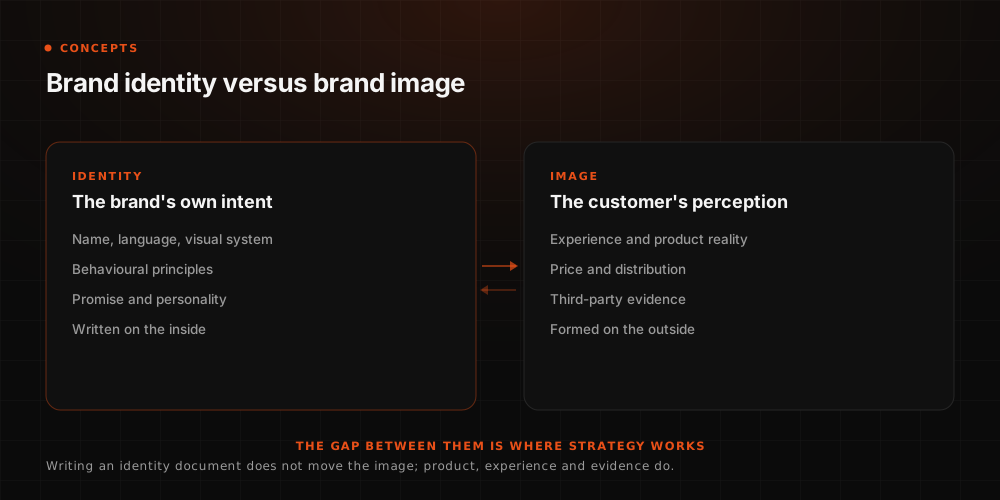
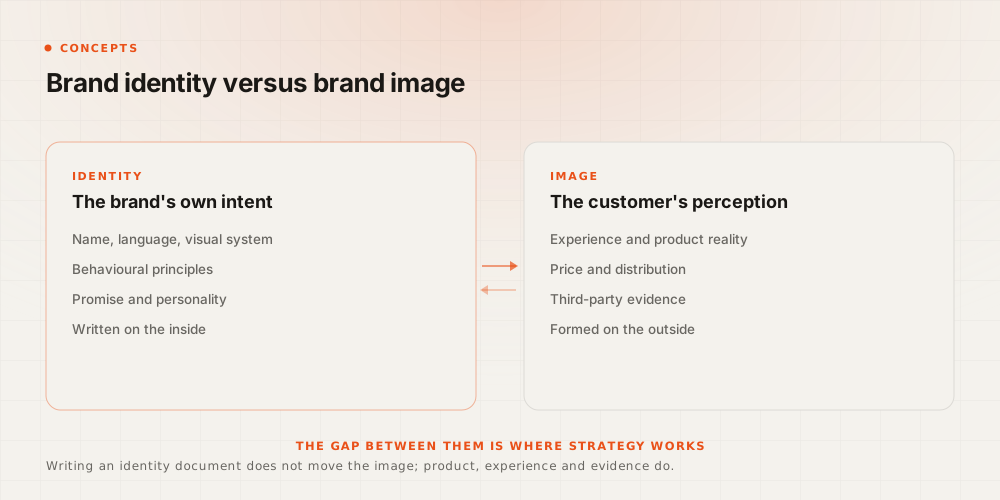
A brand is not just a name and a logo. It is the sum of the associations people remember about a company, product or service; the experiences they have had; the social proof they have heard; and their expectations of what comes next. Strategy is the set of choices made so that this perception is not left to chance. Brand strategy therefore comes before visual identity, and it must point in the same direction as corporate strategy.
In Keller's customer-based brand equity approach, brand equity is the effect of brand knowledge on the customer's response to marketing. That definition introduces an important distinction: brand equity is not just awareness; it is the same product, price or message landing differently because of the brand name.
How do the core concepts differ from one another?
| Concept | What it describes | How it is measured | Common error |
|---|---|---|---|
| Brand strategy | Where the brand will play, what it will stand for and how it will win | Consistency of choices and their contribution to business results | Treating it as a list of mission, vision and slogans |
| Brand identity | How the brand defines and expresses itself | Name, language, visual system, behavioural principles | Reducing identity to the logo |
| Brand image | What customers actually perceive | Research, interviews, social and search data | Mistaking the internally written identity for external perception |
| Positioning | The reason for being chosen in a given target and context | Remembered associations, difference, consideration and choice | Trying to be everything to everyone |
| Reputation | Trust and judgement built from past behaviour | Trust, accuracy, media and stakeholder views | Mistaking crisis communications for reputation strategy |
| Brand value | The intangible force that produces economic results | Behavioural, financial and legal indicators | Treating brand equity and monetary brand value as the same thing |
The confusion in that last row is the most expensive one in practice. Brand equity is the preference power a brand creates in the customer's mind. Brand value is the monetary figure calculated from that power by a defined method. ISO 20671-1 frames brand evaluation as an integrated system of inputs, output dimensions and indicators; ISO 10668 sets out the purpose, valuation basis, method, data and reporting framework for monetary brand valuation.
What is the difference between brand identity and brand image?
Identity is the brand's own intent; image is the customer's perception. The distance between the two is where strategy actually works. Writing an identity document does not change the image; the image only moves when product, experience, price, distribution and third-party evidence move. The first output of brand work should therefore not be a deck, but a measured baseline of perception.
Which decisions must a brand strategy make?
If a brand strategy document does not answer all of the questions below in writing, it is not yet a strategy.
- Which business and growth problem are we serving? Creating a new category, increasing penetration, reducing price pressure, entering a new market or easing conversion do not call for the same strategy.
- For whom and in which situation will we be meaningful? The context in which the need surfaces matters as much as the audience.
- In which competitive frame will we be evaluated? A customer's real alternatives can be broader than the direct competitors.
- Which meaning and association do we want to own? It should be expressible in one sentence, but supported by an evidence system wider than that sentence.
- Which promise can we make and keep delivering? A good promise is as producible operationally as it is desirable.
- Which distinctive elements will strengthen memory and recognition? Name, colour, form, sound, character, language patterns and experience codes should be considered together.
- How will we make sure that people and SI systems reach the same basic facts about the brand? The brand narrative must not contradict itself across the site, data, sources, reviews and partnerships.
- Which leading and lagging indicators will we track? Awareness alone is not enough; it has to connect to behaviour and economic value.
Why is brand strategy more critical now?
Intangible value is growing
According to the World Intellectual Property Organization's 2026 study, brand investment across the economies examined reached 1.4 trillion dollars in 2025 and grew at a compound annual rate of 4.2 percent from 2015. The same report describes brands as a complementary intangible asset producing trust, distribution power, differentiation and price premium, and notes that brand investment creates value alongside product quality, R&D, design, data and organisational capability rather than reducing to advertising spend.
The managerial implication is this: the brand manager's job is not only to produce perception, but to develop a measurable asset tied to governance.
Trust now weighs as heavily as quality and price
In Edelman's 2026 research, 88 percent of 17,688 respondents across 15 countries see trusting a brand as an important or critical purchase criterion, on a level with quality and value. The same research reports that in building trust, the words of customers, advocates and independent people carry more weight than paid brand narrative.
That finding makes "who verifies it, where, and with which evidence" as mandatory a question in brand strategy as "what we say". Earned media, customer reviews, expert opinion, case studies and verifiable corporate information are shared signals that affect both human trust and the quality of representation in SI answers.
Brand discovery is shifting to answer engines and agents
Kantar's 2026 Blueprint work reports that 82 percent of adults worldwide used an SI assistant in the past six months, and that SI has become a new intermediary shaping recommendations, content and choices. Kantar's recommendation is to build meaningful difference in both the human and the machine context, and to be visible in the SI ecosystem.
In the product discovery experience OpenAI introduced in March 2026, users browse products visually inside the conversation and compare price, reviews and features side by side. Connecting merchant catalogues and product feeds to the system shows that brand strategy is now about data quality, catalogue integrity and machine-comparable evidence, not communications alone.
How is SI changing brand discovery and perception?
There is no need to exaggerate the change, but ignoring it is not right either. The verifiable picture can be summarised in a few lines.
| Finding | Figure | Source and date |
|---|---|---|
| Share of generative SI users who also use it for shopping | 91% | Edelman Brand Trust, June 2025 |
| US consumers using ChatGPT for shopping several times a week or more | 49.5% | Bloomreach / Propeller Insights, December 2025 |
| Share of individuals in Türkiye using generative SI | 19.2% | TÜİK SI Statistics 2025 |
| SI chat assistant market share in Türkiye | ChatGPT 77.25%, Gemini 18.93% | Statcounter, August 2026 |
| Correlation of brand mentions with SI visibility | 0.664; backlinks 0.218 | Ahrefs, 75,000 brands, May 2025 |
| Share of SI citations coming from outside the brand's own site | About 83% | Ahrefs follow-up study, 2025 |
Three conclusions follow.
SI presents a shortlist. According to research by YouGov Türkiye and Medina Turgul DDB, SI assistants typically give the user a shortlist of three or four brands; 65 percent of consumers believe SI makes complex purchase decisions easier and 44 percent use it for price comparison. Getting onto that shortlist is the new shelf position. This research was relayed through Marketing Türkiye; because the sample size and fieldwork date were not made public, it should not be treated at the same evidence level as the global studies.
The driver of visibility is brand mentions. In Ahrefs' study of 75,000 brands, brand mentions emerged as the factor most strongly correlated with SI visibility. All three of the top factors are off-site: brand mentions, brand anchors and branded search volume. Strong as it is, the relationship is a signal rather than direct proof of causation, and Ahrefs states this explicitly.
Classic branding is the fuel for that visibility. Awareness, a consistent narrative, strong public relations and solid reputation are the core inputs of machine visibility too. Investing in the brand is investing in machine perception at the same time. SI does not replace branding; it adds a new stage on which branding becomes visible.
The three-minds brand strategy model
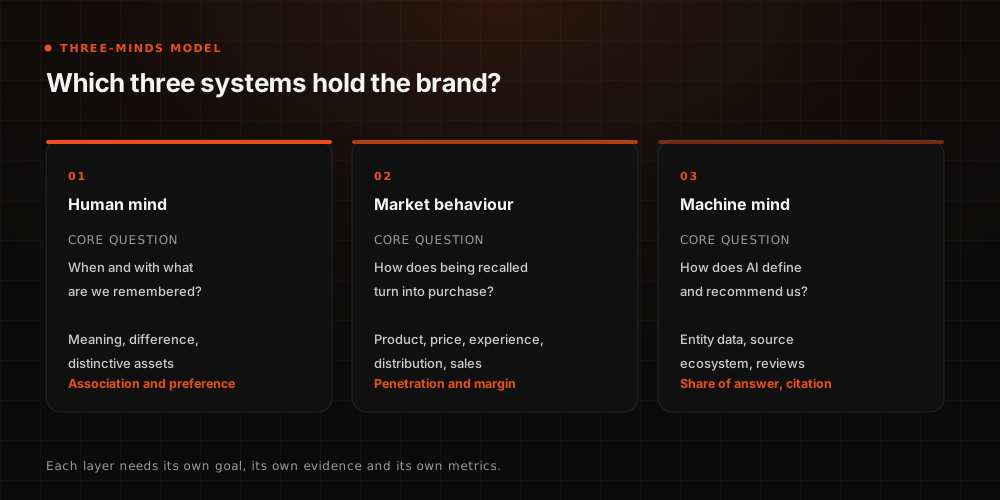
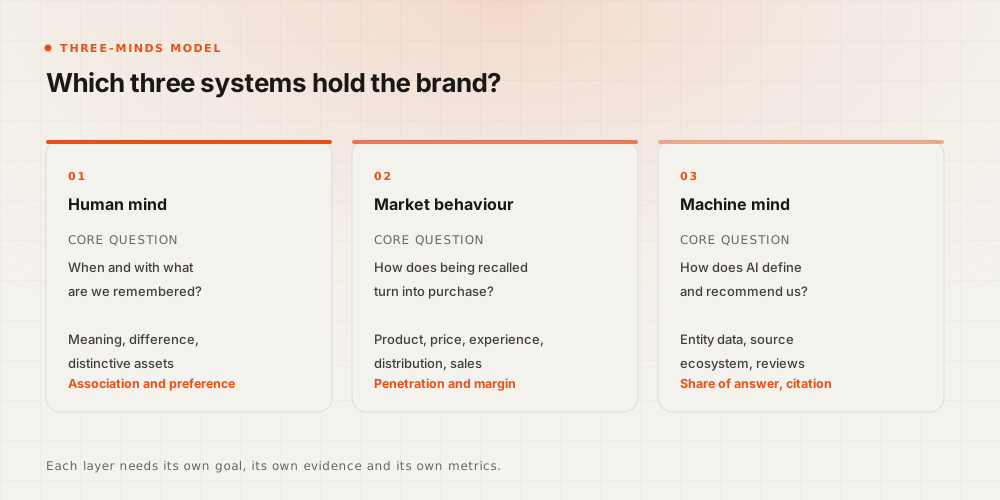
The model proposed here manages the brand across three separate but connected systems: the human mind, market behaviour and the machine mind. This split does not reject classic brand strategy; it completes it with distribution, data and SI visibility. Each layer needs its own goal, evidence and metrics.
| Layer | Core question | Strategic levers | Success signal |
|---|---|---|---|
| Human mind | When and with what should people remember us? | Meaning, emotion, difference, distinctive assets, trust | Correct association, recall, consideration, preference |
| Market behaviour | How does being remembered turn into purchase and economic value? | Product, price, experience, distribution, activation, sales | Penetration, win rate, price premium, repeat, revenue and margin |
| Machine mind | How do SI systems define, verify and recommend us? | Entity data, structured content, source ecosystem, reviews, product feeds | Share of answer, correct definition, positive context, citation, recommendation |
The human mind
The brand's job is not to make people think about it constantly, but to come to mind easily at the relevant moments of need and choice. That requires meaningfulness, difference and salience to be managed together. Kantar's Blueprint, based on 6.5 billion attitude and behaviour datapoints, presents being meaningfully different to more people as the main driver of growth.
Market behaviour
If brand promises are not visible in product, service and experience, perception cannot be sustained. The customer journey is shaped by partners, users, media, communities and environmental conditions alongside brand-controlled touchpoints. Brand strategy therefore cannot stop at marketing communications; it must translate into product management, sales, customer experience, human resources and governance decisions.
The machine mind
SI systems do not read the presentation a brand prepared; they assemble fragments from web pages, databases, product catalogues, press, reviews, communities and other sources. A gap can open between the brand's official identity and the representation that is produced. That gap should be measured as brand perception drift and managed at source level.
Google describes structured data as the standard way to give explicit clues about a page's meaning. For Organization markup it recommends fields such as name, alternate name, legal name, address, contact, founding date, logo, URL and sameAs links. But markup is not a tool for adding invisible or incorrect information; it has to be consistent with the visible, verifiable content on the page.
The components of brand strategy in the SI era
The logic is simple: first the classic foundations, then the SI layer added on top of them.
Classic foundations: what has not changed
- Purpose and values. Why the brand exists. This is the core of how both people and machines understand what the brand is about.
- Positioning. The brand's distinctive place in the consumer's mind. STP, Jobs to Be Done and points of difference and parity are all still valid frameworks.
- Audience. Need, context and decision roles before demographics. We covered this in detail in the audience segmentation guide.
- Brand story and promise. A narrative that builds emotional connection, stays in memory, is distinctive and is operationally deliverable.
- Brand identity and tone of voice. Vision, mission, visual elements, language.
- Distinctive brand assets. Logo, colour, typography, slogan and sound: the codes that make a brand instantly recognisable. They feed mental availability, that is, the likelihood of the brand coming to mind at the moment of purchase.
The SI layer: what is added
- Entity and knowledge graph recognition. The brand being recognised as a clear, consistent entity in knowledge maps. Organization schema, sameAs links, consistent name, address and description. This is the digital counterpart of mental availability: machines need a clear story to tell about the brand.
- A consistent narrative in third-party sources. Because the large majority of citations come from outside sources, being described consistently in encyclopaedias, industry publications, reviews, directories and reputable media is critical.
- Digital PR and brand mentions. Brand mentions, linked or unlinked, are the strongest signal of visibility. This work is now a visibility discipline, not only a reputation one. For the source side, see the online reputation management page.
- Brand guidelines for SI. Alongside the classic guide, add a machine-readable tone of voice reference, an approved and prohibited word list, example texts, a prompt library and governance rules, so content produced at scale does not drift from the brand voice.
- Monitoring brand representation in answers. Tracking how often and how accurately the brand is described in large language models. Misinformation is a real risk; an uncorrected wrong answer spreads. For the measurement side, the GEO service and Visibility Intelligence pages are the relevant ones.
- Machine-readable brand information for agents. In agent-led commerce, SI agents take part in product and brand selection. Product, price and value information has to be presented in a structure machines can read. The agentic commerce readiness and agent experience pages are the starting point.
The ten steps of building a brand strategy
Step 1: Define the business goal and the growth problem
A brand project should not start with an unmeasurable wish like "looking stronger". First pin down the problem the business wants to solve: new customer acquisition, low awareness, price competition, low trust, category confusion, a new market, a post-merger portfolio, attracting talent, or being absent from SI answers. Each problem calls for different research and a different investment logic.
- Business goal: which commercial result should change within 12 to 36 months?
- Behaviour goal: which customer behaviour produces that result?
- Perception goal: which belief or association must change for that behaviour to happen?
- Evidence goal: which product, experience or third-party proof makes that perception credible?
Step 2: Research the market and category reality
The category definition is strategy's invisible boundary. Do not limit the competitor list to companies; examine the substitute behaviours the customer uses to get the same job done, the in-house solution, postponement and the option of doing nothing. Research should combine desk data, search demand, customer interviews, lost deals, reviews, social conversation and SI answers. The market and industry analysis guide sets out a detailed framework for the method.
Step 3: Define the audience by need and purchase moment
Demographics alone are not a strategy. Good targeting explains the job the customer wants to advance, their obstacles, their decision criteria, who carries the risk, who influences it, and which event makes the need visible. In B2B, the economic buyer, technical evaluator, user, security, legal and procurement teams all judge the same brand on different evidence.
- For whom: the priority customer or buying committee
- For which progress: the job they are trying to do and the outcome they expect
- At which moment: the event, problem or opportunity that surfaces the need
- Against which barrier: risk, habit, budget, trust or implementation difficulty
- With which evidence: the experience, data or social proof that makes the choice safe
Step 4: Map the competitive frame and the white space
Do not limit the positioning map to two arbitrary axes. Assess competitors' claims, price and offer structures, the language customers use, organic and paid visibility, distinctive assets, review themes and their representation in SI answers together. The goal is not to find an empty slogan but to choose the value territory the brand's real capability can defend.
Kantar summarises four common routes to difference: category leadership, distinctive identity, emotional clarity and superior functional benefit. Difference does not mean absolute uniqueness; it is a meaningful, credible distinction that makes choice easier in human memory.
Step 5: Make the positioning choice
Positioning is not a word-finding exercise; it is a discipline of giving things up. Target, frame of reference, core need, promise, difference and reasons to believe must be consistent in the same sentence.
- Target: which priority customer can we create the most value for?
- Reference: within which category or alternatives should we be evaluated?
- Tension: what important problem or desire can the customer not solve?
- Promise: which valuable outcome do we offer?
- Difference: why us, and why now?
- Evidence: which product, data, capability, case and third-party verification makes this believable?
Step 6: Build the brand platform
The brand platform should be a short, usable system the organisation applies when making decisions. Purpose, vision, mission, values, brand promise, personality, voice and story must not repeat one another; each should serve a distinct decision function. Values are not adjectives on a wall but principles that determine which behaviour is chosen under pressure.
| Component | Question it answers | Quality test |
|---|---|---|
| Purpose | Which lasting benefit does this organisation exist to produce? | Does it still point somewhere if the product changes? |
| Vision | What will have changed in the future if we succeed? | Does it carry a time horizon and a concrete direction? |
| Mission | Who do we do what for today? | Are the activity and the beneficiary clear? |
| Values | Which behaviours will we protect when deciding? | Can a breach be observed? |
| Promise | What can the customer expect at every interaction? | Can operations produce it consistently? |
| Personality | With what character does the brand behave? | Can it be translated into voice, design and experience? |
| Story | Why this problem, why us, why now? | Is it provable and relevant to the customer? |
Step 7: Plan brand architecture, naming and legal protection
The relationship between company, product, service, technology and programme names should make growth easier, not force the customer to learn a new brand from scratch. Monolithic brand, endorsed brand, sub-brand or house of brands should be chosen against customer clarity, reputational risk, investment efficiency, cross-selling and the future portfolio plan.
Naming does not end with creative judgement. In Türkiye, the patent and trademark office's search system allows queries by similar name and class. Türkiye ranked sixth in the world for domestic trademark applications in 2024 with 366,543 classes; a crowded filing environment raises the value of early legal screening. For international growth, the Madrid System can provide access to more than 130 markets from a single base application.
This section is not a substitute for legal advice. Before a name reaches the shortlist, linguistic, cultural, domain and social handle checks should run alongside a similarity and class review by a trademark attorney.
Step 8: Turn verbal and visual identity into a decision system
Identity makes strategy visible and repeatable. Naming conventions, word choices, message hierarchy, sales narrative, in-product copy, sound and motion principles should be defined as carefully as logo, colour, typography and visual language. Aaker's brand personality work offers sincerity, excitement, competence, sophistication and ruggedness as a measurable starting frame, but it should not be used as a template without validation in the relevant culture and category.
- Distinctive assets: elements that identify the brand even when the name is not visible
- Message backbone: the main promise, three supporting benefits, evidence and objection answers
- Tone system: channel and situation examples rather than a single list of adjectives
- Design principles: recognition, accessibility and scalability before aesthetic preference
- SI generation rules: accepted language, prohibited claims, sourcing requirements and human approval
Step 9: Design the touchpoints and the internal operating model
Brand strategy is only real if it turns into behaviour. Map the priority touchpoints across discovery, consideration, purchase, use, support, renewal and advocacy. For each touchpoint, define the customer's question, the intended perception, the brand behaviour, the evidence, the owner and the measurement method.
In governance, a brand council should evaluate high-impact decisions such as new product names, campaigns, partnerships, sponsorships, crisis responses and SI-generated content against shared principles. The central team acts as the control point while defined flexibility is left to local teams and channels.
Step 10: Manage human and machine perception together
The work does not end when the brand platform is published. First put the brand's factual layer on the internet in order: corporate description, service and product names, leadership, founding date, locations, contact, price and policy information, case results, awards and certifications, legal details and social profiles must be consistent across sources.
Then develop the source ecosystem. Owned content should explain the claims; independent publications, experts, customers and partners should verify them; structured data should help machines resolve the entity. Google's people-first guidance recommends trustworthy content that serves the audience's real need rather than content produced to manipulate rankings.
Visibility should not be measured once and left. Engine, model version, language, location, session and query phrasing can all change the output. Monitoring therefore needs prompt sets, paraphrases, repeated runs and human verification; a single screenshot is not proof of success.
Implementation tools and templates
Positioning statement template
For [priority audience], [brand] offers [distinctive value promise] that delivers [core need or progress] within [frame of reference]. Because [evidence 1], [evidence 2] and [evidence 3]. Unlike competitors, [defensible distinction].
This sentence is not ad copy. It is a hypothesis that aligns internal decisions, and it should be tested against customer research, sales conversations, price tests, campaign tests and real usage data.
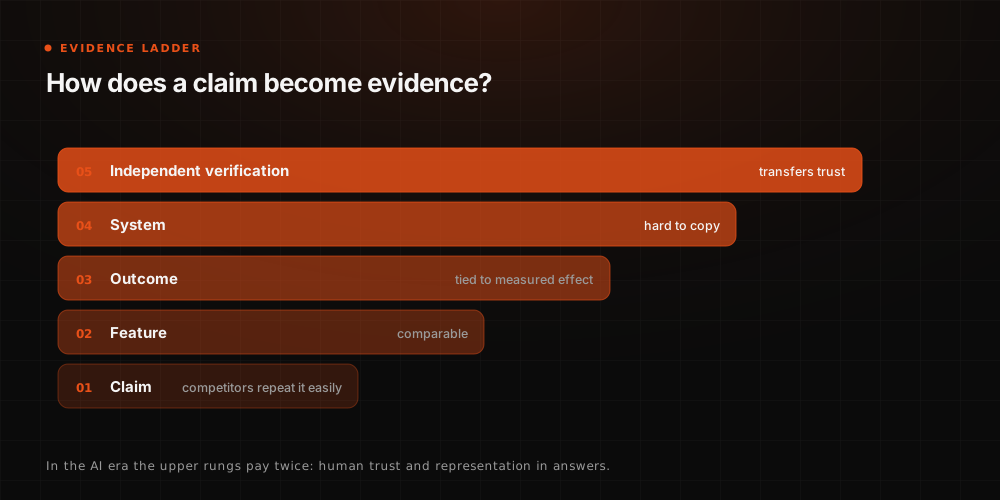
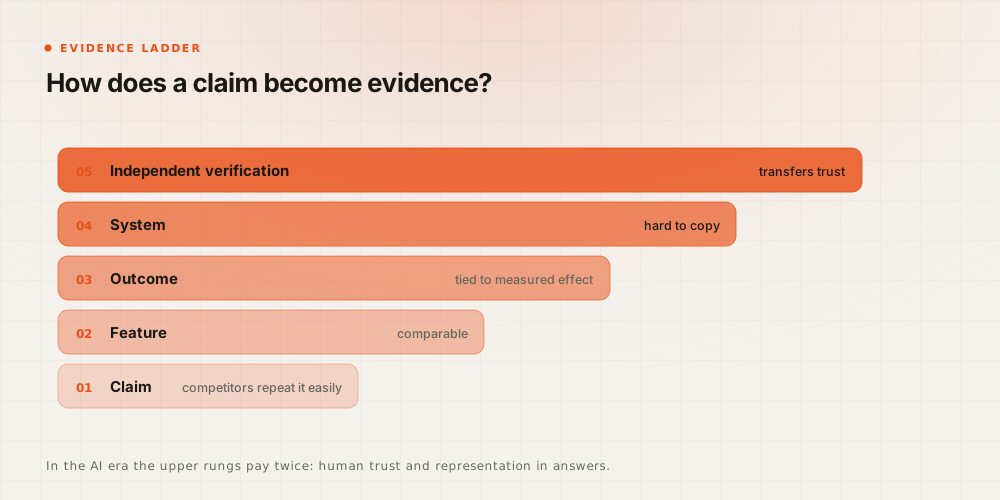
The evidence ladder
| Level | Type of evidence | Example | Strength |
|---|---|---|---|
| 1 | Claim | We are fast, innovative, customer-focused | Low; competitors repeat it easily |
| 2 | Feature | Delivery time, scope, technology, certification | Medium; comparable |
| 3 | Outcome | Customer case, independent test, measured effect | High; tied to a result |
| 4 | System | Proprietary data, process, network, distribution, organisational capability | High; hard to copy |
| 5 | Independent verification | Customer, expert, media, standard or audit | Highest; transfers trust |
In the SI era the upper rungs gained extra value: machine-findable third-party verification feeds human trust and representation in answers at the same time.
Message hierarchy
- Main narrative: the change the brand delivers for the customer and why it matters.
- Three value pillars: a balanced summary of functional, economic and emotional or social benefits.
- Evidence bank: the data, cases, product features, processes and third-party sources behind every claim.
- Audience adaptation: shifting emphasis for leadership, finance, technical teams, users and procurement; an unchanging core promise.
- Objection system: verifiable answers to questions of risk, price, migration, security, duration and uncertainty.
- Channel examples: application for the website, sales deck, advertising, social media, press, product interface and SI answers.
One-page brand strategy canvas
| Field | What to write |
|---|---|
| Business goal | Which commercial result is expected to change, and over what period |
| Priority customer | Whose problem carries high value and high fit |
| Category and alternatives | What the customer compares us against |
| Moments of need | The events and contexts in which the brand should come to mind |
| Positioning | Target, need, promise, difference and evidence |
| Brand platform | Purpose, vision, mission, values, personality, voice |
| Distinctive assets | Name, colour, form, sound, character, motion and language codes |
| Experience principles | The rules that show the promise in behaviour |
| Source ecosystem | Owned, earned and third-party verification points |
| Measurement | Mind, behaviour, business result and machine perception metrics |
A workable project flow
| Phase | Duration | Main work | Deliverable |
|---|---|---|---|
| 1 Diagnosis | 1-2 weeks | Business goal, current perception, data and stakeholder interviews | Decision problem and baseline score |
| 2 Market insight | 2-3 weeks | Customer, category, competitor, search and visibility research | Insight and opportunity map |
| 3 Strategic choice | 1-2 weeks | Target, category, positioning, brand platform | Approved brand strategy |
| 4 System design | 2-3 weeks | Message, evidence, architecture, identity direction, touchpoint principles | Implementation toolkit |
| 5 Activation | 2-4 weeks | Renewal of priority channels and experiences | 90-day launch plan |
| 6 Monitoring | Ongoing | Brand tracking, behaviour, finance and machine perception | Dashboard and learning loop |
These are typical ranges; they shift with research scope, number of countries, portfolio complexity, legal review and the number of decision-makers. Strategy development and identity production can run on the same calendar, but identity decisions should not be finalised before positioning is settled.
How is brand strategy measured?
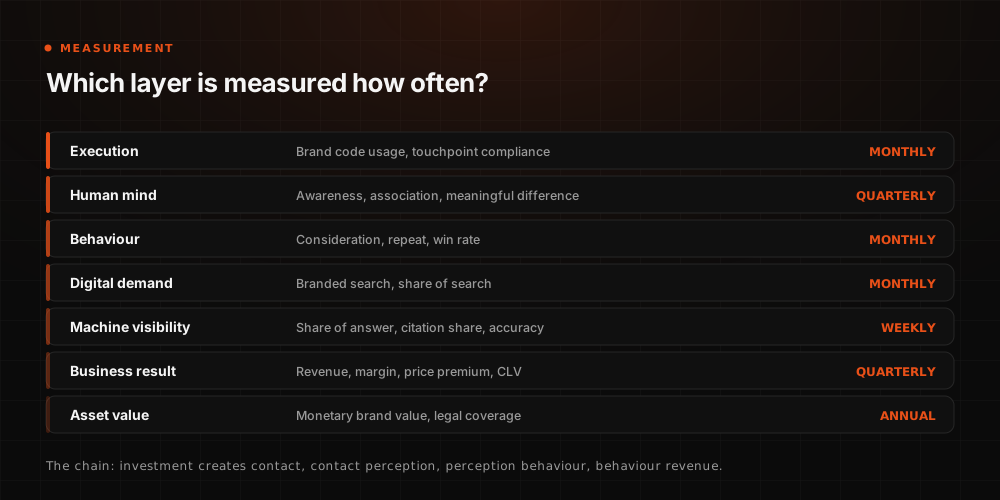
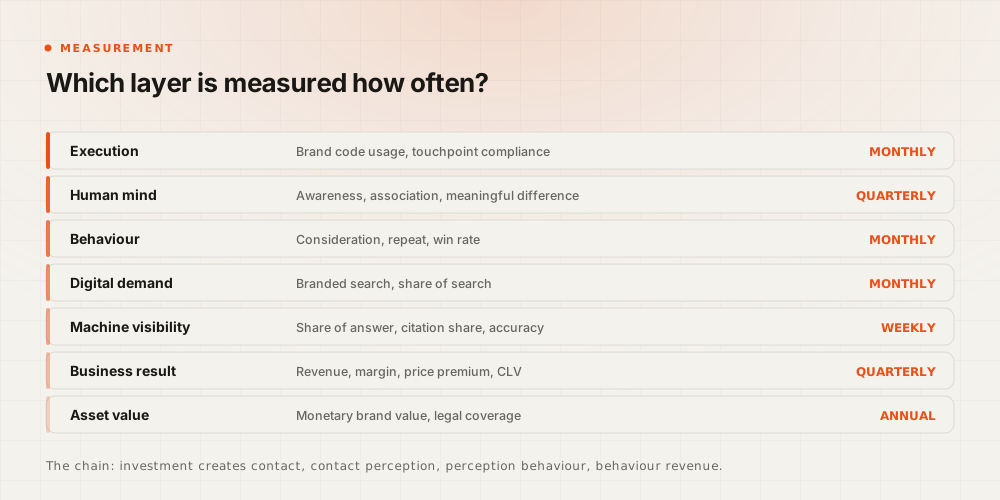
A measurement system should follow the cause and effect chain rather than counting activity: investment and execution affect customer contact; contact affects memory and perception; perception affects behaviour; behaviour affects revenue, margin and company value.
| Layer | Example indicator | Interpretation | Cadence |
|---|---|---|---|
| Execution | Brand code usage, training completion, touchpoint compliance | Shows whether the strategy is being applied internally | Monthly |
| Human mind | Unaided and aided awareness, associations, meaningful difference, trust | Shows change in memory and perception | Quarterly or half-yearly |
| Behaviour | Consideration, trial, penetration, repeat, advocacy, win rate | Shows perception turning into action | Monthly and quarterly |
| Digital demand | Branded search, share of search, direct traffic, organic demand | Proxy indicators for demand and mental availability | Monthly |
| Machine visibility | Share of answer, citation share, accuracy, recommendation, sentiment balance | Tracks machine-mediated discovery and perception | Weekly or monthly |
| Business result | Revenue, gross margin, price premium, CAC payback, CLV, market share | Shows the economic return of the strategy | Monthly and quarterly |
| Asset value | Monetary brand value and legal coverage | Shows financial and legal resilience | Annually or per transaction |
The SI and agentic analytics page describes the measurement architecture for setting these layers up.
Calculation examples for SI brand visibility
- Share of answer = answers mentioning the brand / total eligible prompt runs
- Citation share = citations to the brand or its domain / total brand citations in the category
- Recommendation rate = answers recommending the brand / total answers where a recommendation was requested
- Accuracy rate = correct brand claims / total verifiable brand claims
- Positioning alignment = weighted match score of intended associations / maximum possible score
- Source concentration = the top five sources' share of brand citations; shows dependency risk
- Sentiment balance = distribution of positive, neutral and negative brand statements by topic and engine
These are not standardised financial measures; they should be used as management indicators with an explicit method note. No period-over-period comparison should be made before the prompt universe, language, location, model, date, run count and classification rules are fixed.
Five rules for measurement design
- Do not set targets without a baseline. Record human, behavioural, digital and machine indicators before the project starts.
- Separate leading from lagging indicators. Content production is an input, not a result.
- Do not manage brand and performance as rival budgets. Short-term demand capture and long-term demand creation have different effects and time horizons.
- Do not present correlation as causation. Use holdouts, geo tests, brand lift, price tests and econometric analysis where appropriate.
- Do not manage by a single score. Even an executive summary needs defined measures, data quality and confidence intervals beneath it.
Strategy options by situation
| Situation | Priority | Approach to avoid | First test |
|---|---|---|---|
| New brand | Category clarity, name, positioning, evidence | Starting with a logo and skipping the market hypothesis | Problem interviews and offer testing |
| Growing an existing brand | New moments of need, reach, experience and distribution | Closing in on loyalty campaigns only | New usage context and channel tests |
| Repositioning | Adding new meaning while protecting valuable existing associations | Trying to erase brand memory overnight | Controlled comparison of old and new messages |
| B2B brand | Buying committee, trust, expertise, risk reduction | Talking only to active opportunities | Win-loss interviews and a decision criteria map |
| Multi-brand portfolio | Role, relationship, investment priority and cannibalisation | Creating a new name for every offer | Customer comprehension and cross-sell tests |
| Internationalisation | Cultural meaning, language, legal protection and local evidence | Translating the central message word for word | Local concept, pronunciation and trust tests |
| A brand invisible in SI | Source, entity, content and data consistency | Deciding from a one-off screenshot | Repeated, multi-engine baseline measurement |
Notes specific to the Türkiye market
SMEs and local businesses. Generative SI use is spreading quickly in Türkiye. According to TÜİK's first SI Statistics release, covering 2025, 19.2 percent of individuals use generative SI, with the highest rate in the 16-24 age group. Enterprise SI use rose from 2.7 percent in 2021 to 7.5 percent in 2025, and 46.5 percent of enterprises use SI for marketing or sales. For a local business, machine visibility is no longer a luxury but a new discovery channel.
Exporters and Turquality. Turquality began in 2004 as the first state-backed branding programme of its kind. It supports exporters' overseas promotion, consultancy and trademark registration costs, and corporate maturity and digitalisation weigh increasingly in its assessment. In export markets, machine visibility is a natural extension of branded exporting.
Turkish content and source quality. Large language models work with more limited and more variable sources in Turkish than in English. That is an opportunity for brands producing high-quality, consistent and structured Turkish content: a small number of strong Turkish sources can give disproportionate advantage in answer visibility.
Registration. Trademark registration is the foundation both for legal protection and for the brand being recognised as a clear entity.
Regulation. The Ministry of Trade's amendment to the Regulation on Commercial Advertising and Unfair Commercial Practices was published in the Official Gazette on 1 July 2026 and took effect on 1 August 2026. SI-generated digital characters indistinguishable from humans must be clearly disclosed in advertising, and fabricated testimonial or endorsement advertising through SI-generated digital copies of real people is prohibited. Türkiye's data protection law separately limits the use of personal data in brand data and personalisation.
Common brand strategy mistakes
| Mistake | Why it is a problem | A sounder approach |
|---|---|---|
| Starting strategy with design | A logo change is visible but does not fix a wrong category, weak offer or low trust | Decision problem first, identity second |
| Targeting everyone | Promise and evidence blur | Reach can be broad; the promise still sharpens around priority needs |
| Building difference from adjectives | Innovative, reliable and customer-focused are clichés without evidence | Move to rung three or above on the evidence ladder |
| Detaching brand purpose from product reality | Rhetoric contradicting experience produces risk, not trust | Keep the promise at the level operations can deliver |
| Over-committing to a single persona | Fixed characters hide real purchase moments and multiple decision-makers | Definition based on need and purchase moment |
| Looking only at what competitors say | Difference is built in the system, not in the messaging | Examine product, price, distribution, experience, community and evidence |
| Cutting long-term investment on a short-term metric | Last-click measurement systematically understates delayed brand effect | Measure demand capture and demand creation separately |
| Neglecting third-party sources | Most citations come from outside the site | Plan the earned source ecosystem |
| Skipping entity and schema hygiene | The brand stays in a form machines cannot read | Consistent corporate data and structured markup |
| Treating machine visibility as a technical SEO add-on | Machine perception is the joint result of data, sources, reputation and positioning | Manage brand and visibility in one system |
| Reading a generative answer as a fixed ranking | Answers vary | Repeated, multi-engine, controlled measurement |
| Writing a guide without governance | Without owners, approval thresholds and audits the system falls apart | A brand council and an update cadence |
Frequently asked questions
What is the difference between brand strategy and marketing strategy?
Brand strategy determines which meaning will be owned and which evidence supports it; marketing strategy plans which channels, offers and budget turn that meaning into demand. Brand strategy has a longer horizon and connects product, price, sales and experience decisions alongside marketing.
Is SI replacing branding?
No. The classic foundations, story, differentiation and consistency, are still central. SI adds a new stage on which those foundations become visible. The strong relationship between brand mentions and visibility says the same thing: investing in the brand is investing in machine perception.
How long does it take to build a brand strategy?
A limited-scope engagement typically runs 8 to 12 weeks. Duration shifts with research scope, number of countries, portfolio complexity, legal review and the number of decision-makers. Results read on a scale of quarters, not weeks.
How do I find out how my brand appears in SI?
Build a fixed question panel; record language, location, engine, model version and date; run each question more than once and put the answers through human review. A single screenshot is not measurement. Share of answer, citation share, accuracy and source concentration are calculated from that panel.
What happens if SI gives wrong information about my brand?
Misinformation is a real risk. Spreading correct, consistent and current brand information on your own site, in credible third-party sources and in structured data reduces it. An uncorrected wrong answer can propagate to other sources over time, which is why regular monitoring is essential.
Does machine visibility really matter for a small business?
Yes. SI assistants typically present a shortlist of three or four brands. On local and niche queries, getting onto that shortlist can be relatively easy and high-return for small businesses.
Are the classic brand frameworks still valid?
Yes. Keller's customer-based brand equity, Aaker's identity and personality work, Kapferer's identity prism and the Ehrenberg-Bass tradition of mental availability are still the soundest tools for building the core of a brand. The SI era does not replace them; it adds a visibility layer on top.
How should I update my brand guidelines for SI?
Add a machine-readable tone of voice reference, an approved and prohibited word list, example texts and a prompt library alongside the classic guide. Preload brand context into the tools your teams use, and put the human approval threshold in writing.
Do B2B companies need a brand strategy?
Yes, and it gets more critical as the decision cycle lengthens. Every role in the buying committee judges the same brand on different evidence. Trust, expertise and risk-reduction signals directly affect the order of preference in B2B.
When should brand architecture change?
When customers struggle to understand the portfolio, when an acquisition or merger brings new names, when a new category is entered, or when the reputational risk of one brand threatens the whole portfolio. Architecture is an investment and risk decision, not a communications one.
At which stage is corporate identity produced?
After positioning is settled. Identity work can start in parallel with strategy, but identity decisions should not be finalised before positioning is approved.
When should you not start brand strategy work?
If you have an urgent cash-flow situation and need sales next month, budget should go to demand capture first. Brand work pays back on a scale of quarters; it does not close an urgent sales gap.
Conclusion
A strong brand strategy is not built by writing a beautiful story. It is built by defining the customer's moment of choice, the brand's defensible difference, the organisation's ability to produce that difference and the way results will be measured, all within one system. In the SI era a fifth task joins that system: making the correct and distinctive facts about the brand findable, resolvable and verifiable through credible sources by machines.
To begin, pick a single decision problem, measure current perception both with people and in answer systems, write the positioning hypothesis and test it in a small implementation. To measure how the brand is represented in answer systems, Visibility Intelligence is the starting point, and the GEO service page connects that visibility to growth. The full scope sits on the services page.