How to Build an AI GEO Strategy for Multilingual Websites
Learn how to build multilingual AI GEO with local intent, hreflang, entity signals, market context, and language-based visibility tracking.

Multilingual GEO requires each language and market to be planned according to its own intent, entity structure, trust signals, cultural context, and answer behaviour. In the age of AI Search, translating content alone is not enough. Users expect answers in their own language, shaped by local market conditions, cultural expectations, legal requirements, pricing logic, delivery options, and decision-making needs.
AI-powered search systems may generate different answers for the same brand across countries because they evaluate local sources, language signals, entity relationships, and user prompts separately. For content, product, localisation, and growth teams, the real objective is not only to publish translated pages. The goal is to help the brand appear in the right questions with the right language, source signals, product information, and trust context in each market.
A strong multilingual GEO strategy should combine market-level prompt research, hreflang and canonical structure, country-specific entity signals, localised content formats, structured data, AI crawler accessibility, and language-based performance measurement.
Why Translation Alone Is Not Enough for Multilingual GEO
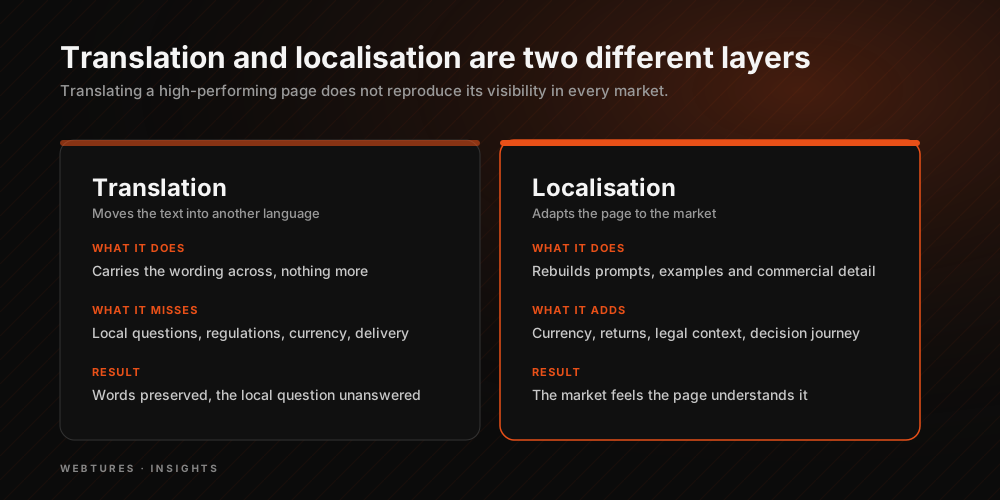
One of the most common mistakes in multilingual websites is assuming that translating a high-performing page from the main language will produce the same visibility in every market. AI Search systems do not only evaluate the language of the content. They also evaluate whether the page matches the real questions, local sources, decision criteria, regulations, and trust expectations of that market.
A user may search for the same product in Germany, Türkiye, the United Kingdom, or France, but the language, wording, comparison criteria, trusted sources, payment expectations, legal details, and support needs may differ. A direct translation may preserve the words, but it may fail to answer the local question.
Translation and localisation should therefore be treated as separate layers. Translation transfers the text into another language. Localisation adapts the content to the market’s prompt patterns, cultural expression, currency, delivery conditions, return policies, legal context, and decision journey. For brands that want to be represented accurately in AI answers, the real value comes from making each market feel that the content understands its local reality.
How to Analyse Prompt Intent by Market
In multilingual GEO, intent should not be interpreted through translated keyword lists alone. Each market should be analysed separately to understand which questions users ask, which comparisons they make, which trust signals they need, and when they are ready to make a decision.
In one market, price and delivery speed may be the strongest decision factors. In another market, certification, country of origin, sustainability, data security, warranty, or after-sales support may carry more weight. AI systems can reflect these differences when they generate answers, so multilingual content should give them enough local context to work with.
Content planning should include separate prompt clusters and user scenarios for each language and country. Local guides can support informational prompts, market-specific comparisons can support decision-stage prompts, and delivery, returns, pricing, warranty, and trust content can support users closer to conversion. When AI systems can extract these local intent differences from the page, the brand can be represented more accurately across markets.
How to Keep Language, Country, and Entity Signals Consistent
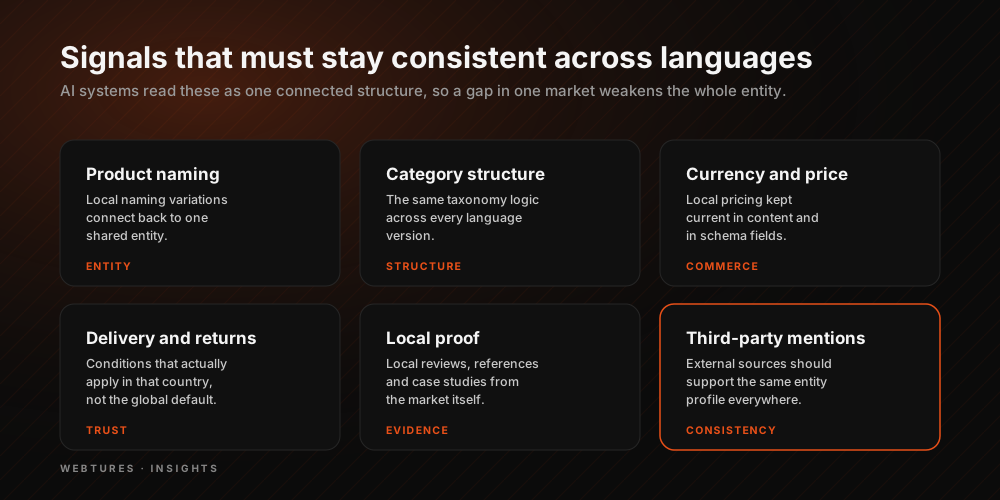
Entity signals in multilingual websites are not limited to the brand name or product name. Language, country, location, currency, product naming, category structure, delivery conditions, regulations, customer reviews, local sources, and cultural expressions should be evaluated together.
AI Search systems interpret a brand across markets by reading these signals as a connected structure. Product naming in one language, category structure in another, local pricing information, and third-party mentions should support the same entity profile. If these signals are inconsistent, answer systems may misunderstand the relationship between the brand, its products, and the local market.
Trust signals are especially important in international markets. Users want to see delivery information, return conditions, legal suitability, support language, local reviews, and regional references that apply to their own country. If product information is updated in the English version but outdated in the German version or incomplete in the French version, AI systems may evaluate the brand more weakly in those markets.
Each language version should therefore be treated not as a copy of the main site, but as a separate visibility asset that builds trust in its own market while still staying connected to the global brand entity.
Why Hreflang, Canonical, and Local URL Structure Matter
Technical infrastructure is one of the core layers affecting multilingual GEO visibility. If hreflang, x-default, local URL structure, canonical tags, language targeting, crawlability, and local schema implementation are not clean, search systems may struggle to understand the correct language and country version of a page.
Google recommends using separate URLs for different language versions and using hreflang annotations to help connect those localised variations. Hreflang does not replace good content localisation, but it helps systems understand the relationship between equivalent language or regional pages.
The technical structure should prevent confusion between versions. If a Turkish page canonicalises to the English version, if the German page is missing from the hreflang set, if x-default is used incorrectly, or if all local pages point to the same generic URL, the right local page may be less likely to appear for the right user.
Schema fields such as currency, address, organisation details, product price, availability, delivery information, and local business data should also be updated by market. Technical auditing should therefore be treated not only as error fixing, but as the safety layer of multilingual source selection.
Which Content Formats Create Stronger Signals for Multilingual GEO?
Content formats on multilingual websites should not be copied in exactly the same way across every market. Local guides, market-specific FAQ sections, localised comparisons, regional case studies, country-specific delivery and return pages, local customer reviews, and industry-specific use case content can create stronger AI Search signals.
These formats help users receive answers not only in their own language, but also within their own market reality. They also help answer systems understand which version of the brand is relevant for which country, user need, and decision scenario.
The following formats are especially valuable for multilingual GEO:
- Local guides: Explain how a product, service, or solution is evaluated in a specific market.
- Market-specific FAQ sections: Answer local questions around delivery, pricing, regulations, usage, warranty, and support.
- Localised comparisons: Address alternatives and decision criteria in the user’s own country.
- Regional case studies: Strengthen trust by showing proven experience in that market.
- Local reviews and references: Provide social proof from the user’s own market.
- Country-specific commercial pages: Clarify pricing, delivery, payment methods, return conditions, legal requirements, and service coverage.
This approach turns multilingual content from translated text into a separate AI visibility layer for each market.
Multilingual GEO Localisation Matrix
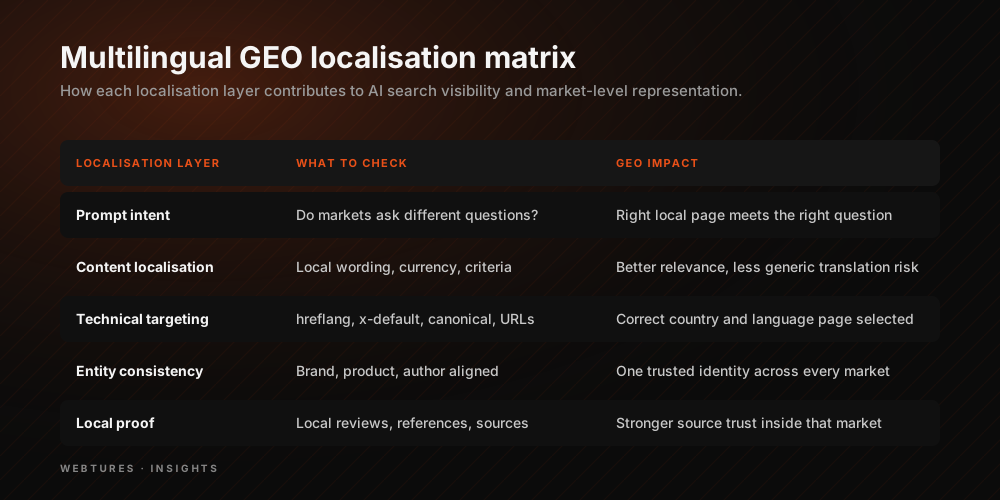
The matrix below can be used to plan GEO for multilingual websites across market and language layers. The aim is not only to list tasks, but also to show how each localisation element contributes to AI Search visibility, source trust, and market-level representation.
| Localisation Layer | What Should Be Checked? | How to Strengthen It | GEO Impact |
| Prompt intent | Do users ask different questions in each market? | Build separate prompt clusters for each language and country. | Helps answer systems match the right local page with the right question. |
| Content localisation | Does the page reflect local wording, examples, regulations, currency, and decision criteria? | Adapt examples, comparisons, commercial details, and trust signals by market. | Improves answer relevance and reduces generic translation risk. |
| Technical targeting | Are hreflang, x-default, canonical, and local URL structures correct? | Audit every language version regularly and fix conflicting signals. | Increases the likelihood of the correct country and language page being selected. |
| Entity consistency | Are brand, product, category, organisation, and author details aligned across languages? | Connect local naming variations to a shared entity structure. | Helps the brand be recognised with the same trusted identity across markets. |
| Local proof | Are there reviews, case studies, citations, or sources from that market? | Add local references, review content, regional success stories, and third-party mentions. | Supports trust and source eligibility in local answer environments. |
| Structured data | Are currency, availability, address, organisation, product, and local service details accurate? | Use relevant schema types and keep visible content aligned with markup. | Helps systems understand the page context and reduce market ambiguity. |
How to Measure Multilingual GEO Performance
Multilingual GEO performance should not be measured only through total organic traffic or global visibility metrics. Each language and market should be monitored separately for visibility, representation quality, source selection, sentiment, answer accuracy, and conversion impact.
A brand may appear strongly in English AI answers but not appear at all in German or Spanish answers. It may be represented with the right product in one market but associated with outdated content or incorrect sources in another. This is why language and country-level reporting is essential.
Search Console can be used to analyse country and page-level performance, analytics data can show local conversion behaviour, and AI prompt monitoring should track separate prompt sets for each market. Where available, generative AI performance reporting can also help teams understand visibility in AI Overviews and AI Mode.
Competitor visibility should also be evaluated by market because the competitive set may differ by country. At this point, Brantial, as an AI visibility tool, can help brands monitor their AI visibility separately across different languages and markets, understand which prompts represent them in each country, and compare their visibility against local competitors.
The healthiest approach is to report market-level visibility, source usage, sentiment, answer accuracy, prompt coverage, brand mentions, and conversion impact together. This gives teams a clearer view of whether the multilingual strategy is building real market authority.
Common Risks and Quality Points for Multilingual Websites
One of the biggest risks in multilingual websites is managing every language version as a direct translation of the main language content. This approach can miss local intent, cultural differences, local pricing, delivery conditions, legal requirements, and user trust expectations.
Outdated content, incomplete hreflang sets, incorrect canonical usage, automatic translation errors, missing local sources, inconsistent schema fields, and weak local proof can also reduce AI Search visibility.
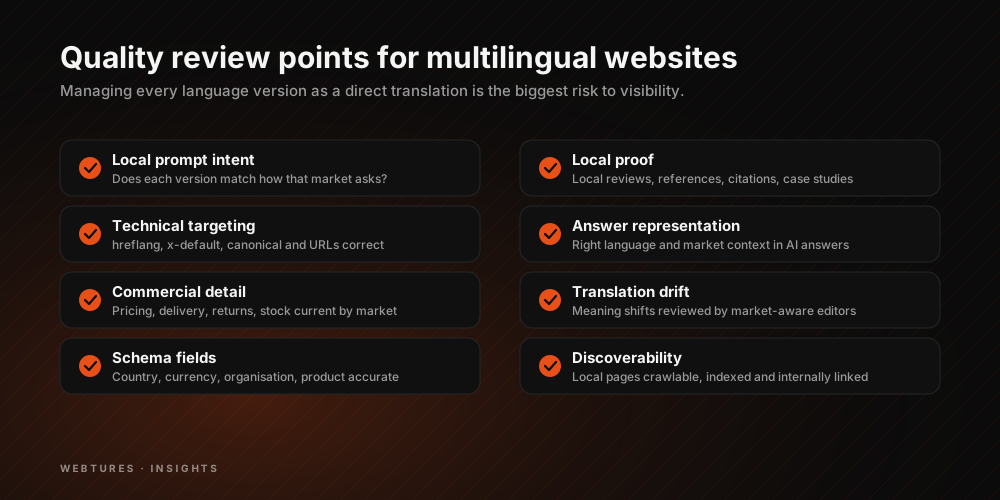
The following points should be reviewed regularly during quality review:
- Does each language version match local prompt intent?
- Are hreflang, x-default, canonical, and local URL structures working correctly?
- Are product pricing, delivery, returns, stock, currency, and service details up to date by market?
- Are country, currency, organisation, product, and local business details accurate in schema fields?
- Are there local reviews, references, citations, or case studies?
- Is the brand represented in the correct language and market context in AI answers?
- Are meaning shifts caused by automatic translation being reviewed by native or market-aware editors?
- Are local pages crawlable, indexed, internally linked, and included in the right sitemap structure?
These reviews improve both technical discoverability and the likelihood of accurate representation in AI-powered answers.
An Actionable Growth Plan for Multilingual GEO
First, the existing language and country inventory should be mapped. Each market should be evaluated separately in terms of technical structure, content quality, local intent alignment, entity consistency, local proof, and AI visibility. This analysis shows which language versions are mainly translated, which markets have technical confusion, and where local content gaps exist.
In the second stage, separate prompt clusters and user scenarios should be created for each market. In the third stage, hreflang, canonical, x-default, local schema, sitemap, internal link, and URL structures should be cleaned up technically. In the fourth stage, local guides, market-specific FAQ sections, localised comparisons, regional case studies, and review-led content should be produced.
In the final stage, AI visibility, source selection, sentiment, answer accuracy, prompt coverage, brand mentions, and conversion impact should be monitored regularly for each language and country. This kind of growth plan turns multilingual GEO from translation management into a sustainable market-based visibility strategy.

Let us make your brand visible in AI search.
Share your goals, we'll come back with a custom growth plan within one business day. A strategy lead will reach out personally.
Get in touch